Fractions of a Set: Half of a Group Is Different From Half of a Cookie
A third grader named Marcus once handed me a cookie he'd broken in two and said, "That's half." He was right, and he was proud. Ten minutes later I put twelve grapes on his desk and asked for half. He stared at them. Then he broke one grape in two. He'd learned that "half" meant "cut the thing into two pieces," and nobody had told him the thing could be a whole pile.
That gap is the whole reason fractions of a set for kids deserve its own lesson. Half of a cookie and half of a group of grapes use the same word and almost none of the same thinking. If your child breezes through fractions of a shape and then hits a wall on "what is half of 12," this is why.
One fraction, two very different pictures
When we cut a cookie in half, the fraction lives inside one object. We split a single whole into equal parts and shade one. That's a fraction of a region, and it's the version almost every kid meets first because it's easy to draw.
A fraction of a set is different. The "whole" is a collection. Six socks. Twelve grapes. Twenty crayons. To find half, you don't cut anything. You share the group into equal piles and count what's in one pile. The objects stay whole. The number of them is what gets divided.
Kids who only know the cookie version try to slice individual objects, like Marcus and his poor grape. Or they count out "one, two" and stop, thinking half means two of something. The concept underneath is the same idea of equal shares, but the action your child has to take is completely different, and that's worth saying out loud to them.
Why the group version is harder than it looks
There's real math hiding in "half of 12." To answer it, a kid has to hold three things at once:
- The whole group has a size (12).
- We're splitting it into a certain number of equal piles (2, because half means two shares).
- The answer is how many are in one of those piles (6).
That's division wearing a fraction costume. Half of a set is the group divided by 2. A quarter of a set is the group divided by 4. If your child hasn't connected sharing to division yet, fractions of a set will feel like a brand new mystery instead of something they can already sort of do.
The other trap is uneven groups. Half of 12 is clean. Half of 7 is not, and a kid who's memorized "split into two piles" gets stuck when the piles won't match. That's fine. You don't need to jump to three and a half. Just steer early practice toward friendly numbers so the idea lands before the messy cases show up.
How to teach it at the kitchen table
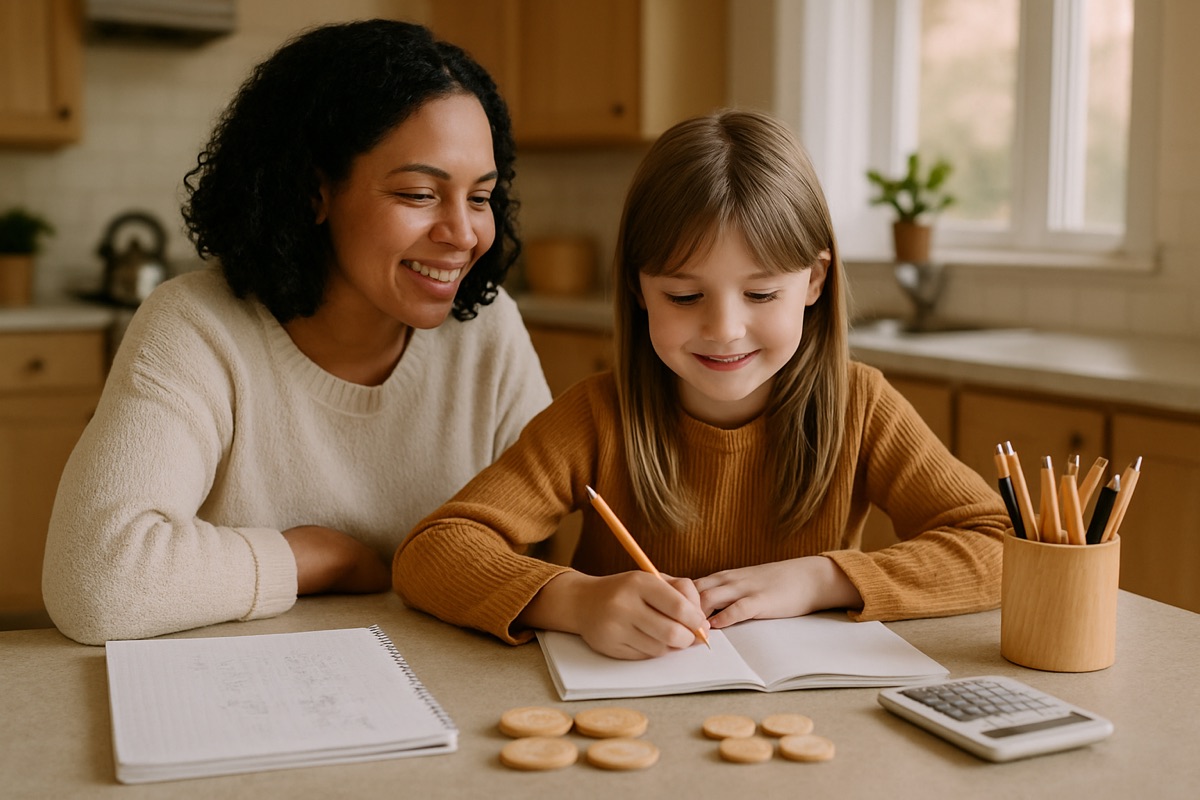
You don't need worksheets for this. You need a handful of small objects and about ten minutes. Grapes, dry beans, Legos, coins, whatever's nearby.
Start by making the connection visible. Put out eight beans. Ask your child to share them fairly between the two of you, one for you, one for them, back and forth. When they're done, each of you has four. Then say the sentence that ties it together: "You just found half of eight. Half of eight is four." You're labeling what they already did, not teaching a new trick.
Then change the group size and keep the question the same. Half of six. Half of ten. Half of four. Let them physically deal the objects into two piles every time at first. The dealing is the math. Later, when they start saying the answer before they finish dealing, they're ready to do it in their head.
A few moves that help:
- Say the whole sentence, not just the answer. "Half of ten is five," not "five." The structure is what transfers.
- Use their world. Half of your ten minutes of screen time. A quarter of the twelve stickers. Real stakes make them concentrate.
- When half is solid, introduce a quarter as "share into four piles." Same action, more piles.
The trap of teaching the shortcut too early
At some point a well-meaning grown-up tells the kid, "To find half, just divide by two." It's true, and it's tempting because it's fast. But if you hand over that rule before the sharing idea is solid, you get a child who can compute half of 12 and has no idea what the six they got actually means.
I see this every year. A kid divides by two on autopilot, then can't tell me whether a fifth of a group should be bigger or smaller than a third. They lost the meaning to get the speed. The fix is boring and it works: keep the objects in play longer than feels necessary. Let them deal out beans for a week of quick five minute rounds. The shortcut will arrive on its own, and when it does, it'll sit on top of real understanding instead of replacing it.
This is also where a good practice app earns its keep, because the strong ones show the group and let the kid pull it into piles rather than just quizzing "half of 12" cold. We built that kind of visual step into Math Prizes for exactly this reason, since the picture is what makes the number mean something.
What you're really after
The goal isn't a kid who can rattle off "half of 12 is 6." It's a kid who hears "a third of the class" and pictures the class getting split into three groups. It's a kid who, handed twelve grapes and asked for a quarter, deals them into four little piles and counts three, and knows why three is right.
Marcus got there. It took a couple of weeks of beans and grapes and out-loud sentences. The day he looked at a pile of sixteen crayons and said "a quarter is four, because four piles of four," without touching a single crayon, I knew it had gone in for good. That's the moment you're working toward, and it's closer than a stack of fraction worksheets would make it look.