Place Value to the Millions: Helping Kids Read Big Numbers Confidently
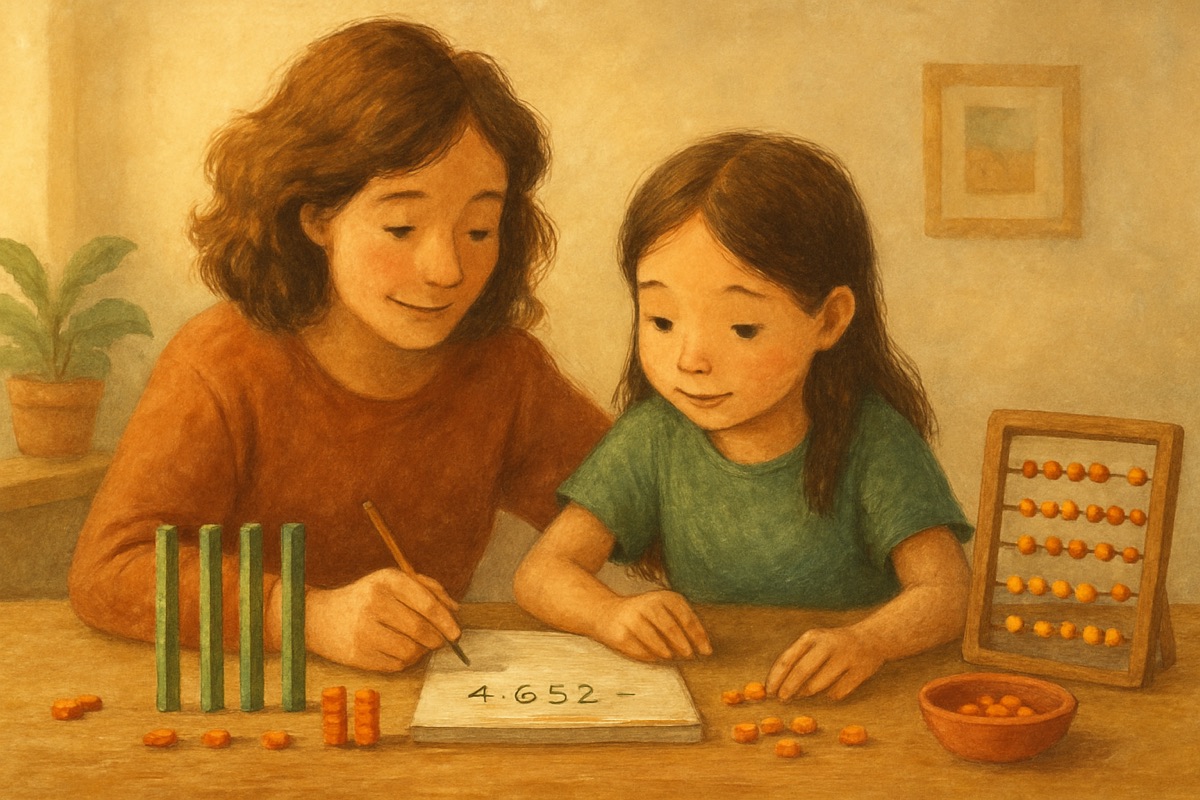
In this illustrative example, a parent and child read 4,208,000 together. Reading each digit separately can hide the value of the whole number. Split it at the commas instead: 4 | 208 | 000. The groups mean four million, two hundred eight thousand, and zero ones. Read the nonzero groups as "four million, two hundred eight thousand."
Big numbers look intimidating because kids see a long string of digits and try to take it in all at once. The trick is that you never read a big number all at once. You read it in chunks, and the chunks are already marked for you. Once a kid gets that, a seven-digit number stops being a wall and becomes three small numbers with labels.
Start with what the columns mean
Before the millions, a kid needs the small stuff solid. Place value just means that where a digit sits tells you what it's worth. The 3 in 30 is worth thirty. The 3 in 300 is worth three hundred. Same digit, different value, and the only thing that changed was its seat.
Going right to left, the seats are ones, tens, hundreds, then thousands, ten thousands, hundred thousands, then millions. Each seat is ten times bigger than the one to its right. If your kid is shaky on this, don't rush ahead to the millions. A house needs a foundation. Spend a few days on three and four digit numbers until "which column is that digit in" comes easily.
The commas are the real lesson
The commas split a big number into groups of three, and each group gets a name. Starting from the right:
- The first group is the ones (up to hundreds)
- The comma after it says "thousand"
- The next group is another set of three digits
- The comma after that says "million"
So 4,208,000 isn't one giant number. It's three little groups. You read the first group, say its name, read the next group, say its name, and so on. "Four million, two hundred eight thousand." The commas literally tell you where to say "million" and "thousand." Point to each group while reading its value aloud.
Ask your child to point at each comma and say its group name before reading the digits around it. Start with the right-hand comma for "thousand," then the left-hand comma for "million." Now read the groups from left to right, beginning with "four million."
A concrete way to practice at home
You don't need worksheets for this. You need a strip of paper and a pen.
Write a big number with no commas, like 3405120. Then have your kid put the commas in themselves, counting three digits from the right each time. 3,405,120. The act of placing the commas is where the understanding lands, because they have to count the groups to do it. Then they read it back to you: "three million, four hundred five thousand, one hundred twenty."
Do it the other way too. Say a number out loud, like "two million, sixty thousand, four hundred," and have them write it. That one is sneaky. The "sixty thousand" with no hundred-thousands means they need a zero as a placeholder, and the "four hundred" with nothing after means two more zeros. 2,060,400. Kids who only ever read numbers get tripped up here, because writing them forces you to account for the empty seats.
The zero problem
Speaking of empty seats, zeros are where most of the real confusion lives. A zero doesn't mean "nothing here to worry about." It means "this seat is empty, but it still counts as a seat." That's the part kids skip.
Take 500,007. Reading it as "five thousand seven" or "five hundred seven" drops the empty places. But those four zeros are holding places open. It's five hundred thousand, and seven. The zeros are why the five means five hundred thousand and not five hundred. If a reading changes the number's value, check each group and the zeros that keep its places open.
Make the numbers real
Big numbers stay abstract until a kid connects them to something. Population is one way to do this. Look up the population of your town, then your state, then the country. Suddenly seven-digit numbers have a reason to exist. Distances work too. The moon is about 238,900 miles away. Read that one together. Money is the classic, because a million dollars is a number kids already have feelings about.
The point isn't the specific fact. It's that "four million" means something when it's four million people or four million miles, instead of just a string of digits on a page. A number a kid can picture is a number a kid can read without fear.
Return to the illustrative example after practicing: can your child split 4,208,000 into its groups, name each nonzero group, and explain why the last three zeros do not add another spoken group? If a step is unclear, work through a smaller number together before trying again. Use the explanation to choose what to practice next, rather than setting a deadline for understanding.