Reading a Calendar and a Clock: The Time Skills Schools Assume Kids Have
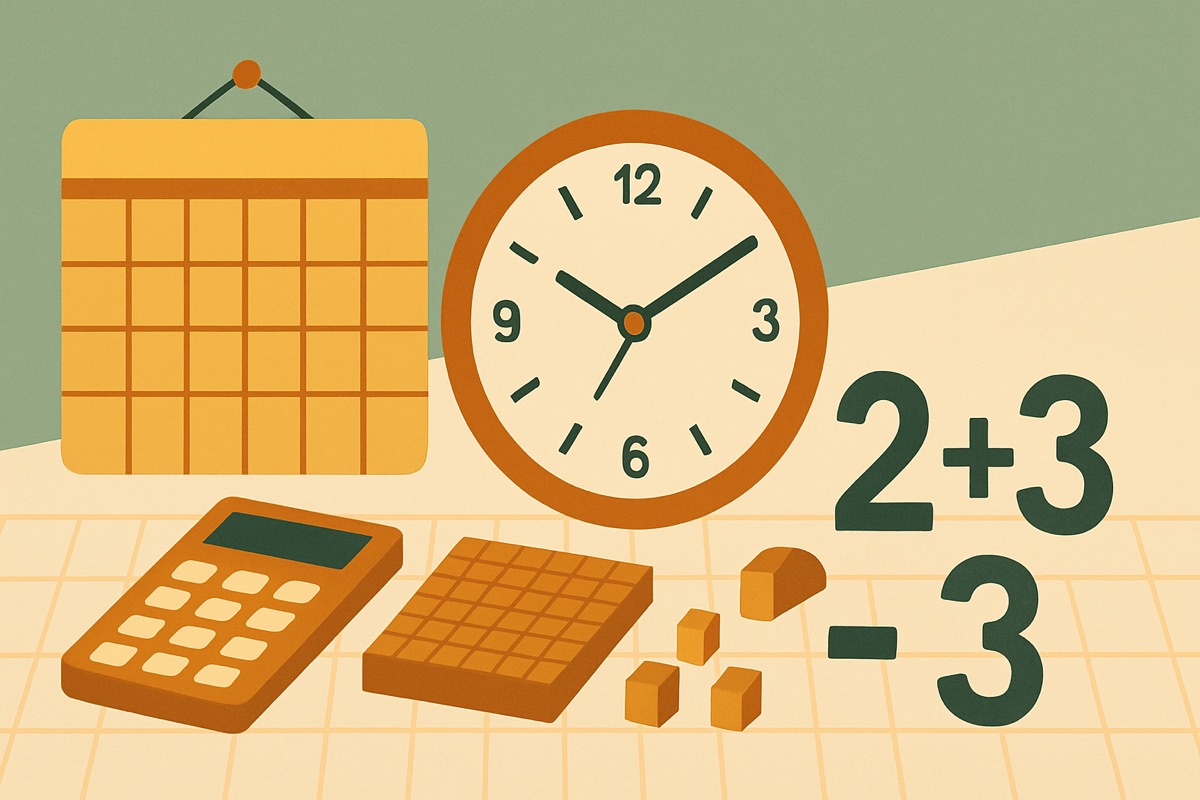
I gave a third grade class a word problem that should have been easy. Soccer practice ends at 5:15. Right now it's 4:40. How long until practice is over? Half the room froze. A couple started subtracting 40 from 15, got a negative number, and gave up. These were sharp kids. They just hit a wall the curriculum assumed they'd already climbed.
That's the thing about time. Schools introduce it fast, check the box, and move on, assuming the rest gets absorbed at home. Then they build fractions and scheduling and word problems on top of it. If you want to teach kids elapsed time, and reading a clock and a calendar underneath it, you're usually filling a gap the school doesn't even know it left.
Why time is genuinely hard
We forget how weird our time system is because we've used it forever. But think about what we're asking a kid to hold in their head. Time counts in base 60, not base 10. There are two overlapping systems on an analog clock, the hours and the minutes, and the same tick mark means five minutes and one minute depending on which hand you're reading. Then a calendar switches everything to base 7 for weeks and irregular months, some 30 days, some 31, one that can't decide.
None of that lines up with the tidy tens the kid has been learning in every other part of math. So when they stall on time, it's not because they're slow. It's because time breaks the rules they just spent two years memorizing. Give them credit for finding it confusing. It is.
Start with the clock, and start analog
There's a temptation to skip the analog clock since every screen shows digital. Don't. The analog clock is a number line bent into a circle, and reading it builds a spatial sense of time that digital never does. A kid who reads analog can see that 4:40 is close to five, that there's not much of the hour left. A kid who only reads digital sees two unrelated numbers.
Here's the order I teach, and it moves slower than most parents expect:
- The hour hand alone. Just the hour, ignore the long hand entirely at first. "It's a little past three."
- O'clock and half past. The two anchor points kids feel in their bodies.
- Quarter past and quarter to, tied to money. A quarter of an hour is 15 minutes like a quarter is 25 cents, a nice parallel.
- Five-minute counting around the face. Count by fives while pointing at each number. This is where the minute hand finally makes sense.
- The single-minute marks, last. These are the hardest and the least important, so save them.
Point at real clocks constantly. The one on the oven, the one on the wall at the doctor's office. "What does that clock say" is a free math lesson you can run twenty times a day.
Then the calendar, which is its own skill
Calendar reading gets treated as trivial, and it isn't. A kid needs to grasp that a week loops every seven days, that months have different lengths, that "two weeks from Tuesday" is a calculation, not just a phrase. I've met fifth graders who could multiply fractions but couldn't tell me what date it would be a week from Thursday.
Hang a real paper calendar where your kid can reach it and put their stuff on it. Their game Saturday, the half day next week, the countdown to a birthday. When a kid tracks their own life on a calendar, the structure sinks in because it matters to them. "How many days until your party" is a subtraction problem they'll actually want to solve. Counting the boxes with a finger is completely fine at first. That's how the base-7 rhythm gets into their hands.
Elapsed time is where it all comes together
Elapsed time is the boss level. It pulls together clock reading, counting by fives, and the base-60 wrinkle all at once, which is exactly why my soccer kids froze. The mistake they made, subtracting straight across like it was regular numbers, is the classic one. You can't borrow from the minutes column the way you borrow from the tens column, because there aren't ten minutes in an "hour place," there are sixty.
The method that clicks for almost every kid is counting up in friendly jumps, not subtracting. Back to 4:40 to 5:15:
- From 4:40, jump 20 minutes to get to 5:00. That's a clean landmark.
- From 5:00, jump 15 more minutes to reach 5:15.
- Add the jumps. 20 plus 15 is 35 minutes.
No borrowing, no negative numbers, no crying. Kids can picture it, especially if they draw a little number line and mark the jumps. I have them hop along a drawn timeline from the start time to the next whole hour, then on to the end time. Once they see it as hops on a line instead of a stacked subtraction problem, the freezing stops.
Practice it with things that already happen. "The movie started at 6:50 and it's 7:25, how long have we been watching." "Dinner's at 6, it's 5:20, how much longer." Real elapsed time, all day, no worksheet required.
Keep it in the real world
Time is one of the few math skills a kid will use every single day for the rest of their life, so it's worth teaching for real understanding rather than as a unit to survive. The kid who can look at a clock and feel that there's twenty minutes left, or count up from 4:40 to 5:15 without panicking, has something a worksheet score can't measure. My frozen soccer players got there in about two weeks of counting up on number lines. The problem was never the kids. It was that somebody assumed they already knew, and nobody had actually shown them.