Making Ten: The Addition Strategy That Beats Rote Flashcards
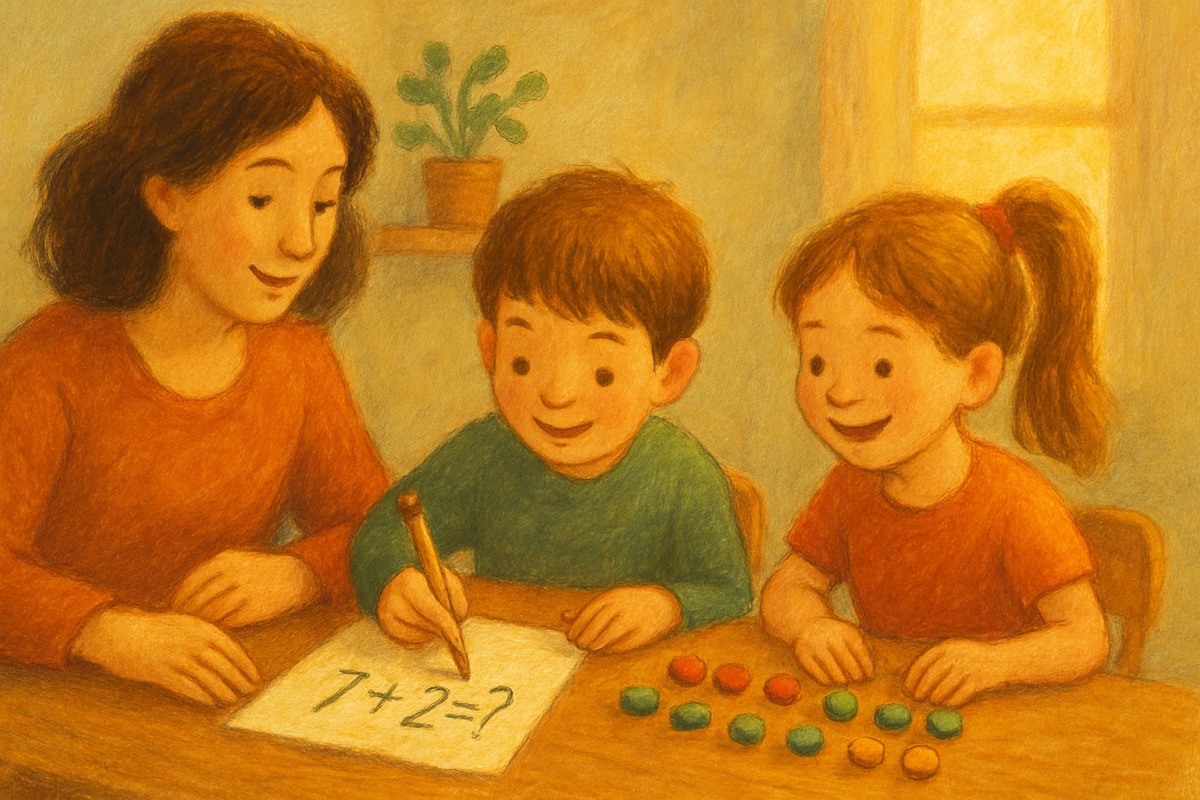
Why 8 plus 5 stumps a kid who can add tens in his sleep
Ask a first grader what 10 plus 3 is and he will tell you thirteen without blinking. Ask the same kid what 8 plus 5 is and watch him freeze, or start the slow finger count, or just guess twelve. Same answer, wildly different difficulty. The number ten is special to us because we count in tens, and kids feel that even before they can explain it.
The make a ten addition strategy is the trick that turns the hard problem into the easy one. Instead of memorizing 8 plus 5 as an isolated fact, a child learns to rebuild it into 10 plus 3, which he already owns. It is one of the most useful things you can teach a young kid, and it beats flashcards because it does not just store an answer. It teaches him how numbers move.
What "making ten" actually means
The idea is simple enough to say in one breath. Ten is the friendliest number, so when an addition problem is awkward, you borrow just enough from one number to make the other one a clean ten, then add on what is left.
Take 8 plus 5. Eight wants two more to become ten. So we crack the five open into two and three. Give the two to the eight to make ten. Now the problem is ten plus three, which is thirteen. We did not change the total. We just rearranged it into a shape that is easy to hold.
Once a kid sees it, he sees it everywhere:
- 9 + 4 becomes 10 + 3
- 7 + 5 becomes 10 + 2
- 8 + 6 becomes 10 + 4
- 6 + 7 becomes 10 + 3
The "hard" addition facts are almost all the ones that cross over ten, and this single move tames the whole set of them.
Make it real with your hands and ten of something
Do not start with the numbers on paper. Start with objects, because a six year old needs to see the two jump from one pile to the other before the idea means anything.
The classic tool is a ten frame, which is just a two by five grid, but you do not need to buy anything. An empty egg carton with two cups snipped off is a perfect ten frame. So is a muffin tin. Give your kid ten little counters, dried beans or cereal or coins, and one of these frames.
Here is a scene from my classroom that I run at least once a week. A student is working on 8 plus 5. She puts eight beans in the frame, filling most of it, with two empty cups left. Then she counts out five more beans in her hand. I ask, "How many more does the frame need to be full?" She counts the empty cups. "Two." "Okay, move two beans in." Now the frame is a full ten, and she has three beans still in her hand. "So how much do you have?" She looks at the full ten and the three. "Ten and three. Thirteen." She did not memorize a thing. She watched the answer happen. Do that a dozen times and the picture lives in her head, ready for the day the beans are gone.
Build the habit before the speed
Two smaller skills make making ten click, and they are worth practicing on their own first.
The first is knowing the pairs that make ten cold: 1 and 9, 2 and 8, 3 and 7, 4 and 6, 5 and 5. If a kid has to think hard about what goes with eight to make ten, the whole strategy stalls. So drill just those, gently and briefly, until "eight needs two" is automatic.
The second is breaking a number apart on purpose. Can your kid take a five and split it into two and three, or one and four, quickly and comfortably? This is the move that lets him hand the right piece to the other number. Play with it. "Show me five beans as two groups. Now show me a different way." There are no wrong answers, which is exactly why anxious kids relax into it.
Keep the sessions short and calm. Five minutes at the counter while dinner cooks does more than a long worksheet, and it does it without the dread. You are not trying to get fast yet. Fast comes later, on its own, once the picture is solid.
Why this beats a stack of flashcards
Flashcards can drill 8 plus 5 into a kid until he spits out thirteen on command. But that is one answer, memorized alone, brittle, and gone the moment he is tired or nervous. Making ten gives him something better.
- It transfers. The exact same move handles 8 plus 5, 80 plus 50, and eventually the borrowing and carrying of bigger arithmetic. A memorized fact just sits there.
- It has a backup. If he blanks on the answer, he is not stuck. He can rebuild it from the ten, so he never has to guess and he never has to panic.
- It builds real number sense, the deep feel for how numbers come apart and go back together, which is the thing that separates kids who like math from kids who fear it.
- It is honest work. The kid is actually reasoning, not performing a trick he does not understand.
That last point is the one I care about most. A child who understands why 8 plus 5 is 13 is standing on solid ground. A child who only memorized it is standing on a memory, and memories fade. Some good math apps lean on this, ours included, showing kids the ten frame filling up and letting them make the move themselves instead of just scoring a right-or-wrong. But you do not need any app for this. You need ten beans, a muffin tin, and about five unhurried minutes. The rest takes care of itself.