Long Division, Finally Made Clear for the Parent Helping at the Table
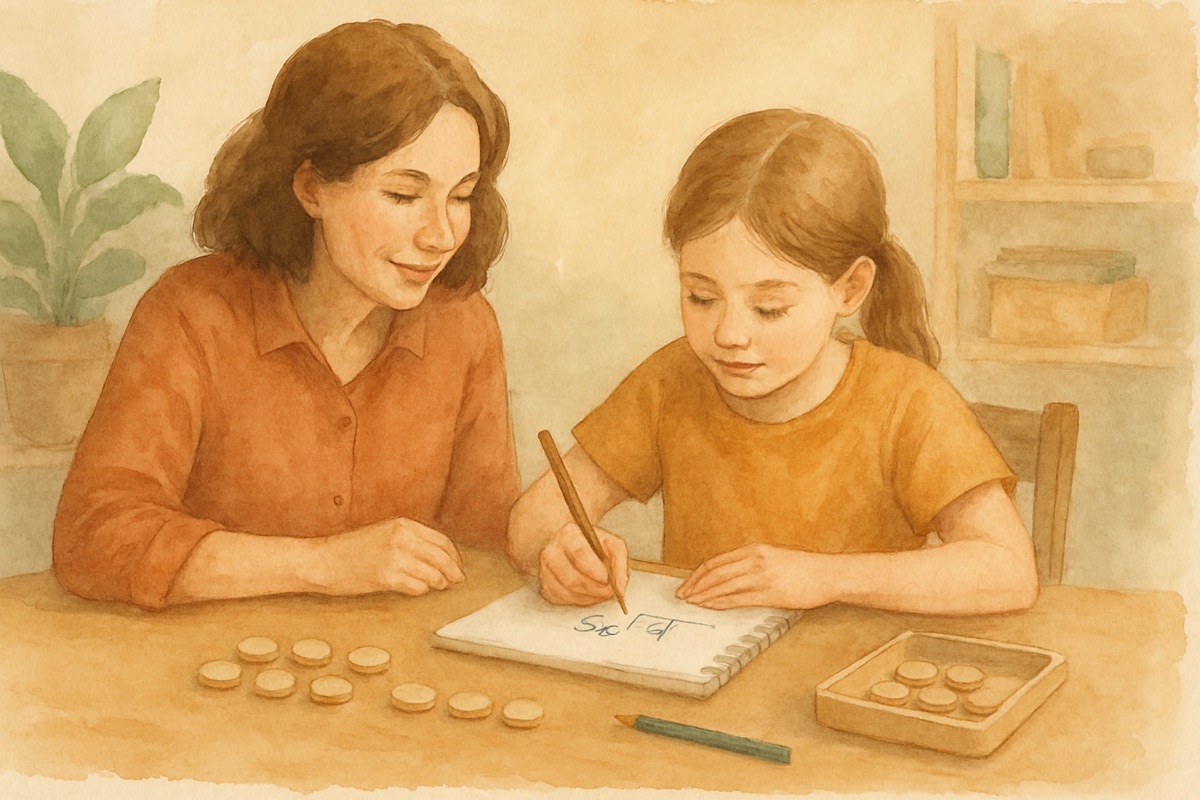
A fourth grader I taught used to write the whole "divide, multiply, subtract, bring down" chant in the margin of her paper before she started every problem. She had it memorized perfectly. She still got most of them wrong, because she was following a dance she didn't understand. That's the thing nobody warns you about when you sit down to help. Knowing how to teach long division is not about the steps. It's about what the steps are actually asking.
Long division is the first piece of math that looks genuinely intimidating on paper. All those numbers stacked up, the little brackets, the arrows. But underneath it, you are just sharing things into equal groups and keeping track of what's left over. If your kid understands sharing, they can understand this. The trouble is that the standard algorithm hides the meaning behind a routine, and a lot of kids memorize the routine without ever seeing the point.
Start with real sharing, not the bracket
Before you write a single division problem, do it with objects. Grab 52 pennies, or dry beans, or LEGO bricks. Ask your kid to share them equally among 4 people. Let them actually deal the objects out, one to each pile, like dealing cards.
They will end up with 13 in each pile. Now show them that what they just did by hand is exactly what the written method does, only faster. The written steps are a shortcut for the dealing. When a kid has physically split a pile and seen a remainder sit there because it wouldn't divide evenly, the whole thing stops being mysterious.
I do this with a class every year and the reaction is always the same. Someone says "wait, that's all it is?" Yes. That's all it is.
Teach the biggest chunks first, not one digit at a time
Here is where I break from how a lot of us were taught. The traditional method makes you go digit by digit, which forces a kid to think about place value at exactly the moment they're most overwhelmed. There's a friendlier way to start, sometimes called partial quotients or the "chunking" method.
Say you're dividing 156 by 6. Instead of asking "how many times does 6 go into 15," ask a bigger, easier question. "How many groups of 6 can we pull out of 156?" Your kid might not know instantly, so let them build up in chunks they can handle.
- 6 times 10 is 60. Pull that out. You have 96 left.
- 6 times 10 is 60 again. Pull that out. You have 36 left.
- 6 times 6 is 36. Pull that out. Nothing left.
- Add up the chunks: 10 plus 10 plus 6 is 26. That's the answer.
This looks longer, and it is, but it never asks a kid to do something they can't reason through. They're using facts they already know (multiples of ten, easy multiplication) to sneak up on the answer. Once they trust the process, the standard algorithm is just the tidy, compressed version of the same idea, and they'll be ready for it.
Give the steps a reason, not a rhyme
When your kid is ready for the standard bracket method, the four steps still matter. But narrate why each one happens instead of chanting the sequence. Take 84 divided by 3.
Divide: Look at the 8 first, which really means 8 tens. How many groups of 3 fit into 8? Two, and that's 2 tens, so write the 2 above the 8. This is the step kids rush. Slow down and name the place value. It's 2 tens, worth 20, not just "2."
Multiply: 2 tens times 3 is 6 tens. Write the 6 under the 8. You're recording how much you've used up so far.
Subtract: 8 tens minus 6 tens is 2 tens left over. This is the leftover, the same as the pennies that didn't fit in a pile.
Bring down: The 2 tens left over become 20, and you bring down the 4 to make 24. Now you're asking the same question again with a smaller pile. How many 3s in 24? Eight. Write it. Nothing left. The answer is 28.
The chant works only when a kid already knows what each word is doing. Said blindly, it produces the girl with the perfect margin notes and the wrong answers.
Expect the remainder to be the sticking point
Remainders confuse kids more than anything else in division, and it's usually because we skip past what a remainder means. When 25 is divided by 4, you get 6 with 3 left over. That 3 is not nothing. It's three things that couldn't form a complete group of 4.
Tie it to a real situation every time at first. Twenty-five cookies, four kids, each kid gets 6 and there are 3 cookies fighting over. Do you break them up (a fraction), give them away (drop the remainder), or does someone need one more to round up? The answer depends on the story, and that's a genuinely useful thing for a kid to notice. Math questions have context. A worksheet strips it out, but you don't have to.
Keep the sessions short and the wins real
Ten minutes is plenty. Long division is dense, and a tired kid learns nothing. Two clean problems your child actually understood beat a full page of guessing. I would rather a kid do three problems slowly, saying out loud what each step means, than fifteen on autopilot.
Watch for the difference between a kid who's thinking and a kid who's just filling in boxes. If you hear them reasoning ("okay, 6 doesn't fit into 4, so I look at 42 instead"), you're winning, even if the final answer is off. If you hear silence and a fast pencil, stop and go back to the pennies. Repetition only helps once the understanding is there. Before that, it just cements the confusion.
We built our own math app partly because so much practice software drills the algorithm without ever teaching the sharing underneath it, and that's exactly backward. Get the meaning first. The speed comes on its own once a kid knows what they're actually doing.
The day that fourth grader stopped writing the chant in her margin was the day she started getting the problems right. She didn't need the reminder anymore, because it had finally turned into something she understood instead of something she was performing. That's the whole goal. Not a kid who can recite the steps, but a kid who could rebuild them from scratch if they forgot, because they know what division is really for.