'I'm Just Not a Math Person': The Sentence To Stop Saying Around Your Kids
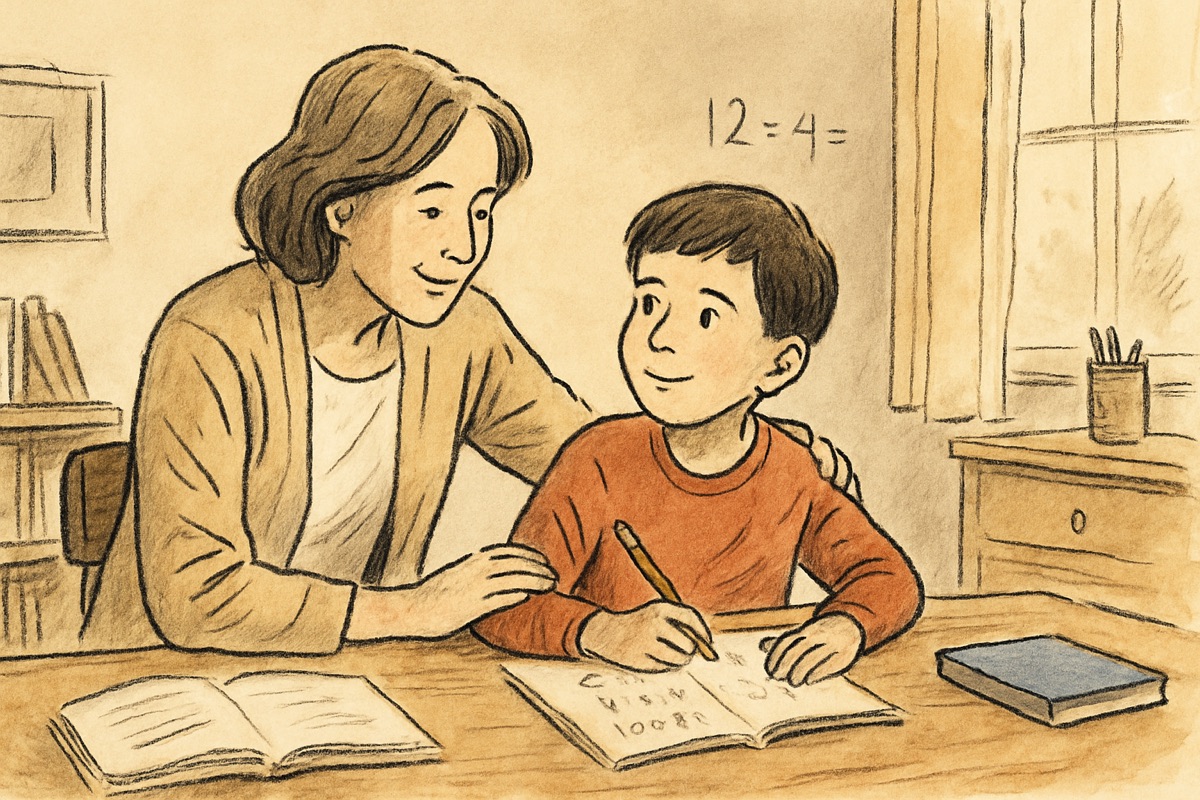
The sentence that gets passed down at the kitchen table
A mom sat across from me at conferences a few years back, looking at her daughter's math scores, and she laughed and said, "Well, I was never a math person either, so." She meant it kindly. She was trying to take the pressure off her kid. But her daughter was sitting right there, and I watched the girl's shoulders drop about an inch. In that one second she got handed a story about herself, and the story was: this is genetic, it's not your fault, and you're not going to be good at this.
That "not a math person" mindset is one of the most contagious ideas I know. Kids catch it from us before they've done enough math to have any real opinion of their own. And once a kid decides the door is closed, they stop pushing on it. Why would you keep trying at something you've already been told you can't do?
Where the belief actually comes from
Almost no one is born unable to do arithmetic. What people call being "not a math person" is usually a pile of specific bad experiences stacked on top of each other. A timed test in third grade that felt like a fire drill. A teacher who explained fractions one way, one time, fast. A homework night that ended in tears. None of those are proof of a broken brain. They're just moments where the math moved faster than the kid did, and nobody slowed down to fix the gap.
Here's the part that matters for you at home. When an adult says "I'm bad at math," a kid doesn't hear an autobiography. They hear a rule about how the world works. If Mom can't do it and Mom is smart and capable at everything else, then math must be some separate magic that only certain people have. That's the fixed mindset in one sentence, and it's wrong. Math is a skill you build, like reading or riding a bike, not a gift you either got or didn't.
What it looks like when it takes hold
I can usually spot a kid who's already absorbed the "not a math person" idea within the first week of school. It's not that they get answers wrong. It's how they behave before they even try.
- They put their pencil down the instant a problem looks unfamiliar, before reading it.
- They say "I don't get it" as a reflex, sometimes before I've finished writing the problem.
- They watch my face for the answer instead of watching the numbers.
- They'll happily do ten problems that look like ones they've already done, and freeze completely on one that's a little different.
That last one tells you it's confidence, not ability. A kid who can do a page of practice problems clearly has the skill. What they don't have is the belief that they can figure out something new. And figuring out something new is basically the whole point of math.
The small swaps that actually change things
You don't fix this with a pep talk. Telling a kid "you're so smart, you can do anything" usually backfires, because the next hard problem feels like proof you were wrong. What works is quieter and more specific. Here's what I'd change if I could change one thing in most homes.
Stop announcing your own math history. Even the jokey version. Your kid is listening, and "I was never good at this either" reads as permission to give up. If it's true that you struggled, you can say something more useful: "I found this hard as a kid too, and honestly I think it's because nobody showed me the slow way. Let's find the slow way together."
Praise the effort and the strategy, not the speed. Fast is not the same as smart. I've had brilliant kids who were slow and careful, and I've had quick kids who guessed. When your child works through something step by step, name that. "You checked your work" and "you tried a different way when the first one didn't work" are the sentences that build a math person.
Let the struggle sit for a minute. When your kid says "I don't get it," resist jumping in with the answer. That instinct is loving and it's also the thing that teaches them they need you to rescue them. Try "what do you notice?" or "what's one thing you could try?" and then be quiet. The silence feels long. It's where the learning happens.
Normalize the wrong answer. In my classroom, a wrong answer is information, not a verdict. When my own son got 6 times 7 wrong for the tenth night in a row, we didn't groan. We just kept circling back to it, low key, until it stuck. A missed fact is a fact you haven't practiced enough yet, nothing more.
Why the "genetic" story is so tempting, and so wrong
I understand why parents reach for it. If math ability is just something you're born with, then a struggling kid isn't a reflection of your parenting or their effort. It lets everyone off the hook. But it also quietly closes the door on your child, and it does it in a warm, loving voice, which makes it worse.
The truth is more hopeful and more work. Kids get better at math the same way they get better at anything: by doing a reasonable amount of it, getting real feedback, and building understanding instead of just memorizing tricks they'll forget by June. That's the whole reason my husband and I built our own little math app for our kids, so the practice would reward actually understanding a thing, not just grinding the same worksheet until they hated it. Repetition without understanding is how you manufacture a "not a math person." Understanding, at a pace the kid can handle, is how you undo one.
What to do the next time your kid melts down over homework
The next time your child pushes the paper away and says they're just not good at this, you have a choice about which story to hand them. You can nod along and pass down the family curse, or you can crouch down and say, "Okay. Show me the part where it stopped making sense." That second sentence tells a kid something the first one never will: that the problem is a specific spot in the work, and specific spots can be fixed.
None of my best math students were born that way. Not one. They were kids who, somewhere along the line, had an adult who refused to believe the door was closed. You can be that adult for your kid tonight. You just have to watch what you say when the numbers get hard.