The Quiet Kid Who Thinks They're Behind in Math
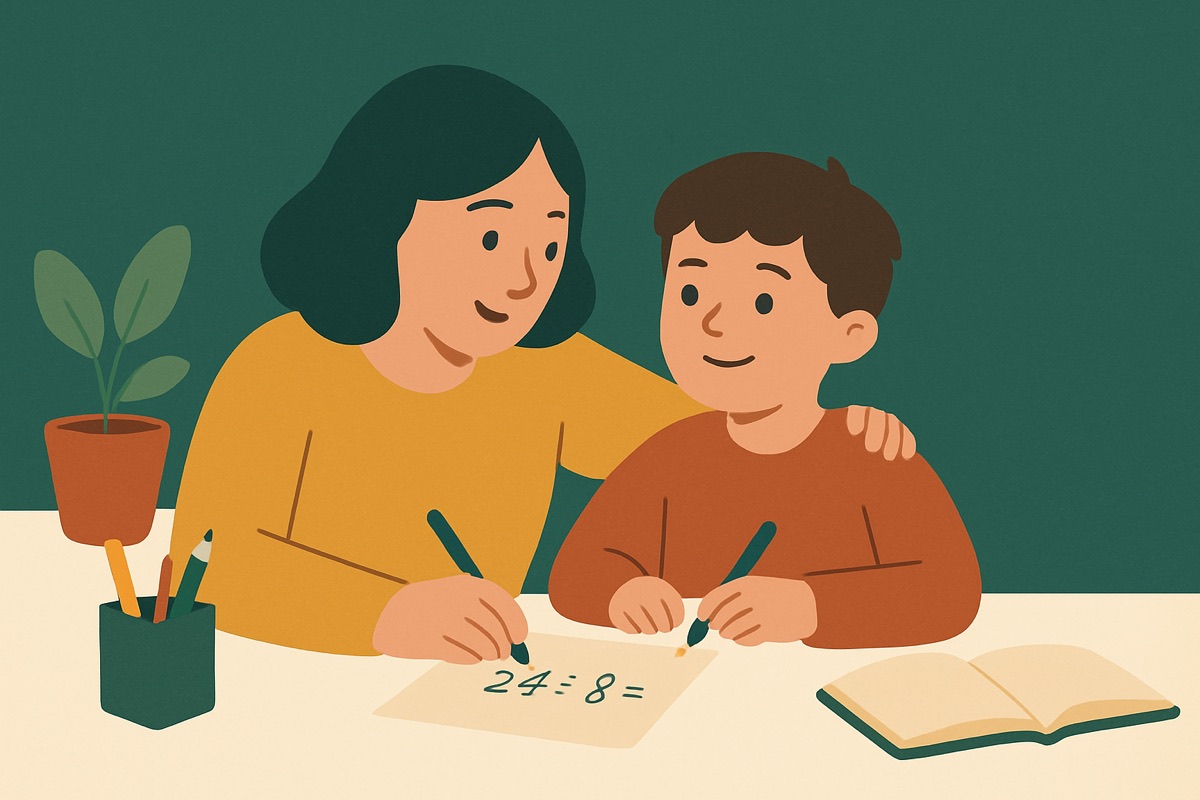
There was a girl in my third grade class named Maya who did every worksheet, got most of it right, and was completely certain she was the worst at math in the room. She never raised her hand. When I called on her she would freeze, even for problems I had watched her solve two minutes earlier at her desk. If your child feels behind in math but the actual work coming home looks fine, you might be living with a Maya.
I have taught elementary math for a long time now, and this is one of the most common gaps I see. It is not a gap in skill. It is a gap between how well a kid is doing and how well they think they are doing. The two are not the same thing, and the second one can quietly wreck the first.
The quiet ones hide it best
Loud struggle gets attention. A kid who cries over homework or throws the pencil, we notice that kid. We help that kid.
The quiet kid who has decided they are bad at math is much harder to spot. They comply. They finish the page. They do not make trouble. So nothing flags them, and the belief just sits there growing. By the time it shows up as an outright refusal or a stomachache before a test, it has usually been building for a year or more.
Here is the tricky part. Being quiet in math class often has nothing to do with ability. Some kids need longer to think and hate being rushed. Some are perfectionists who will not answer until they are certain, and certainty is slow. Some watched a faster classmate blurt an answer once and concluded that fast equals smart. None of that means behind. But a kid cannot tell the difference from the inside. They just feel the silence and read it as failure.
Where the belief comes from
In my experience it rarely starts with a bad grade. It starts smaller.
- One classmate who is genuinely quick, who your kid has quietly decided is the standard.
- A timed test that measured speed and got mistaken for a measure of understanding.
- A well-meaning comment like "this one is easy" that lands as "so what is wrong with me."
- A single hard unit, like when regrouping or fractions first shows up, that felt like drowning for a few weeks.
Any of these can plant the idea. Then the kid starts collecting evidence for it. A missed problem becomes proof. A right answer becomes luck. This is how a perfectly capable eight-year-old ends up sure the whole class is ahead of her when the truth is she is right in the middle of it.
How to check if it is real
Before you can fix the feeling, find out whether there is also a real gap underneath it. These are not the same problem and they need different responses.
Sit down with your kid, no pressure, and watch them do a few problems out loud. Not to correct, just to listen. Ask them to talk through their thinking. What you are listening for is the difference between "I do not know how to do this" and "I can do this but I think I am doing it wrong."
- If the method is sound and the answers are mostly right, the gap is confidence, not skill. The math is fine. The self-image is the thing to work on.
- If they genuinely get stuck on the steps, there is a real skill gap too, and that is good to know. It is fixable, and naming it usually comes as a relief.
Most quiet, worried kids I have worked with land in the first group. The work is there. They just cannot see it.
What actually helps
You cannot talk a kid out of feeling behind by saying "you are so smart." They will not believe it, and vague praise makes it worse because it is not tied to anything they can point to. What works is quieter and slower.
Notice the specific thing. Instead of "good job," try "you carried the ten there without me reminding you." Specific, true, and about the process. That is a fact they can hold onto, unlike a compliment they can wave away.
Show them their own progress over time. Kids have no memory for how far they have come. Keep a couple of old worksheets from three months ago and put one next to today's. "Look what used to be hard." Seeing the gap between past and present is the single most convincing evidence that they are not stuck.
Take speed off the table at home. If they need to count on their fingers or take a full minute, let them, and do not comment on it. Understanding first, speed later, and the speed almost always comes on its own once the fear is gone. This is also why I am wary of anything that rewards rushing. Real progress is worth more than a fast wrong answer, and kids can feel the difference. A good practice tool, whether it is flashcards at the table or an app like Math Prizes, should reward getting it right, not getting it fast.
Let them explain a problem to you. Being the teacher for two minutes does more for a shaky kid than a dozen worksheets. You cannot explain something you do not understand, and when they successfully walk you through it, they hear themselves being competent. That sound is hard to argue with.
The long game
Maya came around, but not because of one conversation. It was months of small, specific noticing, of her seeing old work next to new work, of nobody rushing her. One day in the spring she raised her hand, got it wrong, and shrugged. That shrug was the win. She had stopped treating a mistake like a verdict.
If your kid feels behind, start by finding out whether they actually are, and most of the time you will find a capable kid carrying a story that is not true. Your job is not to argue with the story. It is to keep handing them small, real facts about themselves until the story quietly runs out of evidence.