How to Turn Any Board Game You Already Own Into Math Practice
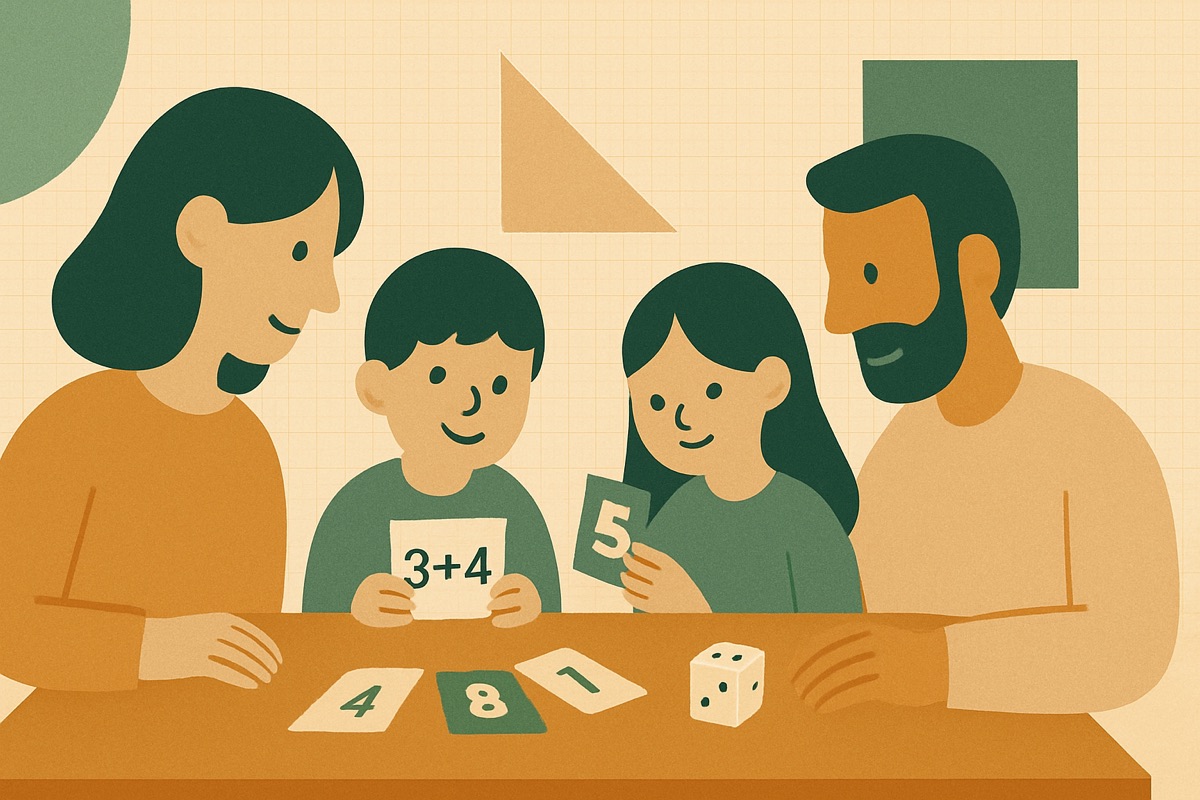
There is a stack of board games in most houses that comes out twice a year and then goes back on the shelf. Monopoly with three missing houses. A Candy Land box held together with tape. Yahtzee that somebody's uncle left behind. I've spent years telling parents they don't need to buy anything new to build math skills, because the tools to turn board games into math practice are already sitting under the coffee table.
I taught second and third grade for a long time, and the fastest number sense gains I ever saw did not come from a workbook. They came from kids who played games at home where counting and adding actually mattered to whether they won. A child who couldn't add 7 and 5 on a quiz will count that same sum in their head three times in one turn of a game, because the game made it worth doing.
Start with what the game already asks for
Most games have math baked in and nobody points it out. Your job is to slow down the moment where the math happens and let your kid do it instead of doing it for them.
- Rolling and moving. In any roll-and-move game (Trouble, Sorry, Candy Land with a die swapped in), have your kid say the number, then count each space out loud as they move. For older kids, use two dice and make them add before they touch the board.
- Money. Monopoly and The Game of Life are addition and subtraction machines. Make your child be the banker. Counting out $340 in change teaches place value better than any worksheet on tens and hundreds.
- Scoring. Yahtzee is a full arithmetic lesson. Adding a column of dice, deciding whether three fours beats a small straight, tallying the final score. Let your kid keep the score sheet even if it's slow.
The trick is patience. When your seven-year-old lands on a space and pauses, the temptation is to just tell them the answer so the game keeps moving. Don't. That five second wait is the whole point.
Add one small rule to raise the math level
Once the built-in math feels easy, you can bolt a rule onto a game your kid already knows. Familiar board, new challenge. Here are ones I've used that work.
Candy Land is pure luck with no arithmetic, so I turn it into a counting-on game. Draw a card, but before you move, your kid has to tell me how many spaces they'll travel and what number space they'll land on if they're currently on space 12. That's addition dressed up as a prediction.
Chutes and Ladders becomes a subtraction game when you ask, "You were on 47 and the chute dropped you to 26. How many spaces did you lose?" Real stakes, real subtraction, and the answer matters because they're annoyed about it.
For a card game like Uno, I have kids add the value of the cards left in their hand at the end of a round, which is exactly the tallying the real scoring uses anyway. A hand of a 9, a 4, a skip (20), and a wild (50) is a nice messy sum for a fourth grader.
Match the twist to the grade
Don't put a multiplication rule on a kindergartner or a counting rule on a fifth grader. The math should sit right at the edge of what your kid can already do.
Kindergarten and first grade should be counting spaces one at a time, recognizing the number on a die without counting the pips, and comparing whose number is bigger. First and second grade can add two dice, count on from a number, and make change with play money. Third grade and up is ready for multiplication (roll two dice and multiply instead of add), keeping score across several rounds, and simple probability questions like whether they're more likely to roll a 7 or a 2 with two dice.
That last one is worth doing out loud once. Ask a nine-year-old which sum shows up most when you roll two dice. Most kids guess 12 because it feels special. Rolling twenty times and tallying the results teaches more about probability than a chapter would, and they'll remember it because they were wrong first.
Keep it a game, not a quiz
Here is the line I watch for, because I've crossed it and killed the fun. The moment a game turns into a drill, kids feel it. If every roll comes with "and what's 6 plus 4?" in a teacher voice, they shut down. The math has to stay in service of playing, not the other way around.
A few things that keep it feeling like a game:
- Let them win sometimes without narrating the math.
- Do your own math out loud too, including your mistakes, so the arithmetic feels like something everyone does, not a test aimed at them.
- Stop while they still want another round. A short good game beats a long resentful one.
I had a student whose family started letting him be the Monopoly banker on Sunday nights. Nobody called it math practice. By spring he was the kid in class who could make change fastest, and he had no idea it was connected. That's the goal. The learning should be invisible while it's happening and obvious only in hindsight.
When you want something beyond the closet
Board games are fantastic for number sense and mental math, but they're uneven. A kid can play Yahtzee for a year and never touch division. If you notice your child needs steady practice on a specific skill, that's when a structured tool earns its place, whether that's a stack of flash cards, a workbook, or an app like Math Prizes that keeps the practice tied to actual progress instead of endless repetition.
But start with the closet. Pull out the game with the missing pieces this weekend, hand your kid the dice and the score sheet, and just let them do the counting. You'll be surprised how much math is already in there, waiting for someone to slow down and let a kid do it.