Skip Counting Games That Build the Bridge to Multiplication
There's a stretch in second grade where a kid can chant "2, 4, 6, 8, 10" like a song but has no idea they're doing math. That gap is the most useful thing a teacher can work with, because that little chant is multiplication in disguise. Skip counting games are how you turn the song into understanding, and they do it while a kid thinks they're just playing.
Here's what a lot of people miss. When a child counts by fives, they're building the exact pattern that becomes the five times table. Counting by twos becomes the twos. Every group they count is a "times," even though nobody's said that word yet. So when multiplication shows up a year later, the kid who spent time skip counting isn't starting from zero. They already feel the rhythm. The kid who only ever memorized "5 times 3 is 15" from a flashcard has the answer but not the sense underneath it, and that sense is what carries them through the harder tables.
Why skip counting beats early flashcards
I'm not against flashcards. But if you put them first, before a kid has felt the pattern, you get memorization without meaning. That's the same trap as making a kid recite multiplication facts they can't reconstruct. It works until it doesn't, usually around the sevens and eights, where memory alone runs thin.
Skip counting builds the reconstruction ability. A kid who's counted by fours a hundred times can find 4 times 6 by counting up if they blank on it. That's not a failure, that's a working backup, and it's exactly what a strong math student does. So spend the time on the pattern first. The facts stick better when they land on top of something real.
Games for counting on the move
Kids remember patterns better when their body is involved, so I lean on movement games first. These need no materials.
- Jump the count. Have your kid jump in place and count by twos with each jump. Then try fives, then tens. The physical rhythm locks the sequence in. My students beg to do this and I let them, because it works.
- Clap and stomp. Count by fives, but clap on the numbers that end in five and stomp on the ones that end in zero. 5 clap, 10 stomp, 15 clap, 20 stomp. It forces them to actually hear the pattern instead of running the words on autopilot.
- Beanbag toss. Toss a beanbag back and forth, saying the next number in the count each time you catch it. Drop it, start over. Simple, and the catch-and-say rhythm is close to how facts eventually need to come out.
- Stair steps. Count by twos going up the stairs, one number per step. Ten stairs gets you to 20. Kids love the built-in finish line.
Keep these short. Two or three minutes on the way out the door is plenty, and it beats a ten minute worksheet because they'll actually do it.
Games at the table
For quieter time, a few games with things you already have around the house do the job.
Coin counting. Nickels are the best teaching tool for fives that exists, and dimes for tens. Give your kid a pile of nickels and have them count the total. They're skip counting by five and learning money at the same time, and the coins make it concrete in a way a number line never does. A real handful of change beats an abstract page.
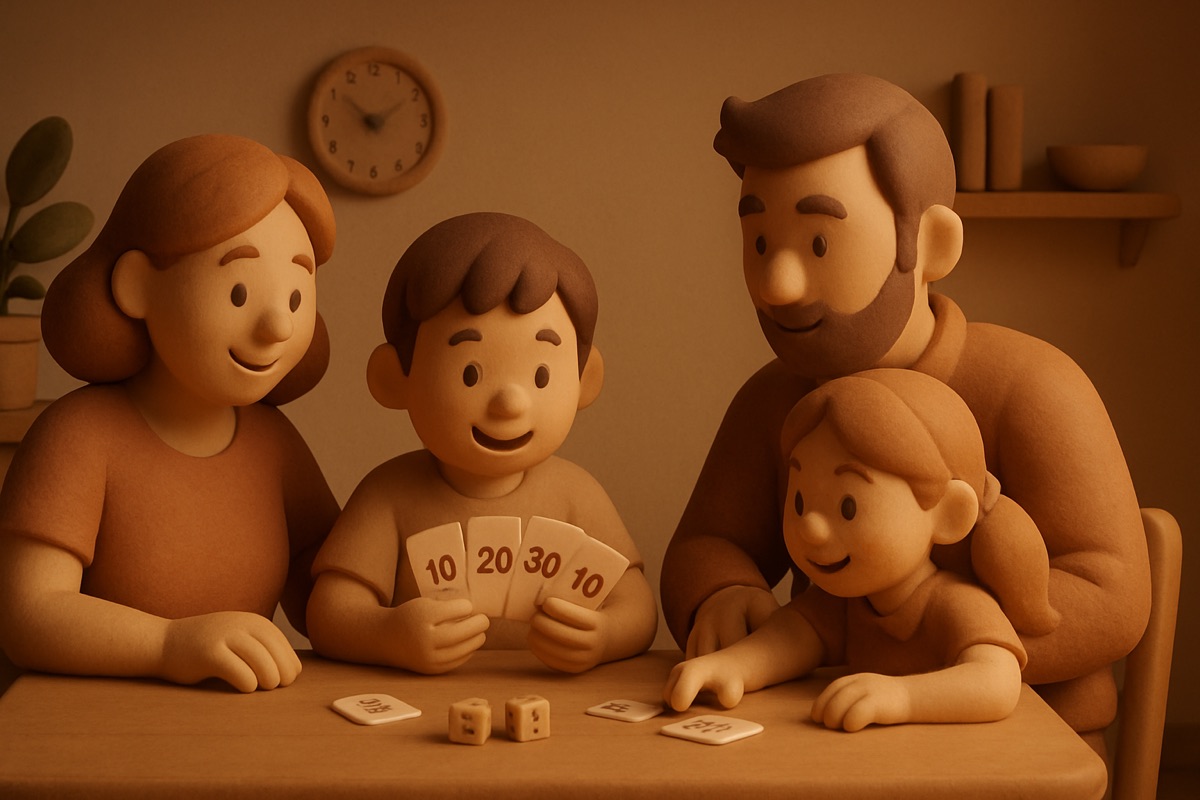
Dot cards or dice groups. Roll two dice, but instead of pips, use dice that show groups (or draw quick dot cards yourself). Show three groups of four dots and ask how many total. If they count each dot, fine, but nudge them toward counting by fours: 4, 8, 12. This is the exact moment skip counting turns into multiplication, and you can watch it happen.
The hundred chart hunt. Print a chart with the numbers 1 to 100. Have your kid color every number they land on counting by threes. A pattern shows up on the page, a diagonal stripe, and seeing that visual is a genuine lightbulb for a lot of kids. Do it for different counts and compare the patterns.
Connect it to multiplication out loud
The bridge only gets built if you name it at some point. Once a kid is comfortable counting by, say, threes, sit with them and make the link explicit. Count "3, 6, 9, 12" and then ask, "so if we counted three, four times, where did we land?" Twelve. "That's what 3 times 4 means. Four groups of three." Do that a few times across different counts and the connection forms.
I had a boy who could skip count by sixes flawlessly but froze on 6 times 4. We counted it out together, 6, 12, 18, 24, four numbers, and I watched his face when he realized the answer had been in his mouth the whole time. He just hadn't known the two things were the same thing. After that, the tables came fast, because he understood he wasn't memorizing random facts. He was labeling a pattern he already owned.
Keep it light and keep it going
None of this should feel like drilling. The whole advantage of skip counting games is that a kid will do them cheerfully and repeatedly, which is exactly the repetition that actually helps, the kind wrapped around real understanding instead of a stack of flashcards. Five minutes here and there beats a long forced session, and it beats it by a lot.
Rotate the games so nobody gets bored. Jump the twos on Monday, coins on Tuesday, hundred chart on the weekend. Follow the counts your kid needs. Twos, fives, and tens come first because they're the easiest and the most useful. Threes and fours next. The trickier ones like sixes, sevens, and eights come more easily once the early patterns are solid, because by then a kid trusts that the numbers have a rhythm worth learning.
That second grader chanting "2, 4, 6, 8" isn't just singing. She's a year ahead of where she knows she is. Give her the games, name the pattern when she's ready, and the times tables that scare so many kids will feel to her like something she figured out on her own.