How to Motivate a Perfectionist Kid Who Won't Try Unless They'll Ace It
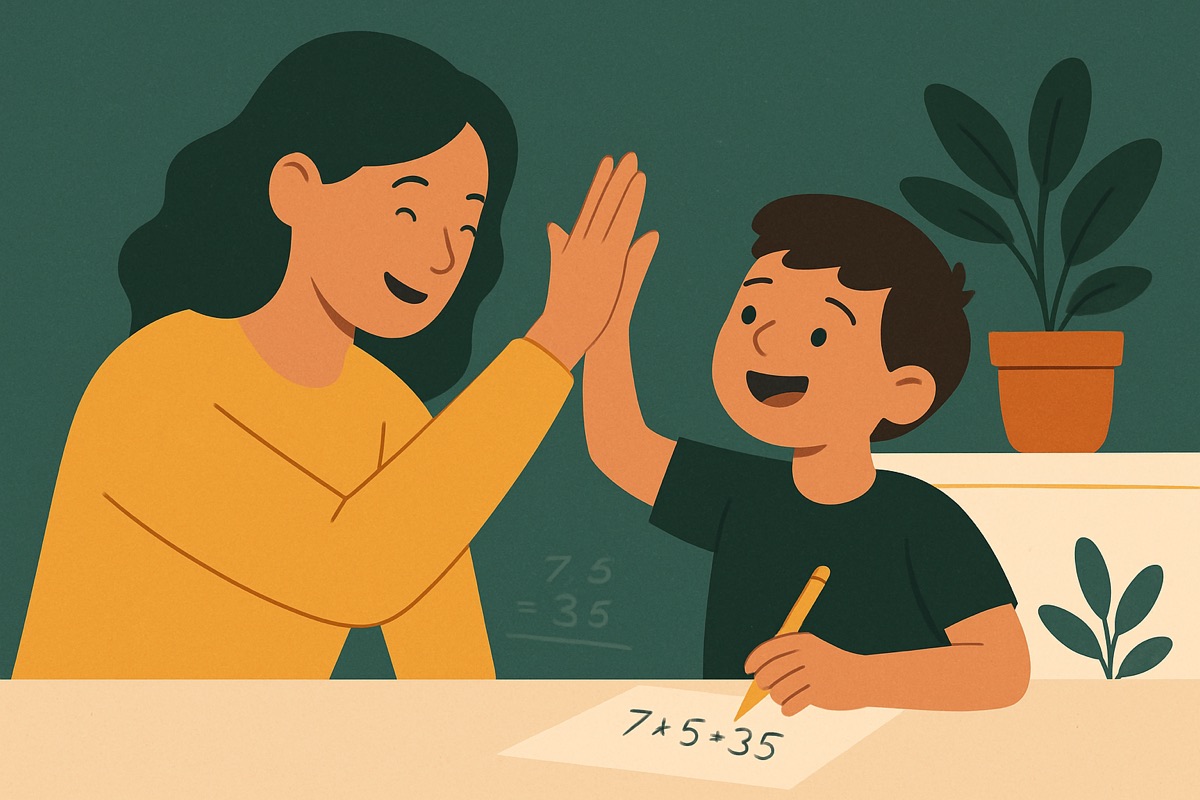
I had a fourth grader named Marcus who could do multiplication in his head faster than most of the class could copy the problem down. But the day I put a two-step word problem on the board, he set his pencil flat on the desk and stared at it. Not one number went on the page. When I knelt next to him and asked what was wrong, he said, quietly, "I don't know if I'll get it right." He would rather do nothing than risk doing it wrong.
That's the thing people miss about a perfectionist kid. They're not lazy and they're not unmotivated. They're often the opposite. Perfectionist child math motivation is a strange puzzle because the kid cares so much about being right that trying and missing feels worse than not trying at all. A blank page can't be wrong. A wrong answer can.
Why "you're so smart" made it worse
For a long time we handed kids like Marcus a steady diet of "you're so smart, this is easy for you." It felt supportive. It backfired.
If a child's whole identity is built on being the smart one, every hard problem becomes a threat. Getting it wrong doesn't just mean a missed question. It means the label might be false. So the safest thing to do is only attempt problems where success is guaranteed, and avoid anything that could crack the image. That's why the strongest math student in the room is sometimes the one who freezes first on something new.
The fix isn't more praise. It's changing what you praise. Instead of "you're so smart," try noticing the process out loud:
- "You tried it a different way when the first one didn't work."
- "You caught your own mistake and fixed it."
- "That was a hard one and you stuck with it for a while."
None of those depend on the answer being right. They tell the kid that the trying is the valuable part, which is exactly the thing a perfectionist has decided doesn't count.
Make the stakes small and the mess normal
Perfectionists need low-stakes reps where a wrong answer costs nothing. If every math moment feels like a test, they'll keep protecting themselves by opting out.
One thing I did with Marcus was start problems wrong on purpose. I'd write 7 x 8 = 54 on the whiteboard and say, "Something's off here, help me find it." Now he wasn't the one on the hook. He was the checker, the expert catching my slip. Kids who won't attempt a fresh problem will happily hunt for a grown-up's mistake, and hunting for a mistake is the same skill as checking your own work.
At home you can do the same. Do a problem out loud and fumble it. Miscount the change from a five dollar bill on purpose and let your kid catch you. When adults are visibly fine being wrong and fixing it, the kid learns that a mistake is a normal step, not a verdict.
Aim for "hard enough to be interesting"
There's a sweet spot for these kids, and it's narrower than you'd think. Too easy and they're bored, and boredom feeds the idea that math should always come instantly. Too hard and they shut down before the first line. You want the problem that's a genuine stretch but reachable in a couple of tries.
When you find that zone, protect it. Don't let a hard-won answer turn into "see, that was easy." It wasn't easy, and telling a perfectionist it was easy quietly tells them that struggling means they're slow. Say the true thing instead. "That took some real thinking and you got there."
I also stopped timing everything. Speed drills are fine for some kids, but for a perfectionist a stopwatch turns every fact into a chance to fail publicly. Take the clock off the table for a while and you'll often see them actually attempt the problems they used to skip.
Reward the attempt, not the streak
This is where a lot of well-meaning motivation goes sideways. If the reward only shows up for a perfect score, you've just built a machine that teaches a perfectionist to avoid anything risky. They'll grind the easy stuff to protect the streak and never touch the hard problem that would actually grow them.
Tie the payoff to effort and real progress instead. A kid who got 6 out of 10 on a new kind of problem, having refused to start it a week ago, made more progress than the kid who aced 20 problems he could already do in his sleep. Reward that. If you use an app, pick one that gives credit for working through something hard rather than one that only celebrates a clean run. We built Math Prizes partly around that idea, that the payoff should follow real progress, not a spotless record. Whatever tool you use, the principle holds. Reward the reach.
Here's a small script that helps when a perfectionist stalls out: "You don't have to get this right. I just want to see how you'd start it." That takes the outcome off the table. It gives them a way to move a pencil without betting their whole self-image on the result.
The long game
Marcus didn't turn into a kid who loved being wrong. That's not the goal, and it's not realistic. What changed was smaller and better. By spring, when I put something unfamiliar on the board, he'd pick up his pencil and try a first line, even a shaky one. He'd cross it out and try again. The blank page stopped being his default.
That's the whole win. You're not trying to make failure feel good. You're trying to make it survivable, so a kid who's terrified of getting it wrong will risk finding out. Once trying stops feeling dangerous, the perfectionism relaxes on its own, and the smart kid who used to freeze starts doing the thing he was capable of all along.