How To Help a Child With Math Anxiety Without Making It Worse
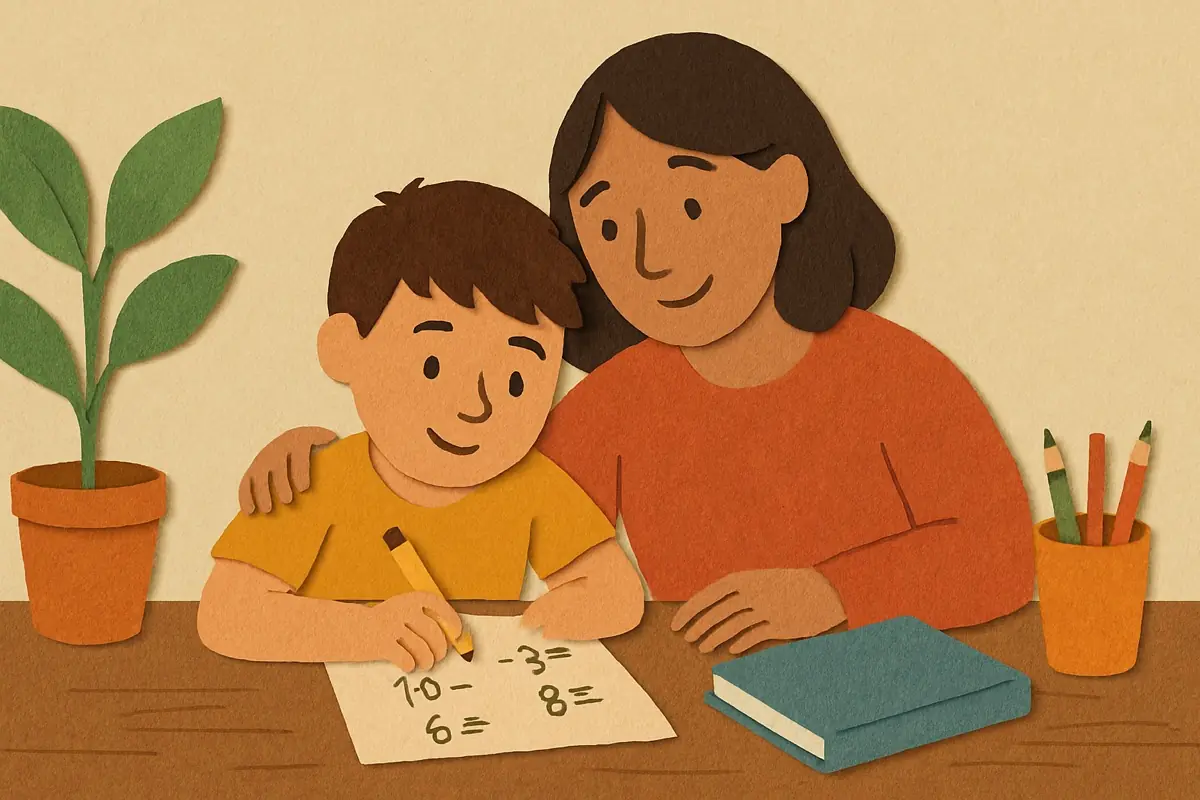
I had a third grader named Marcus who could tell me, out loud and correctly, that six times seven was forty-two. He'd say it in the hallway, at his desk, while packing his backpack. Then I'd hand him a page of multiplication and he'd sit there with a pencil frozen an inch above the paper, breathing shallow, doing nothing. Same kid. Same facts. The paper changed everything.
That's what math anxiety looks like up close. It isn't the same as being behind, and figuring out how to help a child with math anxiety starts with seeing that difference clearly. A kid who's behind needs more practice. A kid who's anxious knows some of it and can't get to it because the fear gets there first. If you treat the second kid like the first one, more worksheets, more drilling, you make the freeze worse, not better.
I've taught elementary school for sixteen years. Here's what actually helps, and what quietly backfires.
First, tell the two problems apart
Before you change anything, watch your child during math for a few days. You're looking for where the wall is.
A behind kid tends to work steadily and get wrong answers. An anxious kid tends to stall before they even start, or rush through so fast they don't read the problem, just to get it over with. Some tells I look for:
- Body stuff: fidgeting, stomachache before math specifically, needing the bathroom the second the page comes out.
- "I don't get it" before they've read a single problem.
- Being fine talking through a problem with you but shutting down the moment it's written and graded.
- Fine at home, panic on a timed test.
Marcus was that last one. He knew forty-two. The clock and the red pen were the problem, not the six and the seven.
Watch your own face
This one's hard to hear, so I'll say it plainly. Kids read us before they read the math. If you sigh, if your voice tightens, if you say "this is easy, just focus," they file math under danger. Not because you're a bad parent. Because you're their weather system and they check it constantly.
The line that does the most damage is a cheerful one: "I was never a math person either." You mean it kindly. What the kid hears is that this is genetic, it's hopeless, and the door is already open. I've watched capable eight-year-olds quit on themselves after a parent said that at conferences, sitting three feet away, meaning well.
So watch your face and your throwaway comments. Neutral and calm beats enthusiastic and tense every single time. You don't have to love math. You just can't perform dread.
Take the clock off it
Almost every math-anxious kid I've met has a story where speed hurt them. A timed test, a "who finishes first," a classmate who called out the answer while they were still thinking. Speed and anxiety are wound together, so the fastest way to lower the fear is to remove the timer.
At home that's simple. No stopwatch. No "you should know this by now." If a problem takes ninety seconds of real thinking, ninety seconds is fine. Understanding shows up before speed does, and speed follows on its own once the kid stops being scared. It almost never works the other way around.
I tell parents to try this exact swap. Instead of "how many can you do in a minute," say "show me how you'd figure this one out." You're asking for the thinking, not the finish line. A kid who's allowed to think stops racing their own heartbeat.
This is also where I get a little grumpy about rewarding sheer volume. Handing out points for grinding through forty problems teaches an anxious kid that math is a treadmill they're always behind on. Tie the good feeling to actually understanding something, to a fact that finally clicked, and the whole mood shifts. We built our little app, Math Prizes, around that idea partly because I watched too many kids get rewarded for speed and punished by their own nerves.
Make mistakes boring
An anxious kid treats a wrong answer like a verdict. Your job is to make it a nothing. Not a celebration, which feels fake and they'll see through it, just a normal, uneventful part of the work.
When my daughter gets one wrong at the kitchen table, I don't wince and I don't cheer. I say "okay, let's see where it went sideways," and we look. Same tone I'd use if she spilled a little water. Wiped up, moving on. Over a few weeks a kid learns that a mistake doesn't cause a storm, and that's when they start being willing to try the hard ones instead of only the safe ones.
A concrete move that helps: work a problem wrong on purpose, out loud, and let them catch you. "Twelve minus five, that's eight, right?" When your kid gets to correct you, they feel like the one who knows things. It flips the whole dynamic from being tested to being the expert, and experts don't panic.
Shrink the task until it's not scary
A full worksheet is a wall. Anxious kids see all thirty problems at once and their brain says nope. So make the visible thing smaller.
Fold the paper so only one row shows. Cover the rest with an index card. Put out three problems, not the packet. The math didn't change, but the mountain did, and a kid who'll refuse thirty problems will often do three without noticing they're doing math at all. Then three more. I've folded a lot of worksheets over the years and it works far better than any pep talk.
If even three is too much on a rough day, do one together, out loud, with you holding the pencil. Getting unstuck matters more than who did the writing. The point is to break the freeze, and the freeze breaks when the task stops looking impossible.
What actually turns it around
The kids who beat math anxiety mostly don't have some breakthrough moment. They just accumulate a stack of small experiences where math happened and nothing bad followed. No timer. No sighing parent. No red-pen verdict. Enough of those in a row and the body stops bracing.
Marcus got there by spring. Not because he learned new facts, he already had them, but because we spent two months making the paper safe. Untimed. Mistakes treated like spilled water. Three problems at a time. By April he was doing full pages and, more to the point, he'd stopped holding his breath when I handed one over.
Go slow, keep your face calm, and let the wins be real ones. That's the whole thing. A scared kid mostly needs to find out, over and over, that the math can't actually hurt them.