How to help a child who is struggling with math
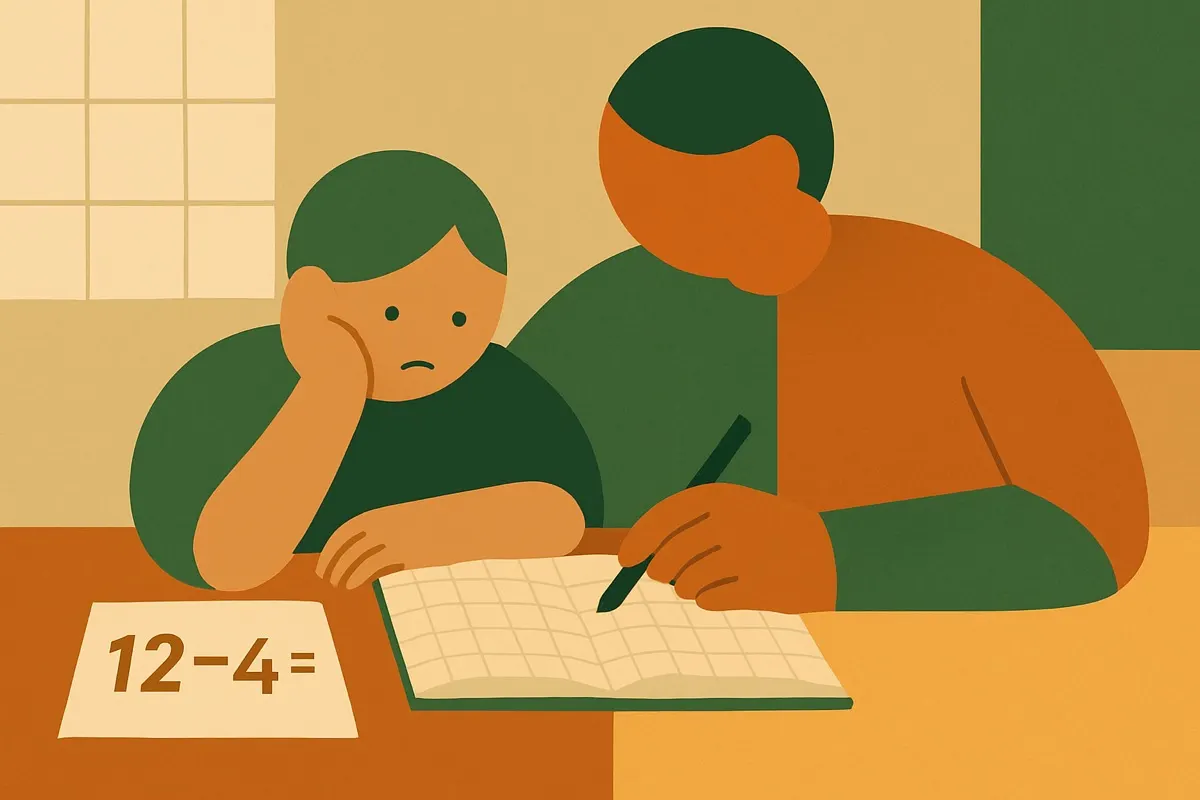
When a kid tells you they are bad at math, they usually believe it. That belief does more damage than any missing skill, because a kid who has decided they cannot do something stops trying, and a kid who stops trying falls further behind, which proves the belief. My job as a teacher is to break that loop. After sixteen years I can tell you the fix is almost never another worksheet like the last one.
Here is the order I work in when a child is struggling. It works at the kitchen table too.
First, find the real gap, not the surface one
The problem your kid is crying over is rarely the actual problem. A fourth grader who cannot do long division usually has shaky multiplication facts. A kid who freezes on word problems often reads fine but does not know which operation the words are asking for. The visible struggle sits on top of an earlier skill that never got solid.
So before you drill the thing on tonight's homework, drop down a level and check the floor under it. Ask a few problems from a year ago. If those are slow or wrong, you have found the real work. Fixing the floor is what makes the ceiling reachable, and it is far less painful than grinding the hard skill over and over on a foundation that will not hold it.
Shrink the problem until they can win
Confidence comes back from success, not from pep talks. A child who has failed at math ten times in a row does not need to be told they are smart. They need to actually get one right, then another, then another, on their own.
So make the next problem small enough that they will get it. If double digit multiplication is a wall, go back to single digit. If that is shaky, go to the facts. Start where they succeed and inch forward. Ten easy wins in a row rebuilds more than one hard win ever will, because it changes the story they tell themselves.
Separate speed from understanding
Being slow at math is not the same as not understanding it, and treating the two the same is how a lot of kids get labeled. A child can understand exactly what multiplication means and still take a while to recall six times seven. That is a fluency problem, and it is fixable with short daily practice. It is not a sign your kid is bad at math.
When you help, notice which one you are looking at. If they can explain it but are slow, they need reps, not reteaching. If they cannot explain it, slow down and rebuild the idea with something they can see or hold before you ask for the answer.
Watch your own face
Kids read us. If you tense up at math, or say things like "I was never a math person either," they hear that math is a scary thing that some people just cannot do, and they file themselves under cannot. You do not have to fake being thrilled about fractions. You do have to stay calm and treat a wrong answer as information, not a verdict.
The single most useful thing you can say when they get one wrong is "okay, show me how you got that." It turns a failure into a puzzle you are solving together, and it tells you exactly where the thinking went sideways.
Give the practice a reason
Here is the honest part. Most kids will not practice a hard, boring thing just because it is good for them. Adults barely do that. What keeps a kid coming back is either the work being genuinely satisfying, or a reward on the outside that they care about, or both.
That is the whole idea behind how we built Math Prizes: the kid earns tickets for correct math, and trades them for something you set at home. The reward is real and it is yours to control, so the practice keeps happening long enough for the skill to actually build. Whether you use an app or a sticker chart or ice cream on Fridays, the principle is the same. A reason gets them to the reps, and the reps are what fix the math.
Know the difference between a gap and a bad week
Not every rough patch is a crisis. Kids have off weeks, hard units, and teachers they click with less. Before you worry, ask whether this is a pattern over a month or a bad Tuesday. If it is a real pattern, act on it early, because gaps in math compound. If it is a bad week, the best thing you can do is stay steady and keep the daily practice small and winnable.
The short version
- Find the earlier skill under the visible struggle, and fix that first.
- Make problems small enough that your kid wins, then build up.
- Tell apart slow (needs reps) from confused (needs reteaching).
- Stay calm. Ask "show me how you got that" instead of correcting.
- Give the practice a reason so the reps actually happen.
Struggling with math is not a personality. It is almost always a specific, findable gap plus a story the kid has started to believe. Fix the gap, change the story, and keep the practice steady. That is the job, and it works.