Fractions on a Number Line: The Model That Ties It All Together
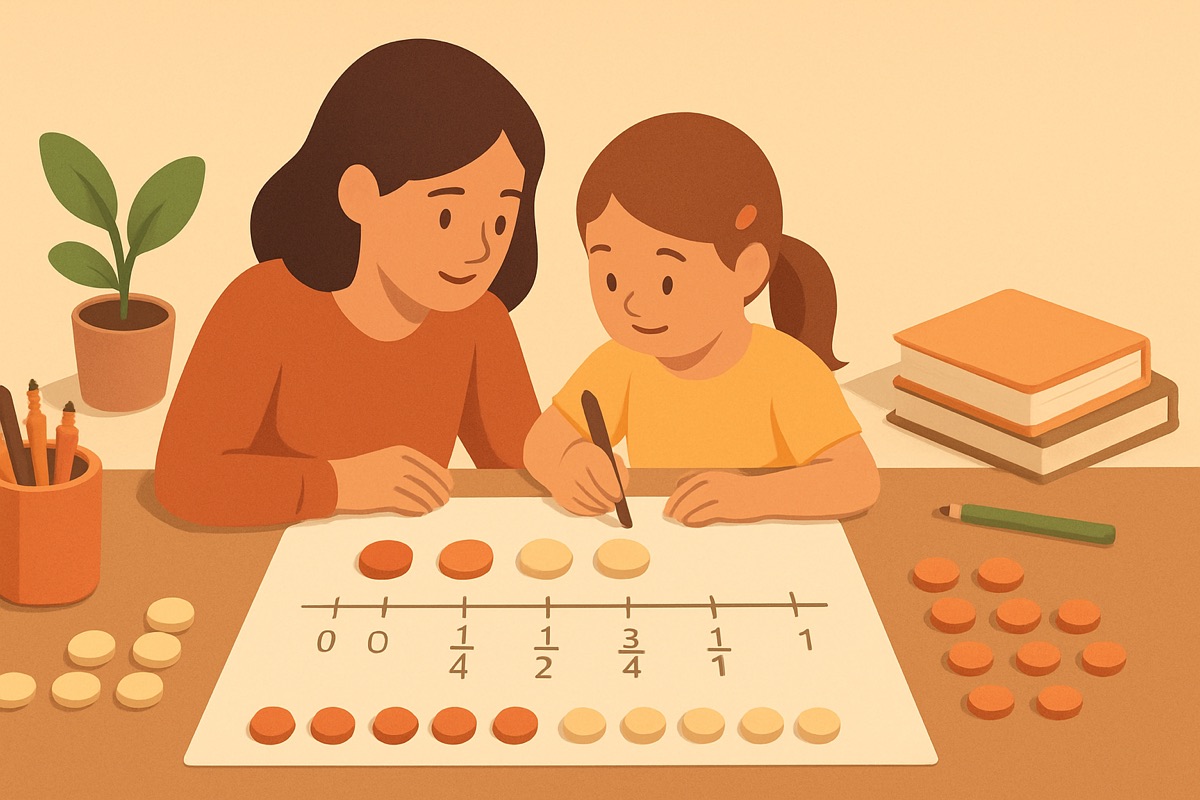
Where pizza runs out
A fourth grader once told me that 1/8 was bigger than 1/4 "because 8 is bigger than 4." She wasn't being lazy. She'd learned fractions entirely as pizza slices, and in that world more pieces sounds like more. The pizza model is a fine start, but it hides the one truth that matters most later: a fraction is a number, and every number has a spot on a line. That's why fractions on a number line is the model I reach for once slices stop pulling their weight.
Here's the plain claim. A number line does something pizza can't. It puts fractions and whole numbers in the same place, in order, on the same ruler. Once a kid sees 3/4 living to the left of 1, and 5/4 sitting past it, a lot of confusion just dries up.
A fraction is a number, not a picture of food
When you cut a pizza, the fraction describes a leftover. When you plot a fraction on a line, the fraction is a location. That shift is the whole point.
Draw a line. Mark 0 and 1. Now the denominator is a simple instruction: it tells you how many equal jumps to split that stretch into. Fourths means four equal jumps from 0 to 1. The numerator tells you how many jumps to take. So 3/4 is "three jumps of a fourth," and you land three-quarters of the way to 1.
Say that out loud with a kid a few times. "The bottom number says how big the jumps are. The top number says how many jumps." Kids who can chant that stop guessing. They also stop thinking the bigger bottom number wins, because they can see that cutting the same stretch into more pieces makes each piece smaller.
Why this model beats slices for the hard stuff
Slices break down the second the numbers get interesting. A number line keeps working.
- Comparing fractions. Put 2/3 and 3/4 on the same line with the same 0 and 1. Whichever one sits farther right is bigger. No common denominators required to see it, and the seeing comes first.
- Fractions bigger than 1. On a pizza, 5/4 makes no sense. You can't eat five of four slices. On a line, you just keep jumping past 1 and land at 5/4, one fourth past a whole. That's how improper fractions and mixed numbers finally connect.
- Equivalent fractions. Mark 1/2. Then split the same stretch into fourths and mark 2/4. Same spot. Kids can see that 1/2 and 2/4 are two names for one location, not two different amounts.
I've watched kids who "hated fractions" relax the moment they realize they're just labeling points on a ruler. A ruler is not scary. They've measured a Lego tower with one.
Building it at the kitchen table
You don't need anything special. A strip of paper and a pencil will do, and honestly a strip of paper is better than a printed line because the kid makes the marks themselves.
Tear a strip about a foot long. Write 0 on the left end and 1 on the right. Ask the kid to fold it in half and open it back up. That crease is 1/2, and they made it, so they believe it. Fold again to get fourths. Now four creases, and you can label 1/4, 2/4, 3/4 together. Ask where 2/4 and 1/2 landed. Same crease. That's equivalence they can touch.
Then push past 1. Tape a second strip on the end and keep the fourths going. Now 5/4, 6/4, 7/4, 8/4 march right along, and 8/4 lands smack on the 2. A kid who folds their way to "8/4 is the same as 2" has understood something a worksheet of shaded circles rarely delivers.
One caution from years of doing this. Make the jumps actually equal. If a kid eyeballs the marks and the fourths come out lopsided, the whole idea leaks away, because unequal jumps quietly teach that fractions are fuzzy. Fold, don't guess. The folding forces the equal parts for you.
Reading a mixed number off the line
Once the line goes past 1, mixed numbers stop being a rule to memorize and start being a description. Point to 7/4. Ask, "How many whole jumps of 1 did we pass?" One. "How far past that 1 are we?" Three fourths. So 7/4 is 1 and 3/4. The kid read it straight off the picture instead of dividing 7 by 4 and hoping.
Go the other way too. Ask them to find 2 and 1/3. They count two whole units, then take one more jump of a third. When converting back and forth is something a kid can see, the conversion rules they'll meet later feel like shortcuts for something they already understand, not magic incantations.
This is the part I care about most. A kid who only memorizes "multiply the whole number by the denominator and add the numerator" can get right answers for a while and still have no idea what a mixed number is. A kid who's walked the line knows exactly what it is, and the procedure is just a faster way to do what they already picture.
The payoff you won't see for a year
The reason I lean so hard on this model is what it sets up down the road. Adding fractions with unlike denominators, plotting fractions and decimals together, even the coordinate plane in later grades, all of it assumes a kid pictures numbers as points on a line. Kids who never build that picture keep treating fractions as a separate, weird species of math, and the gap widens every year.
So spend the extra week on the line before rushing to procedures. Fold the strips. Let the kid mark the jumps and catch their own uneven ones. When they can plop any fraction you name onto a line and tell you roughly where it sits before they calculate anything, you've handed them the model that ties the rest of fractions together. That's the difference between a kid who does fractions and a kid who understands them, and the second kid is the one still fine with fractions in seventh grade.