Fractions Aren't Scary When You Start With a Sandwich
The problem isn't the fraction. It's the symbol.
A second grader hands you a turkey sandwich and asks you to cut it in half so she can share it with her brother. She knows exactly what half means. She'll complain if one piece is clearly bigger. She has a working definition of fair sharing, equal parts, and the whole, and she built it without a single worksheet.
Then she gets to school, sees 1/2 written on the board, and freezes.
That gap is the whole story of how to teach fractions to kids. The idea lives in their hands already. The written form is a code they haven't cracked yet. Most of the trouble I see comes from teaching the code before the idea is solid, so kids memorize rules about a symbol that means nothing to them.
So we start with food.
Cut a real thing in front of them
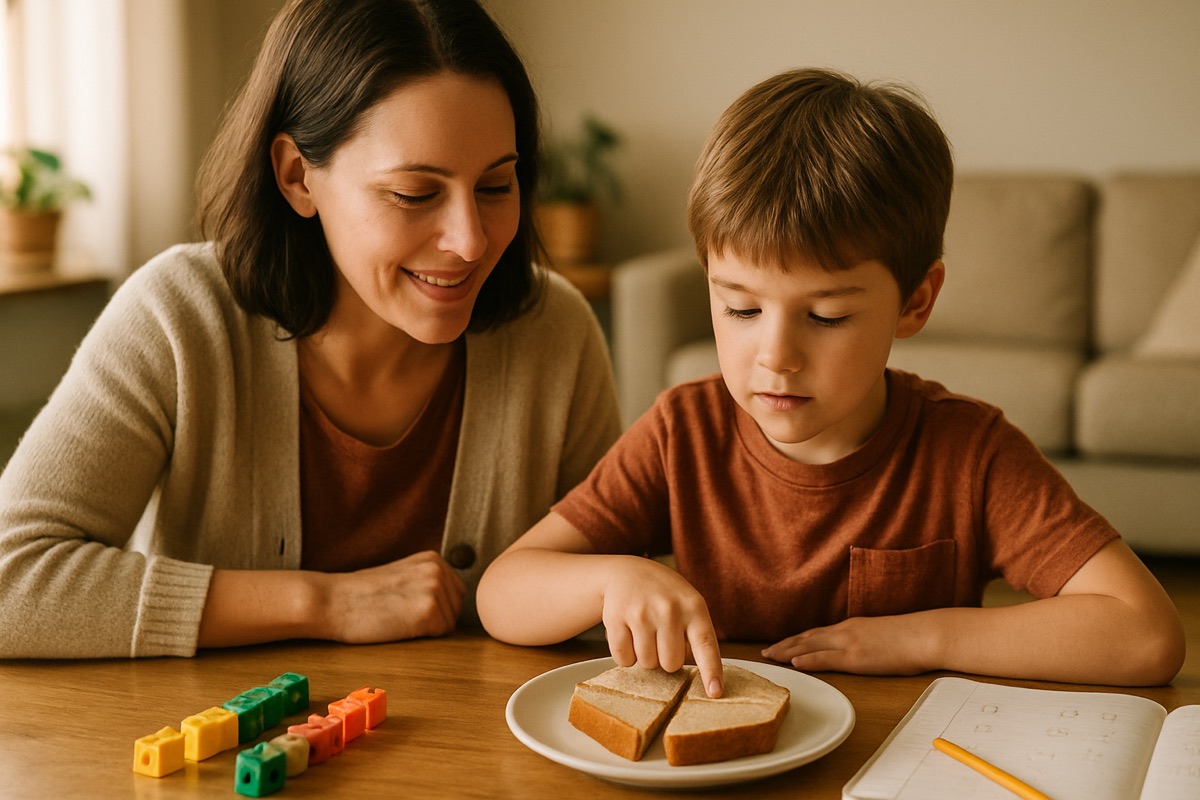
Get an actual sandwich, or a graham cracker, or a quesadilla. Something your kid cares about eating. Cut it in half while they watch.
Then say the two things that matter: the pieces have to be the same size, and there have to be two of them. That's what the bottom number is telling you. Two equal pieces. Cut it into four and now you've got fourths, four equal pieces. The bottom number counts how many equal parts the whole got split into.
Here's the part kids find genuinely surprising. Ask them which is bigger, a half or a fourth. A lot of them say a fourth, because four is bigger than two. Then you hand them one half of the cracker and one fourth of the cracker and let them hold both. The half is obviously bigger. The bigger the bottom number, the smaller the piece, because you're splitting the same thing into more shares. That one contradiction, felt in the hands, does more than a page of practice problems.
The top number is just counting pieces
Once the bottom number makes sense, the top is easy. Cut a candy bar into four equal chunks. Eat one. You ate one out of four, so 1/4. Eat another. Now 2/4 is gone. The top number just counts how many of those equal pieces you're talking about.
I like to narrate it out loud while we go:
- "The whole bar is four fourths. That's the same as one whole bar."
- "You ate two fourths. Half the bar is gone."
- "Two fourths and one half look like the same amount of chocolate."
That last line plants a seed for equivalent fractions later, but I don't name it or push it. I just let them notice that two of the four pieces is the same as half. Kids love catching that on their own.
Move from food to drawings, slowly
The point of the sandwich isn't to eat lunch every time you practice. It's to build the mental picture. Once your kid can talk about halves and fourths with real food, move to drawing.
Draw a rectangle. Tell them it's a chocolate bar. Have them split it into three equal parts and shade one. Now they've drawn 1/3 without you writing a rule. Do a few of these. Let the drawings be a little crooked. The math is in the equal-parts thinking, not the neatness.
A pizza box works great here because it's already a square you can divide a bunch of ways. So does a clock face for halves and quarters, which quietly sets up telling time later. The goal is for your kid to see 3/4 and picture something, a pizza with three of four slices left, before they ever try to do anything with it on paper.
Where parents accidentally make it harder
A few honest traps, because I've watched them happen at kitchen tables:
- Rushing to the written symbol. If your kid can't yet explain what the bottom number means, they're not ready to add fractions. Slow down. There's no prize for speed here.
- Using unequal pieces. If you eyeball a cut and one half is visibly bigger, a sharp kid will call it, and they should. Equal parts is the entire idea. Fold the paper or measure if you have to.
- Treating the top and bottom as two separate numbers. Kids will try to add 1/2 and 1/3 and get 2/5 because they added straight across. That happens when the fraction never became one single amount in their head. More food time fixes this better than more rules.
- Turning it into a drill. Twenty fraction problems in a row teaches a kid that fractions are a chore. Three real problems that they actually understand beat twenty they guessed at.
That last one matters more than people think. A kid who does five problems and gets why each one works is in far better shape than a kid who grinds through a packet on autopilot. Understanding is the thing you're after, not a stack of finished pages.
A ten-minute routine that works
Here's what I'd do a couple of times a week, no prep required.
Grab whatever's around at snack time. Cut it into equal parts together and name the fraction out loud. Ask one "which is bigger" question, like a third versus a fourth, and let them reason it out with the actual pieces. Then draw one quick picture on the back of an envelope and have them shade a fraction you name.
That's it. Ten minutes, no tears, and it sticks because it's tied to something real. If you're using a math app for extra practice, that's fine, but the app should be reinforcing the sandwich, not replacing it. The physical understanding comes first. The screen is a supplement, at most.
My own kid spent a whole spring convinced that 1/8 was more than 1/2 because eight is a big number. The thing that finally fixed it wasn't an explanation from me. It was cutting a brownie into eight tiny slivers and letting her compare one sliver to half the pan. She looked at the sliver, looked at the half, and said "oh, that's barely anything." That was the moment it clicked, and it clicked for good.
Fractions get a bad reputation they don't deserve. Start with something your kid can hold and eat, keep the pieces equal, and let the symbol show up only after the idea is already home. The notation is the last step, not the first.