Printable Math Games for Kids Who Say They Hate Worksheets
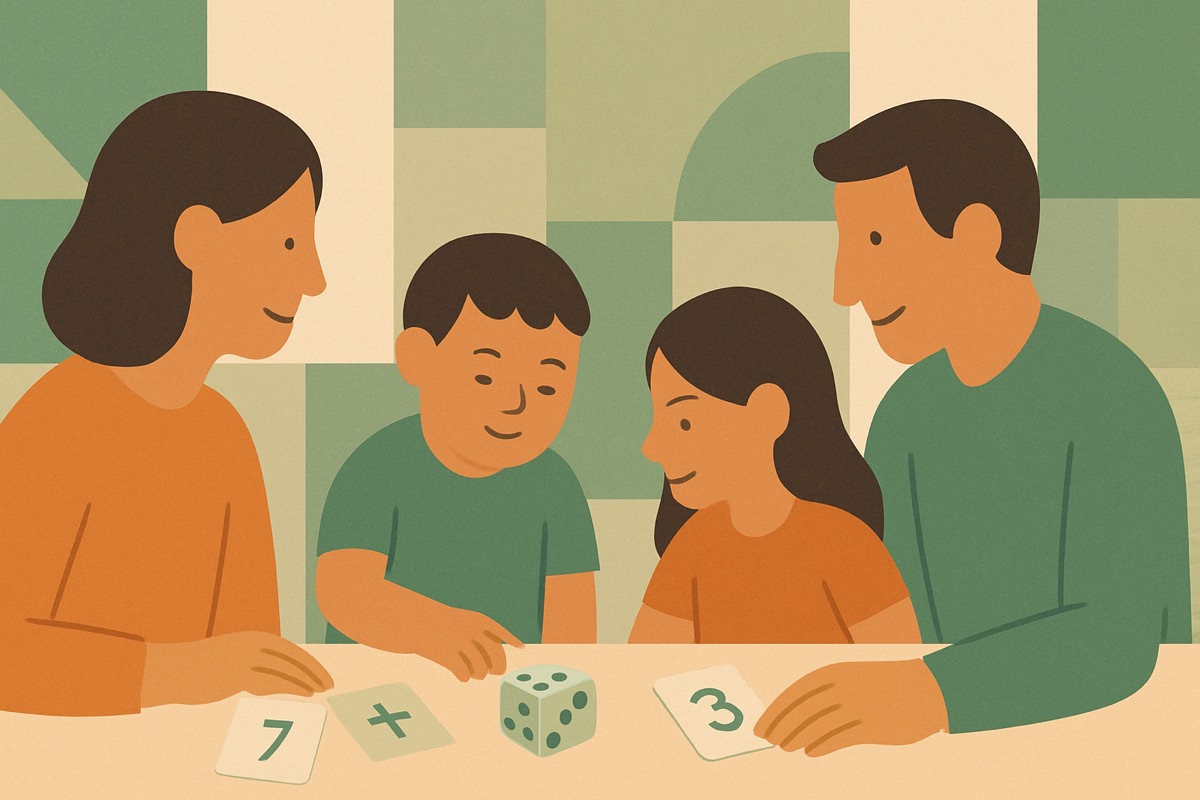
A third grader in my class once slid a worksheet back across the desk and said, flat as a pancake, "I already know this, it's just boring." He was half right. He did know most of it. The boring part was doing thirty of the same problem in a grid. That same kid would happily play twenty rounds of a dice game that used the exact same math, because it had a winner and a little bit of luck. That's the whole idea behind printable math games. Same skill, different packaging, and the packaging matters more than we like to admit.
I lean on printable math games for a specific reason: they cost nothing but ink, they don't need batteries, and I can hand a stack to a parent at conferences and know they'll actually get used. Below are the ones that have earned their place, grouped by what they build. Print them, laminate them if you're ambitious, or just reprint when they get syrup on them.
Why a game beats a worksheet (even the same math)
A worksheet asks a kid to prove they can do something. A game asks them to use it to win. That's a real difference in a child's head.
When there's a game, a wrong answer isn't a red mark, it's a missed chance to score, and they get another turn in ten seconds. Mistakes stop feeling permanent. Kids also self-correct more, because the person across the table is watching and they want to catch their own slip before you do. I've seen a kid who wouldn't attempt a subtraction worksheet cheerfully subtract for half an hour to keep his score ahead of his sister.
The trick is choosing games that need the skill to win, not games with a thin math coat of paint. More on spotting the difference at the end.
Printables for facts and fluency
These are for the drilly stuff that genuinely does need repetition, addition and subtraction facts, times tables, without it feeling like drilling.
- Bump. A classic printable board. Two players roll dice, add (or multiply) them, and cover that number with a chip. Land on a spot your opponent covers and you bump them off. Kids will do a hundred addition facts fighting over one square. Search "addition Bump printable" and you'll find free boards for every operation.
- Multiplication war. Print a simple deck of fact cards, or use a normal deck. Both players flip a card, first to say the product keeps both. It's fast, it's loud, and it builds recall speed the honest way.
- Roll and cover. A printed grid of numbers. Roll, do the operation, cover the answer. First to fill a row wins. Good for the youngest kids because there's almost no setup.
Print two or three of these and rotate them. The same game every night goes stale by Thursday.
Printables for place value and bigger numbers
Once kids move past single digits, the games that help most are the ones that make them build and compare numbers.
- Place value battle. Each player has a printed grid with a hundreds, tens, and ones column. Take turns rolling and deciding which column to write the digit in. Biggest number wins the round. The decision (do I risk putting this 6 in the hundreds?) is where the thinking happens.
- Closest to 100. Draw cards or roll, build a two-digit number, and whoever lands nearest 100 without knowing what's coming wins. It sneaks in estimation, which is a skill worksheets almost never touch.
I like these because the math is inside the strategy. A kid can't win by luck alone, so they have to think about tens and ones whether they mean to or not.
Printables for fractions and money
These two topics live or die on kids seeing them, and printables are perfect for that because you can cut them up.
- Fraction match. Print cards with pictures on some and fractions on others (a circle with three of four parts shaded, and the card that says 3/4). Memory-style matching. Kids who freeze at "three-fourths" on paper handle it fine when they can see the shaded piece.
- Store. Print play money and little price tags. Set up a shop on the kitchen counter with real snacks. Your kid is the cashier and has to make change. My own students learned more about making change in one afternoon of playing store than in a week of change worksheets.
How to tell a real game from a worksheet in a costume
Not everything labeled a "game" is one. Before you print a stack, give it the two-question test.
- Does the kid need the math to win, or is the math just a toll they pay between fun parts? A real math game makes the skill the path to winning. A costume worksheet makes them solve a problem to earn a turn at spinning a wheel, and the wheel is the only part they care about.
- Would they play it twice? If a game is one-and-done, it was probably a worksheet with a border.
The ones I listed all pass, which is why they've survived years of sticky fingers.
One last honest note. A game your kid will actually play beats the "best" game that stays in the printer tray. Start with one from the list, play it with them a couple of times so they know the rules, and let the rest wait. You're not trying to fill an evening with math. You're trying to get ten good minutes where the math happened and nobody groaned. That's a win, and it's more than most worksheets ever get you.