Multiplication Games That Make Times Tables Stick
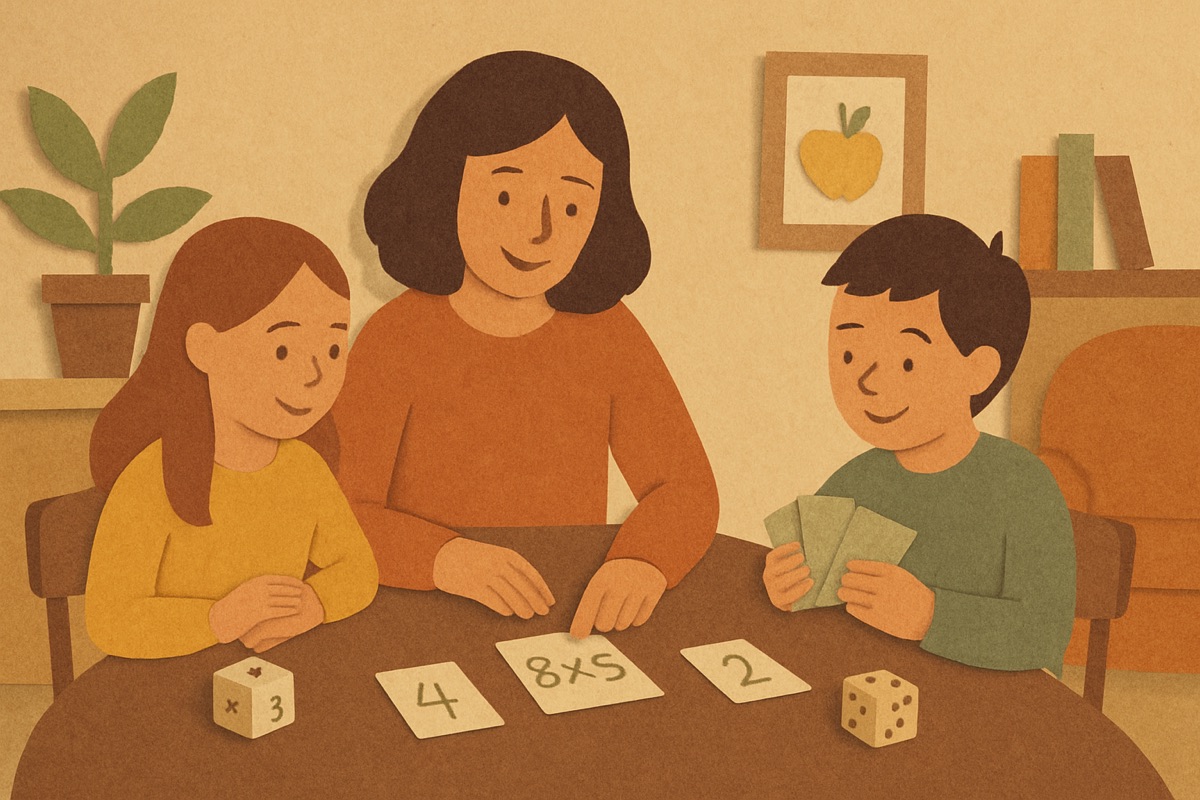
The kid who learned his sixes at recess
I taught a third grader who could not, would not, learn his six times table. We drilled. We flashcarded. Nothing stuck, and he'd started to hate the whole thing. Then one week I taught the class a dice game where you roll two dice and multiply them, and the first person to shout the answer takes the point. Suddenly this kid was fast. By Friday he owned his sixes, because in that game he'd said "six times four is twenty-four" out loud maybe two hundred times, laughing the whole way, never once thinking of it as studying.
That's the whole idea behind good multiplication games for kids. Times tables come down to fast, automatic recall, and recall is built by retrieving the fact over and over. A game just makes the kid want to retrieve it. The trick is picking games that actually make them say the facts, not games that hide the math behind flashy taps.
What makes a multiplication game work
Not every game with numbers on it teaches. I've watched plenty where a kid presses buttons and wins with barely any math happening. Before a game earns a spot at my table, it has to pass a few tests.
- The kid produces the answer, out loud or written, instead of picking from choices. Recall is stronger than recognition.
- It happens fast and often. Lots of small reps beat a few slow ones.
- There's a little pressure or fun to make speed matter, since automatic recall is the goal.
- The math is the game, not a loading screen between the fun parts.
- A wrong answer gets corrected right away, so nothing wrong gets rehearsed.
Judge any game, on a screen or a table, by that list. If a kid can win without saying the facts, it's not teaching multiplication. It's just entertainment wearing a math costume.
Dice and card games that cost almost nothing
You can do most of this with stuff already in a drawer. These are the ones I hand parents most often.
- Multiplication war. Split a deck, each player flips a card, first to say the product of the two cards wins both. Face cards are 10 or drop them. Fast, competitive, and a kid burns through dozens of facts in ten minutes.
- Roll and multiply. Two dice, roll them, multiply, first to shout the answer scores. Use dice with more sides once your kid outgrows the sixes. This is the recess game that fixed my third grader.
- Salute. Three players. Two hold a card to their forehead without looking, the third calls out the product of both. Each cardholder has to figure out their own hidden number from the product and the card they can see. This one sneaks in division too.
- Times table bingo. Fill a grid with products, call out the facts, kids cover the answers. Great for a group and for the facts a kid keeps dodging.
The point of these isn't the game itself. It's the sheer number of times the kid says a fact while having fun. Volume is what turns "let me think" into instant recall.
Screen games, chosen carefully
Apps can work, but this is where you have to be picky, because a lot of them are built to keep a kid tapping rather than to teach. Hold them to the same test. Does the kid actually enter or say the answer? Does progress come from getting facts right, or just from time spent tapping? Is a wrong answer corrected, or does the game just move on so it stays "fun"?
The good ones make a kid recall the fact, respond quickly, and give an honest signal when they're wrong. The weak ones let a kid win by mashing buttons and pretend that counts as practice. If your child can play for ten minutes and come away no better at their sevens, the game isn't teaching, whatever the store description claims. A well-built math app rewards a kid for actually mastering a fact, not for showing up. That distinction is worth more than any feature list. (We built our own kids math app on exactly that principle, and it's the first thing I'd check in anyone else's.)
How to fit it into a normal week
You don't need a study schedule. Five to ten minutes, a few times a week, does more than a long grind on the weekend. Short and often is how recall gets built.
A rhythm that works for a lot of families:
- Pick one table to focus on at a time instead of the whole chart. Nail the sixes, then move on.
- Play one quick game after dinner while you clear the table. Multiplication war fits in the gap perfectly.
- Circle back to old tables so they don't fade. The twos and fives sneak back into war and dice on their own.
- Keep it light. The second it becomes a chore, the speed you're after disappears.
My six-times kid didn't learn his facts because we found the perfect worksheet. He learned them because a game got him to say them a couple hundred times while he was too busy competing to notice. Find the game your kid actually wants to play, then get out of the way. The facts follow.