Equivalent Fractions: Why 1/2 and 2/4 Are the Same Pizza
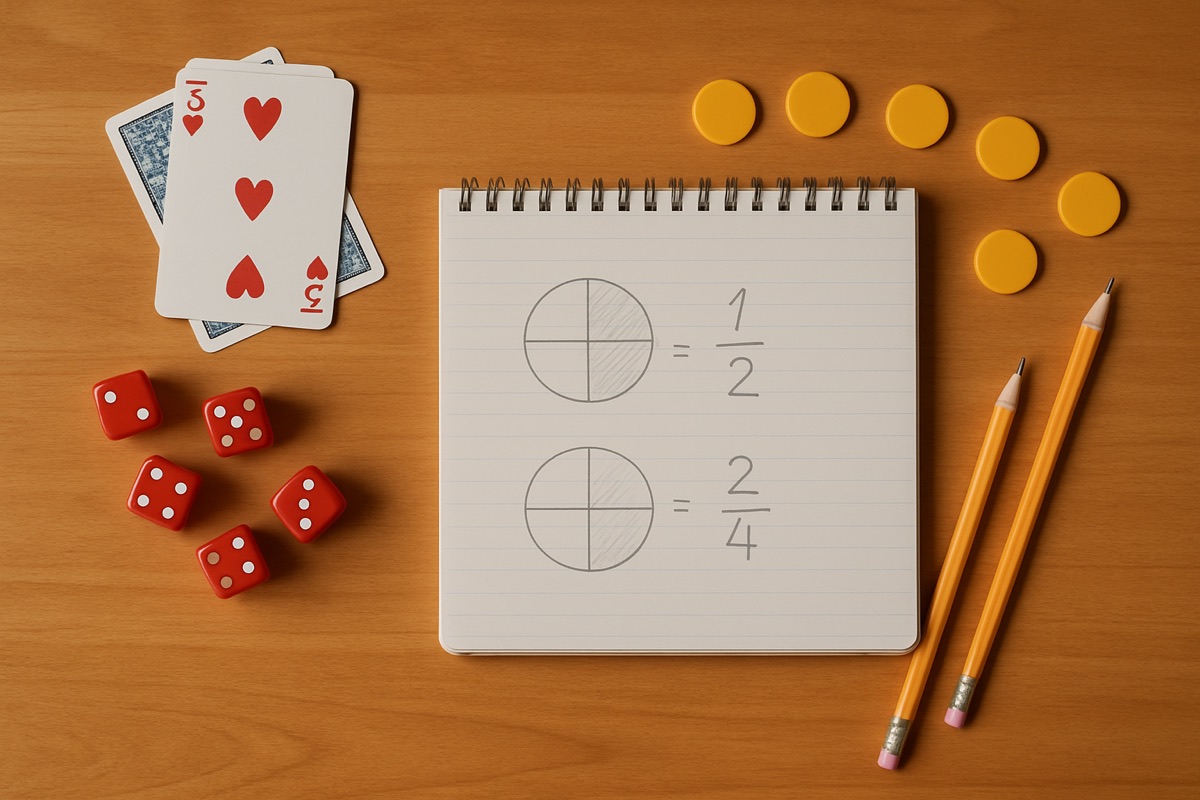
Cut a pizza in half and give a kid one piece. Now take that same pizza, cut both halves in half again so you've got four slices, and give the kid two of them. Ask which deal is better. Every kid I've ever taught says they're the same, and they're right. That's equivalent fractions, and they understood it before I wrote a single number on the board.
The trouble starts when we take that obvious, physical thing and turn it into symbols. Suddenly 1/2 and 2/4 look like different amounts because the numbers are different, and a kid who could split a pizza fairly at age five is now convinced fractions are impossible at age nine. So let me lay out equivalent fractions explained the way it actually clicks, which is almost never the way the worksheet does it.
Same amount, different number of pieces
Here's the one idea underneath everything. An equivalent fraction is the same amount of stuff, just cut into a different number of pieces.
1/2 of a pizza and 2/4 of a pizza are the exact same amount of pizza. You didn't add anything. You didn't take anything away. You just made more cuts, so now it takes more slices to describe the same amount. The pizza on your plate is identical either way.
That's it. That's the whole concept. Kids don't struggle with the idea. They struggle because we jump to the trick before the idea is solid.
The trick that skips the understanding
You probably learned it this way: to make an equivalent fraction, multiply the top and bottom by the same number. So 1/2 times 2/2 gives you 2/4. Done.
The math is correct. The problem is that "multiply top and bottom by the same number" is a rule with no picture attached, and rules with no picture attached are the first thing a kid forgets under pressure. They'll do it fine on Tuesday's worksheet and blank on Friday's quiz, because they never had anything real to fall back on.
I'm not saying skip the rule. The rule is useful and they'll need it. I'm saying the rule should be the last thing you teach, not the first. First they need to see it. Then the rule becomes shorthand for something they already believe, instead of a magic spell they're hoping works.
Show it before you write it
Here are the ways I've watched this actually land with kids, no special materials required:
- Fold paper. Take a rectangle of paper, fold it in half, color one side. That's 1/2. Now fold the whole thing in half again the other way and open it up. The colored part hasn't changed, but now it's 2 out of 4 boxes. Same shaded area, new numbers. This one hits hardest because they do it with their own hands.
- The chocolate bar. A bar scored into 12 little squares is a gift for this. Six squares is half. Three squares is a quarter. Ask how many squares make two thirds. Real object, real answer, no abstraction.
- A ruler or measuring cup. Point out that 1/2 cup and 2/4 cup sit at the same line. Cooking is full of this, and kids trust a measuring cup in a way they don't trust a worksheet.
- Money. Two quarters is 2/4 of a dollar. One half dollar is 1/2. Same fifty cents. Kids and money go together, use it.
Notice the pattern. In every one of these, the amount stays put and only the count of pieces changes. Do three or four of these before you ever write "multiply top and bottom" on paper.
Where kids get tangled
A few predictable snags, so you can head them off:
They think a bigger bottom number means a bigger fraction. It's a reasonable guess, because with whole numbers bigger usually is more. But 2/4 has bigger numbers than 1/2 and it's the exact same amount. Point back to the pizza every time this comes up. More slices doesn't mean more pizza.
They multiply the top and bottom by different numbers. A kid turns 1/2 into 2/3 and doesn't see the problem. Go back to folding. If you cut the top piece one way and the bottom a different way, you've changed the actual amount, and it isn't the same pizza anymore. The "same number top and bottom" rule exists precisely to keep the amount from changing.
They can generate equivalent fractions but can't tell if two random ones are equal. That's a sign they've got the procedure without the meaning. Hand them the chocolate bar again and ask them to prove it with the squares.
Practice that's worth doing
Once the picture is solid, they do need repetition to make it automatic. But repetition should mean varied, thinking practice, not fifty near-identical problems that turn into autopilot. Have them find three different ways to write one half. Have them beat you in a game where you both build equal fractions from a deck. When we made Math Prizes for our own kids, we tied the rewards to real progress instead of sheer volume for exactly this reason, because a kid grinding through a worksheet stops thinking around problem number ten.
The goal was never to make fractions memorized. It was to make them obvious. And they are obvious, as long as a kid can still see the pizza behind the numbers. Keep pointing back to it, and 1/2 and 2/4 stop looking like a trick and start looking like what they always were: the same lunch, cut two different ways.