Dice Math Games That Sneak In Real Practice (Grades 1 to 5)
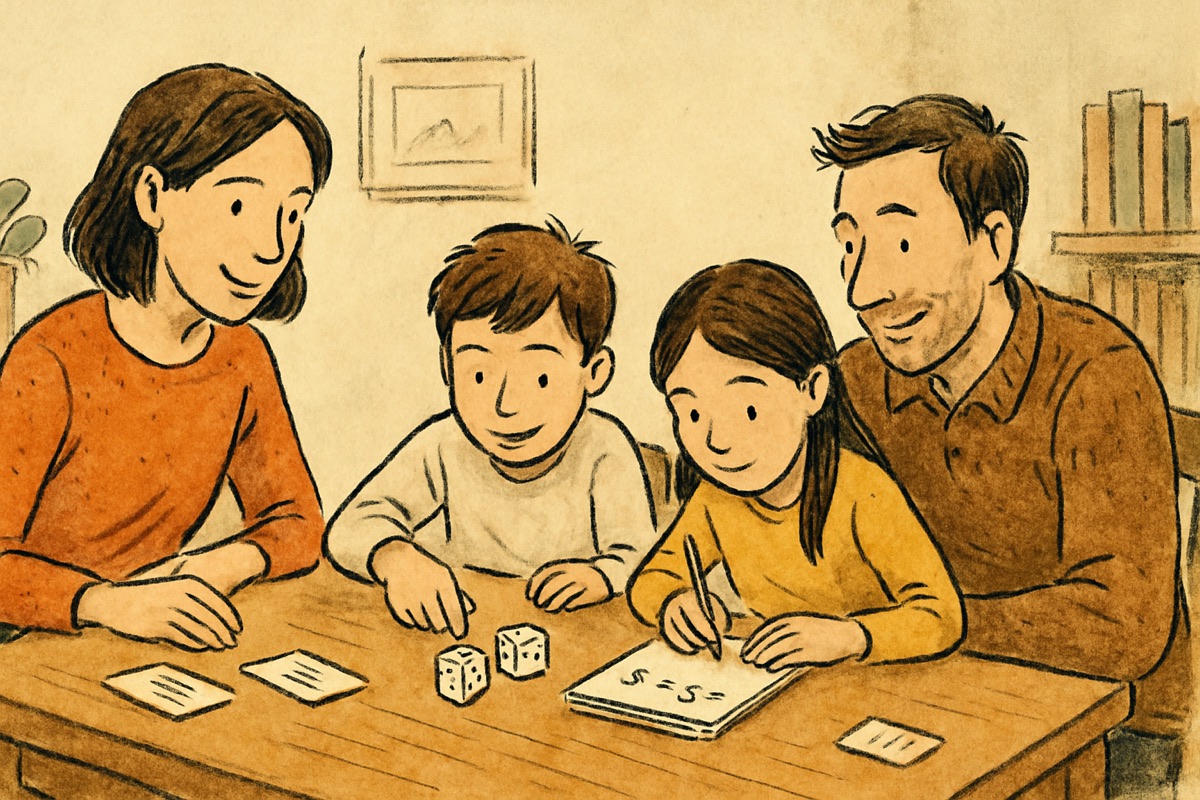
I keep a coffee mug full of dice on my desk at school. Some are the fat foam kind, a few are the little ones you fish out of a Yahtzee box, and there's one giant twelve-sided die a student gave me that I have never once used correctly. Kids reach for that mug like it's candy. And most of the time, they don't notice they're doing math while they roll.
That's the whole reason I love math games with dice. A worksheet announces itself. Dice don't. A kid who groans at ten addition problems will happily roll and add forty numbers to win a silly race to twenty. The math is identical. The feeling isn't, and the feeling is what decides whether your kid shows up to the table tomorrow.
Below are the games I actually use, sorted roughly by grade. You don't need anything fancy. Two regular six-sided dice cover most of it. If you want to go bigger, a ten-sided die (the kind from a role-playing game set) opens up a lot, but plain dice are plenty.
Grades 1 and 2: build the number sense first
Little kids need repetition, but not the mindless kind. They need to see the same small numbers over and over until adding six and three stops being a calculation and starts being a fact they just know. Dice are perfect for that because the dots give them something to count when they're stuck, and then they slowly stop needing to count.
- Race to 20. Take turns rolling one die and adding the number to your running total. First to hit exactly 20 wins. If your roll would push you over, you lose the turn. That "exactly" rule is where the real thinking happens. A kid sitting on 17 has to figure out they need a 3, not a 6.
- Roll and cover. Draw a grid of numbers from 2 to 12 on scrap paper. Roll two dice, add them, cross off that number. First to cross off their whole grid wins. Kids figure out fast that 7 comes up all the time and 12 almost never, which is their first tiny taste of probability.
- Doubles bonus. Roll two dice and add. If you roll doubles, you get to roll again and add that too. Pure addition practice with a jackpot feeling baked in.
I had a first grader last year named Marcus who counted every single dot, every time, well into the spring. His mom was worried. I told her to just keep rolling. By May he was calling out "nine" before the dice stopped moving. Nobody drilled him. He just saw four plus five enough times.
Grade 3: get into place value and bigger sums
Third grade is where addition stretches past the single digits and place value starts to matter for real. Dice games make the tens and ones concrete instead of abstract.
- Build the biggest number. Roll three dice one at a time. After each roll, you decide whether it's the hundreds, tens, or ones digit before you know your next roll. Whoever builds the biggest three-digit number wins the round. This one is sneaky good, because kids have to reason about place value under uncertainty. Do you put that 6 in the hundreds spot and hope for a big finish, or play it safe?
- Target 100. Each player rolls two dice, reads them as a two-digit number (a 4 and a 5 can be 45 or 54, your choice), and adds it to their total. First to reach or pass 100 wins. It's a lot of two-digit addition without a single worksheet, and the "which order" choice keeps their brain on.
Grade 4: multiplication that actually sticks
By fourth grade the pressure is on to know the times tables cold. Rolling for it beats flash cards for a lot of kids, mine included, because there's a stake attached to every product.
- Multiplication war. Split a pile of dice, or just take turns. Each player rolls two dice and multiplies them. Higher product takes the point. Simple, fast, and it hits the exact facts kids fumble. My own daughter kept losing on 7 times 8, so guess which one she finally memorized.
- Ladder to 500. Roll three dice. Multiply the first two, then add the third. Keep a running total across turns, first to 500 wins. It quietly mixes multiplication and addition and forces a little order-of-operations thinking before that's even a formal topic.
A quick honest note on multiplication. Games are wonderful for practice, but a kid needs to understand that 4 times 3 means four groups of three before speed matters. If your child is still shaky on what multiplication even is, slow down and build that first. The dice will still be there next week. Rewards and races are great for cementing a skill your kid already sort of has. They're lousy for teaching one from scratch, and piling on speed drills before the understanding is there just teaches kids to feel dumb fast.
Grade 5: fractions, negatives, and a little strategy
Fifth grade math gets slippery, and this is where a lot of kids decide they're "not math people." A game can carry them past a scary topic before they've had time to be scared of it.
- Dice fractions. Roll two dice. The smaller number is the numerator, the bigger is the denominator. Now compare with your opponent's fraction. Whoever rolled the larger fraction wins the point. Comparing fractions is genuinely hard, and doing it fifteen times in a card game beats doing it three times on homework and calling it a night.
- Above and below zero. Assign one die color as positive and one as negative. Roll both, combine them, and track your running total as it dips below zero and climbs back. It makes negative numbers feel like a normal part of a number line instead of a trick.
- Closest to a target. Pick a target number, say 30. Roll four dice and combine them with any operations you want to get as close to 30 as possible. This is my favorite for older kids because there's no single right answer, just a better and worse one, and they argue about it in a good way.
How to keep it real and not turn it into a chore
The fastest way to ruin a dice game is to treat it like a test. A few things I've learned the hard way, at school and at my own kitchen table:
- Keep it short. Ten minutes of dice beats thirty minutes of anybody watching the clock. Stop while they still want one more round.
- Let them roll for you sometimes. Kids love being in charge of the dice, and it keeps a slow player from stalling the whole game.
- Say the math out loud yourself. When it's your turn, mutter "okay, six and five, that's eleven" so they hear the thinking, not just the answer.
- Don't correct every mistake instantly. If your kid says four times six is twenty-two, roll your own dice and let the game keep moving. Half the time they catch it themselves a minute later.
We built a little math app for our own kids partly because we couldn't always sit down with dice every night, and the same idea drives it. Practice a real skill, get a real reward, skip the busywork. But you don't need an app or anything else to start tonight. You need two dice and one kid who's willing to play, and honestly, the willing part is easier than most parents expect once the worksheet vibe is gone.
Go dig a couple of dice out of some board game in the closet. That's the whole setup.