10 Kitchen Table Math Games You Can Play With One Deck of Cards
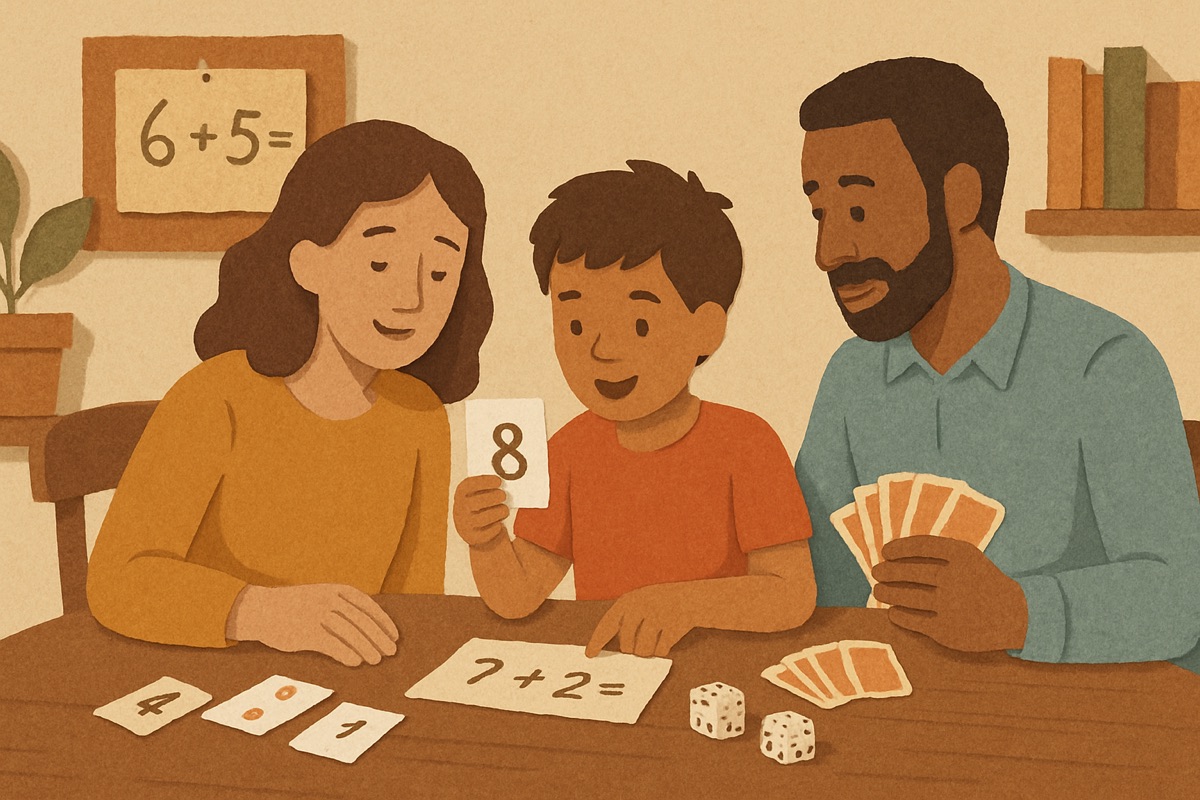
The best math tool in my classroom cost a dollar. It's a beat-up deck of playing cards I bought at a drugstore years ago, and I've watched it do more for kids' number sense than half the worksheets I've copied. When people ask me for math games with cards for kids, I always start there, because a deck is cheap, it fits in a pocket, and nobody at the table feels like they're doing homework.
I promised ten good games instead of a padded list of thin ones, so that's what you get. Every one of these builds a real skill, and I've noted which. Pull the face cards or keep them, your call. I usually let the Jack be 11, Queen 12, King 13, and Ace 1, but for younger kids I take the face cards out entirely so the deck only goes up to ten.
Quick games for younger kids
These are the ones I reach for with kindergarten through second grade. Short rounds, fast wins, no reading required.
War (Compare). Split the deck in two. Each player flips one card. Higher card wins the pair. Ties trigger a "war" where you each lay down three face-down cards and flip a fourth to break it. Builds: comparing numbers, greater-than and less-than. I had a first grader who could not tell me whether 8 or 6 was bigger on a worksheet, but she never once lost track during War. The cards made it real.
Addition War. Same as War, but each player flips two cards and adds them. Higher sum takes all four. Builds: addition fluency to 20. This is the single game I recommend most. It sneaks in dozens of addition problems and the kid thinks they're just trying to beat you.
Ten Pairs (Memory Match for tens). Lay ten or twelve cards face up. Take turns grabbing two cards that add to ten (a 6 and a 4, a 7 and a 3). Keep the pairs you find. Builds: number bonds to ten, the foundation for everything later. Knowing your tens combos cold is what makes bigger addition and subtraction click, so this one is worth playing a lot.
Close to Ten. Deal each player three cards. Add or arrange them to get a total as close to ten as you can without a calculator. Closest to ten wins the round. Builds: mental addition and estimation.
Games with a little more bite
Second through fourth grade territory. Still fast, but there's a decision to make each turn, which is where the real thinking lives.
Multiplication War. Flip two cards, multiply them, higher product wins. Builds: multiplication facts. Once your kid knows their tables halfway decently, this is how you get them to the part where the facts come out without a pause. Face cards make it harder, so add them back in when they're ready.
Salute. This one needs three people and it's my class favorite. Two players each hold a card to their forehead, facing out, without looking at it. The third person, the caller, says the sum (for addition) or the product (for multiplication) of the two cards. Each player figures out their own card by using the total and the card they can see on the other person's forehead. Builds: the link between addition and subtraction, or multiplication and division. It looks silly and it teaches inverse operations better than any lesson I've written.
21 (Blackjack, no betting). Deal two cards each. Face cards count as ten, Ace as 1 or 11. Take more cards trying to get close to 21 without going over. Builds: adding under pressure and simple probability sense. Kids naturally start asking "what are the odds the next card busts me," which is real reasoning, not a worksheet prompt.
Make the Target. Flip four cards into the middle and pick a target number (say 24). Players race to combine the four cards with any operations to hit the target. For example, 6, 2, 3, and 4 can make 24 as 6 × 4 × (3 − 2) = 24, using each card once. Builds: flexible thinking, order of operations, mental math. This is the game that separates kids who memorize from kids who actually understand, and the good news is the second kind is made, not born.
A few for older kids and mixed ages
Fourth grade and up, or a table with a range of ages where you want everyone in the same game.
Fraction War. Each player flips two cards. The first is the numerator, the second the denominator. Whoever has the larger fraction wins. Builds: comparing fractions, which is one of the hardest jumps in elementary math. Watching a kid realize that 3 over 4 beats 5 over 8 without cross-multiplying, just by feeling the size of it, is the whole point. A quiet win.
Integer War (Red and Black). Black cards are positive, red cards are negative. Flip one each, higher value wins, so a black 5 beats a red 9. To make it harder, flip two and add them, so a red 6 and a black 4 gives you negative 2. Builds: positive and negative numbers, which trips up so many kids in middle school. Getting the feel for negatives early, with something physical in their hands, saves a lot of pain later.
How to actually run these at home
A few things I've learned from doing this with hundreds of kids and my own two at the kitchen table.
Keep the rounds short. Five or ten minutes beats a forty minute grind every time, because memory is built by coming back often, not by one long slog. Stop while they still want one more round. That's the trick to getting a tomorrow.
Play a little worse than you can. Not so obviously that they notice, but a kid who wins around half the time stays in the game. A kid who loses every hand quits, and a kid who wins every hand gets bored. You're aiming for close.
Let them do the math out loud, and don't rush to correct. If your kid says "7 plus 6 is 12," wait a beat. Half the time they catch it themselves, and that self-correction is worth more than you jumping in. When they are genuinely stuck, don't just hand over the answer. Show them how to build it from something they know. "You know 6 plus 6 is 12, so 7 plus 6 is just one more."
Don't turn it into a test. The moment you pull out a stopwatch and start tracking a score against last time, some kids tense up and blank on facts they actually know. The value here is that it doesn't feel like the worksheet. Protect that.
If your kid needs an extra nudge to sit down, tie the practice to something small and real that they care about, and tie it to actual effort and progress rather than just clocking minutes. That's the whole idea behind the ticket system we built into Math Prizes for our own kids: the reward is a reason to show up, not the lesson itself. A deck of cards does the teaching either way.
That's ten games from one dollar deck. Start with Addition War tonight, add Salute when you've got a third player, and work your way up. You'll be surprised how much math a kid will do when it looks like a card game.