Converting Fractions, Decimals, and Percents: One Idea, Three Costumes
Three grades, three subjects, one number
In this illustrative example, a parent and child compare half a cookie written as 1/2, 0.5, and 50%. These are three ways to describe the same amount. Place the three labels beside the same half-cookie drawing so the child can check what stays the same when the notation changes.
A fraction, a decimal, and a percent can describe the same amount. Half a cookie is half a cookie whether you call it 1/2, 0.5, or 50%. Use that shared amount to check the conversions, rather than treating each notation as an unrelated rule.
Start with the one that means "out of 100"
Percent gives a useful anchor: the word means "per hundred." So 50% is 50 out of 100, and 7% is 7 out of 100. Phone batteries and game health bars can provide familiar examples. Ask what 20% of a full battery means before connecting it to 20 out of 100.
That "out of 100" idea is the bridge to everything else. A percent is just a fraction with a hidden denominator of 100. So 50% is 50/100, which a kid can simplify to 1/2. And 50/100 written as a decimal is 0.50, which is 0.5. Three costumes, one kid, one amount. Draw a hundred-square grid and shade 50 of the cells. That shaded region is 50%, 50/100, 1/2, and 0.5 all at once, and it's sitting right there on the page not budging.
The two moves that do most of the work
You don't need a chart of a dozen rules. You need two moves, and their reverses.
- Decimal to percent: slide the decimal point two places right, or just multiply by 100. 0.5 becomes 50%. 0.07 becomes 7%. 1.25 becomes 125%.
- Percent to decimal: slide two places left, or divide by 100. 50% becomes 0.5. 8% becomes 0.08.
- Fraction to decimal: divide the top by the bottom. 1/4 is 1 divided by 4, which is 0.25.
- Decimal to fraction: read the decimal out loud and write what you say. 0.25 is "twenty-five hundredths," so 25/100, which simplifies to 1/4.
Reading a decimal by its place value helps identify its denominator. Both "point seven" and "seven tenths" name 0.7; "seven tenths" also tells you to write 7/10. For 0.25, "twenty-five hundredths" gives 25/100, which simplifies to 1/4.
Why "of 100" beats memorizing a table
A conversion table can show familiar equivalents: 1/2 equals 0.5 equals 50%, and 1/4 equals 0.25 equals 25%. Pair it with an explanation of each conversion, then try an amount not on the table, such as 3/8, 0.6%, or 137%.
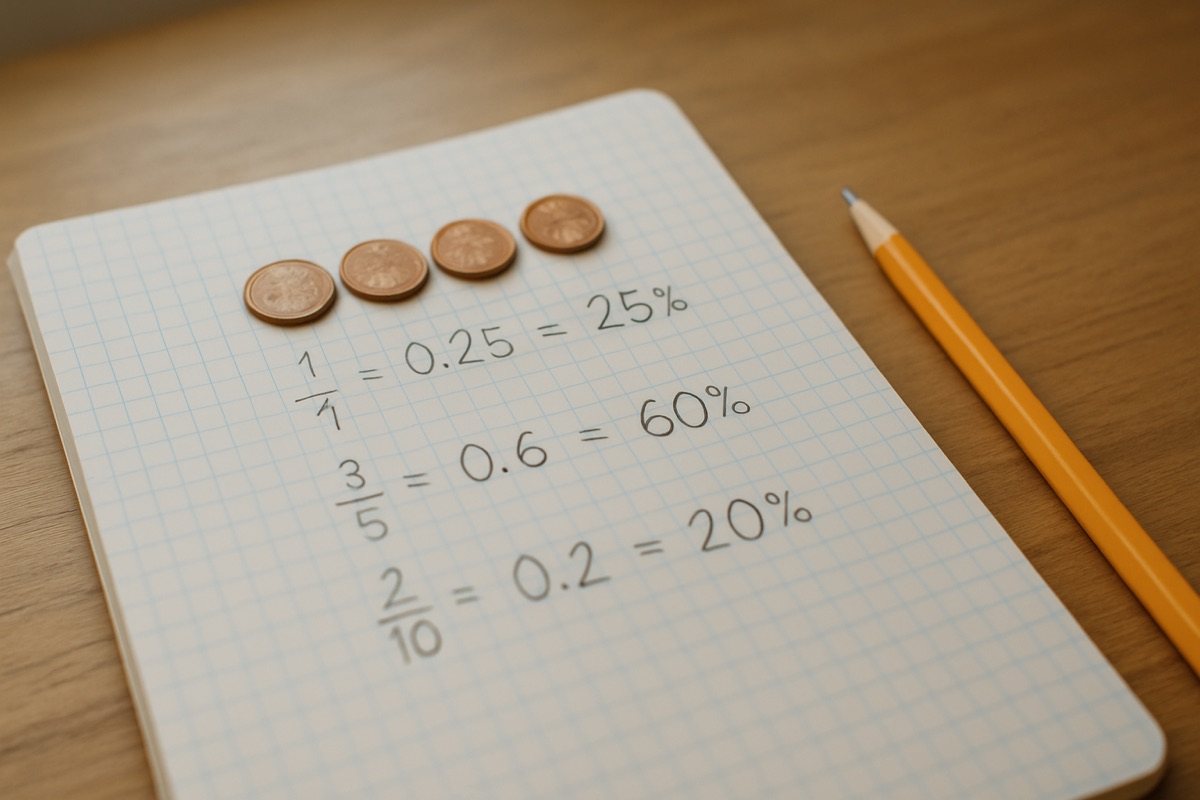
Use the "out of 100" idea with a new example: ask what 3/5 is as a percent. Since 5 times 20 is 100, multiply both the numerator and denominator by 20 to get 60/100, or 60%. Ask your child to explain why multiplying both parts by the same number preserves the amount. A conversion table can then help check the answer.
Try a home example: a jacket is 25% off. Since 25% is a quarter, a quarter off leaves three quarters of the original price. Ask your child to show that relationship using the grid or a drawing.
Build it once, at the table
Grab a piece of paper and draw a 10 by 10 grid, a hundred cells. This one drawing carries the whole idea, so make it together and keep it.
Shade 25 cells. Ask your kid three questions about the same shading. How many out of a hundred? Twenty-five, so 25%. What fraction of the whole grid? 25/100, which is 1/4. And as a decimal? 0.25. Same shaded corner, three answers. Then shade a different amount and run it again. Use the same drawing to compare the single amount underneath the three names; pause or try a smaller step if a question is unclear.
Then take it off the page. Money is the best real hundred-grid there is, because a dollar is literally 100 cents. A quarter is 25 cents, 25% of a dollar, 1/4 of a dollar, 0.25 dollars. Three costumes on a coin they can hold. Ask what half a dollar is in all three outfits. Ask them to explain how each notation describes the same amount.
Keep the idea, drop the drilling
If conversion practice is still confusing, use the hundred-grid or coins to check the underlying idea. Ask your child to show why 1/2, 0.5, and 50% describe one amount before trying another conversion. Their explanation can help you choose which step to practice next.
Try one more check with 0.75: can your child show the same amount as 3/4 and 75%, then explain the connection? If not, return to the grid and compare the shaded parts. Use another amount to check the same connection.