Comparing Fractions: The Trick of Thinking About Missing Pieces
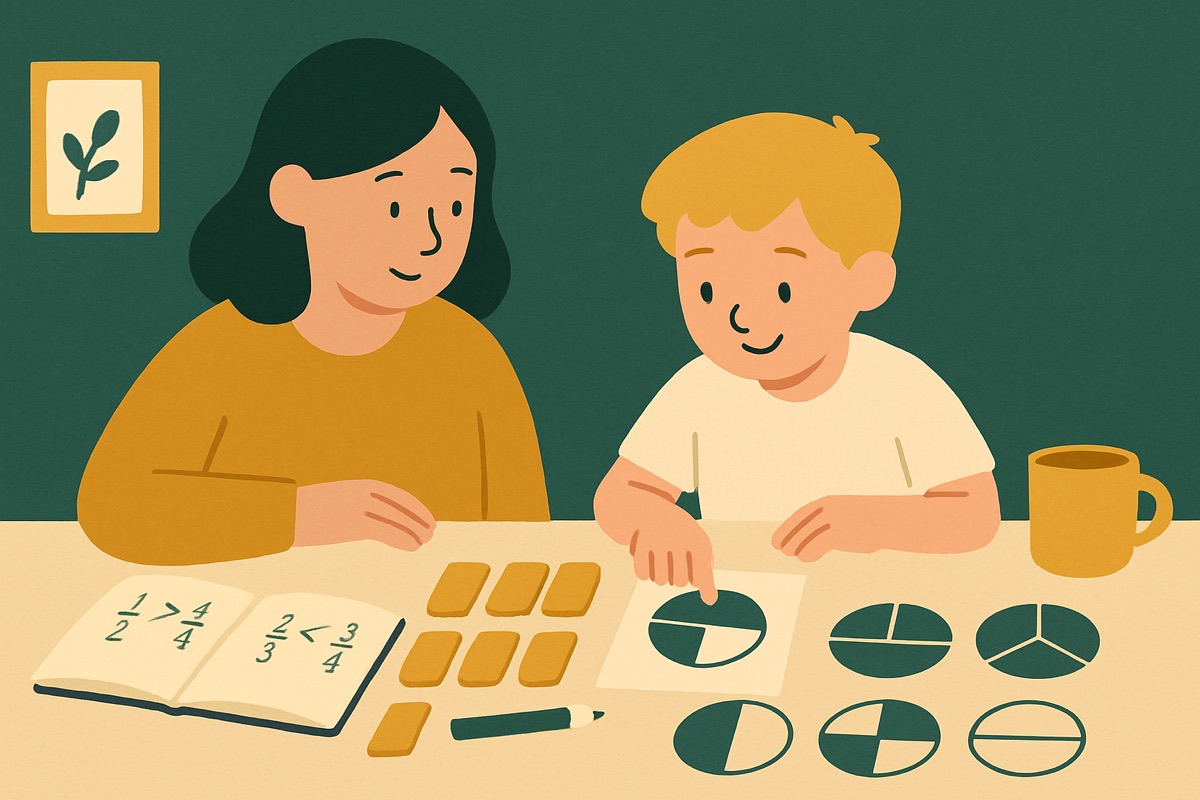
Ask a fourth grader which is bigger, 5/6 or 7/8, and watch what happens. If they've been taught to cross-multiply, they'll start drawing little X's and doing 5 times 8 and 6 times 7 and comparing 40 to 42, and half the time they'll mess up which product goes with which fraction. They get the right answer by luck as often as by understanding.
There's a faster way, and it's the kind of thing that makes kids go "oh, that's it?" The best comparing fractions strategies aren't tricks you memorize. They're ways of actually seeing the fractions, and the sharpest one is thinking about the missing pieces.
The missing piece move
Back to 5/6 versus 7/8. Instead of looking at the pieces you have, look at the piece you're missing.
5/6 is missing 1/6. It's one small slice short of a whole.
7/8 is missing 1/8. It's one even smaller slice short of a whole.
Now the question is simple. Which is a bigger gap, 1/6 or 1/8? A sixth is bigger than an eighth, because sixths come from cutting the whole into fewer, bigger pieces. So 5/6 is missing a bigger chunk. That means 5/6 is further from being whole, so 7/8 is the bigger fraction.
No cross-multiplying. No common denominators. Just "which one is closer to full." Kids get this because they've all had the experience of a cookie that's almost gone versus one that's mostly there.
I taught this to a group who'd been fighting cross-multiplication for weeks, and one boy said "so I just check who's missing less." Yes. That's exactly it. That's the whole move for fractions that are close to one.
When both are near a half
The missing-piece idea is one tool. The other big one is comparing both fractions to a benchmark you already know, usually one half.
Take 3/8 and 5/9. Is 3/8 more or less than half? Half of 8 is 4, and 3 is less than 4, so 3/8 is under a half. Is 5/9 more or less than half? Half of 9 is 4 and a half, and 5 is more than that, so 5/9 is over a half. Done. 5/9 is bigger, because one's above the halfway line and one's below it. You never had to find a common denominator at all.
This works because kids get half in their bones long before they get anything else about fractions. Half a sandwich, half an hour, half the class. Once they can quickly place a fraction as "less than half," "about half," or "more than half," a lot of comparisons answer themselves.
The strategies worth having in your pocket
Here's the short menu I want a kid to be able to reach for, roughly in order of how often they help:
- Same denominator? Then just compare the top numbers. 3/8 versus 5/8 is easy, more eighths wins.
- Same numerator? Then the one with the smaller denominator is bigger, because it's cut into fewer, larger pieces. 2/3 beats 2/7.
- Both close to a whole? Compare the missing pieces. Whoever's missing less is bigger.
- One above half, one below? The one above half wins, no other work needed.
- None of the above? Now find a common denominator or cross-multiply. This is the fallback, not the first move.
The point is that cross-multiplying should be the last resort, not the default. Most fraction comparisons a kid meets in elementary school can be solved by looking, if they've built the habit of looking.
Make it real before it's on paper
None of this lands if fractions are just symbols to your kid. Before the strategies mean anything, they have to feel that 1/6 is a bigger piece than 1/8. That's backwards from how numbers usually work, and it trips kids up constantly. Bigger bottom number, smaller piece.
Cut something. Genuinely. Take a strip of paper or a tortilla and fold one into sixths and one into eighths, then tear off a single piece of each and set them side by side. The sixth piece is visibly chunkier. Once a kid has held those two pieces, "which is missing more" stops being abstract. They can picture the gap.
We used graham crackers for this in class, mostly because the segments break cleanly and nobody minds eating the evidence afterward. A kid who has physically snapped a cracker into fourths and eighths does not forget that fourths are bigger. It's in their hands now, not just their notes.
Let them explain it back
The real test of whether a strategy stuck is whether your kid can say why, not just get the answer. After they tell you 7/8 is bigger than 5/6, ask "how'd you know?" If the answer is "because it's missing a smaller piece," you're done, they own it. If the answer is "I don't know, it just is," there's more work to do, and that's fine.
I ask my students to argue for their answer out loud. Not because I doubt them, but because a kid who can explain that 5/9 is more than half and 3/8 is less than half has understanding you can't fake and they can't forget. The explanation is the learning.
Fractions get a scary reputation, and a lot of that comes from teaching them as a pile of procedures. But comparing them is one of the places where a good picture in the head beats any procedure on paper. Once a kid can look at two fractions and think about the pieces that aren't there, they stop dreading the question and start kind of enjoying it. That shift is the goal.