You're Bad at Math and Terrified of Passing It On: Here's How Not To
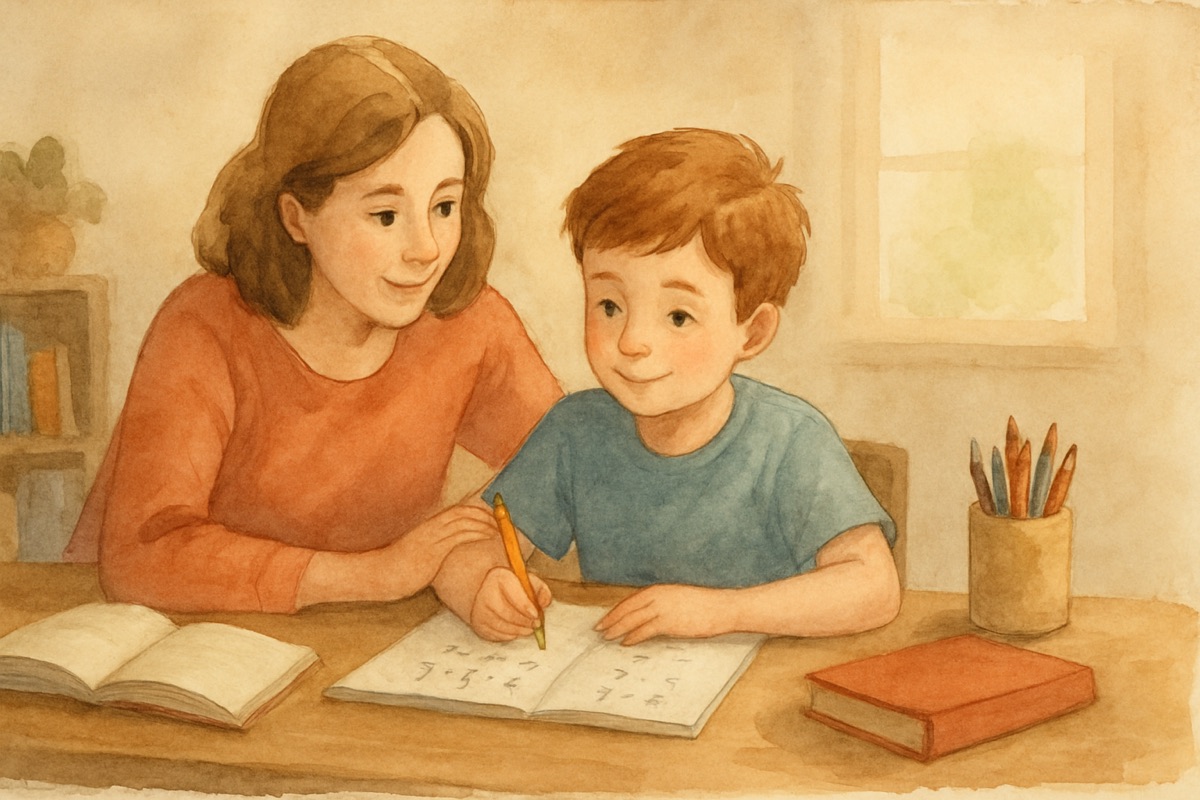
A dad once told me, right in front of his eight-year-old, "Don't worry, honey, nobody in our family is a math person." He meant it as comfort. His daughter heard something else. She heard that the door was already closed, that whatever was coming in fourth grade was a thing that happened to her, not a thing she could do. She was seven. She'd already decided.
I've taught for sixteen years, and if there's one pattern I'd bet money on, it's this. Parents passing math anxiety to kids almost never happens through a lecture. It happens in a shrug, a sigh, a joke made at the dinner table. Kids are watching your face more than they're listening to your words, and your face during homework tells them everything.
So let's talk about how the handoff actually works, and how to jam it.
What kids actually pick up from you
Your child does not know whether you were good at math in ninth grade. They have no idea. What they know is how you act right now when a number shows up. When the check comes at a restaurant and you make a face and slide it across the table, that's a data point. When you say "math was never my thing" while helping with homework, that's a data point.
Here's the uncomfortable part. Research on this is pretty consistent. When math-anxious parents help a lot with math homework, their kids tend to learn less math and worry more about it over the year. When those same parents help less, the effect shrinks. It isn't the helping that hurts. It's the anxiety leaking through the helping.
The good news buried in that finding is huge. Your math ability is not the thing getting passed down. Your relationship to math is. And that's something you can change without ever relearning long division.
Watch your throwaway lines
Most of the damage is in phrases we say without thinking. A few to retire:
- "I was never good at math either." This tells your kid math skill is a fixed trait you're born with or without.
- "Just get through it." This frames the whole subject as suffering to be endured.
- "You don't need this stuff anyway." Kids hear permission to give up.
- "How is that not obvious?" This is the one that makes a kid go quiet and stop asking.
You don't need to replace these with cheerleading. Fake enthusiasm reads as fake. Aim for neutral and curious instead. "Huh, I don't remember how to do that, let's figure it out" is worth more than a hundred "you can do it" pep talks, because it shows a real adult being okay with not knowing.
Sit with not knowing, on purpose
The single most useful thing you can model is being stuck and staying calm. Kids think smart people just know the answer instantly. They don't see the part where an adult reads a problem twice, gets it wrong, and tries again. So show them that part.
Last spring a mom in my class started doing something small. When her son hit a problem she couldn't do, instead of calling for help or shutting down, she'd say "okay, I'm confused too, read it to me again slowly." They'd work it together, and half the time they still got it wrong. Didn't matter. What her son learned was that being confused is a normal step, not a verdict. By June he was the kid in class who kept going after a wrong answer instead of erasing everything and crying.
That's the whole trick. Confusion is not a sign you failed. It's a sign you're doing math.
Separate speed from smart
A lot of adult math fear traces back to timed drills and being called on when you weren't ready. If that was you, notice the urge to rush your own kid. When they pause to think, don't fill the silence. When they count on their fingers, don't correct it. Finger counting is a real strategy that fades on its own when a kid is ready. Snatching it away early just teaches them to hide how they think.
Slow and right beats fast and panicked, at every age. If your child gets there in their own way, that's the goal. The clock is not the subject.
Let the wins be real
Kids can smell hollow praise. "Good job, you're so smart" after a worksheet they rushed through teaches them that the point is finishing, not understanding. Praise the thing that actually happened instead. "You didn't give up on that one" or "you tried it a different way when the first way didn't work." That's praise tied to something real, and it's the kind that builds a kid who keeps going.
This is also why I'm wary of reward systems that pay out for sheer volume. A stack of finished problems isn't the same as understanding. When we built Math Prizes for our own kids, the whole point was to reward real progress rather than mindless grinding, because a kid who's just racing for points learns to hate the thing they're racing through. Whatever tools you use, aim them at understanding, not at speed for its own sake.
You get to start over
You are allowed to have a bad history with math and still raise a kid who doesn't flinch at it. You don't have to fake being good at it. You don't have to secretly relearn algebra at night. You just have to stop performing the fear, stay curious out loud, and let your kid be slow and confused without treating it like an emergency.
Your daughter is watching your face. Give her a different one to remember.