What Math Should My Kindergartner Know? A Teacher's Honest Checklist
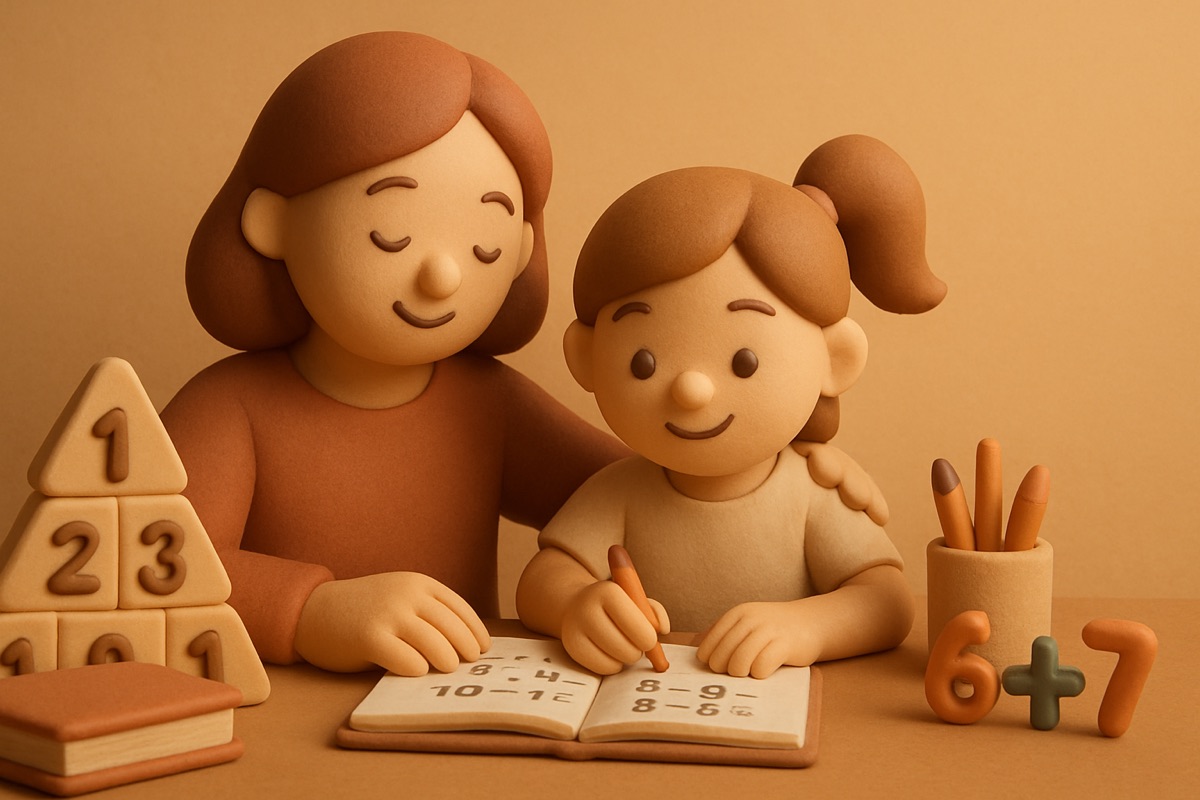
Last September a mom stopped me in the hallway on the second day of school, near tears, because her son couldn't write his numbers past 12. She'd seen another kid in the class counting to 100 and decided her own boy was behind. He wasn't. By June he was one of my strongest counters. The truth about kindergarten math skills is that the stuff parents worry about most is often the stuff that matters least, and the quiet foundations that actually predict later success barely look like math at all.
I've taught elementary for sixteen years, most of it in the younger grades, and I want to give you the honest version. Not the standards document. The list I'd give my own sister.
Counting is more than saying the numbers
Plenty of four and five year olds can rattle off "one two three four five" like a song. That's called rote counting, and it's a fine start, but it isn't the skill that counts. The real skill is called one-to-one correspondence. It means the child touches one object and says one number, touches the next and says the next number, and actually stops when the objects run out.
Here's how I check it. I put out seven buttons and ask a kid to count them. The child who's ready touches each button once and says "seven." The child who's still building the skill counts the same button twice, or keeps saying numbers after they've run out of buttons, or says "seven" and then can't tell me how many there are without recounting.
By the end of kindergarten, most kids can:
- Count objects accurately to about 20
- Tell you how many are in a group without recounting from one (we call that "cardinality," the idea that the last number you say is the total)
- Count forward from a number other than one, like starting at 6 and going up
- Recognize written numbers to 20 and match them to a quantity
If your child can count out five goldfish crackers, hand you exactly five, and not sneak an extra one, that's worth more than reciting to 100.
Numbers to 10 are the whole ballgame
If I could pick one thing for a kindergartner to truly own, it's the numbers up to 10. Not up to 100. Ten.
A kid who deeply understands ten knows that 7 is made of 5 and 2, or 6 and 1, or 4 and 3. They know 8 is two more than 6. They can look at a group of dots arranged like dice and just see "six" without counting. That instant recognition is called subitizing, and it's a quiet superpower. First grade addition and subtraction sit right on top of it.
I had a girl a few years back who could count to 120 but froze on "what's 3 and 4." She had the words but not the meaning. Meanwhile a boy in the same class couldn't count past 30 and could tell me every way to make 8. Guess who breezed through first grade. Depth beats distance every single time at this age.
Shapes, patterns, and sorting count too
Math in kindergarten isn't only numbers, and this part tends to get overlooked at home because it doesn't feel like "real" math.
Kids should be able to name the basic shapes (circle, square, triangle, rectangle) and, better yet, describe them a little. A triangle has three sides and three corners. A square's sides are all the same. You want them noticing, not just labeling.
Patterns matter more than people think. Red, blue, red, blue, what comes next. Clap, stomp, clap, stomp. Recognizing and extending a pattern is early algebra dressed up as a game, and it builds the brain's habit of looking for structure. Sorting is in the same family. Give a kid a pile of mixed Legos and let them group by color or size. That's mathematical thinking.
Comparing is the last piece here. More, less, the same. Bigger, smaller. Taller, shorter. A kindergartner should be able to look at two glasses of milk and tell you which has more, and ideally give a rough reason.
What honestly can wait
This is the part I wish more parents heard. A lot of things that stress families out are simply not kindergarten skills, and pushing them early usually backfires.
- Writing numbers perfectly. Reversed 3s and backward 7s are completely normal well into first grade. The thinking matters more than the handwriting.
- Adding and subtracting on paper. Kids will do addition and subtraction, but with objects and fingers and their whole bodies, not with a plus sign and a worksheet. That formality comes later.
- Counting to 100 in isolation. It's on some checklists and it's fine if it happens, but a child who counts to 30 with real understanding is in better shape than one who parrots to 100 with none.
- Time and money. Beyond "the little hand points to numbers" and "coins are money," this is largely first and second grade territory.
When a parent tells me their five year old is "behind" because a cousin the same age does something fancier, I gently push back. Kindergarten spans kids who just turned five and kids who are nearly seven. That's an enormous range of brain development. A ten month gap is a lot when you've only been alive for sixty.
How to help without a single worksheet
You do not need flash cards or an app or a workbook to raise a kid who's ready for first grade math. You need to make numbers part of ordinary life, and you need to keep it short and light.
Count real things. Stairs on the way up, forks while setting the table, cars at the red light. When you count, sometimes stop and ask "so how many was that?" to build that cardinality idea instead of just the counting song.
Cook together. Measuring cups, "we need two more eggs," dividing a pizza into equal slices. Kitchens are full of math and nobody has to call it math.
Play games with dice and dominoes. Any board game where you roll and move is secretly teaching number recognition and counting on. When your kid rolls a five, resist counting the dots for them. Let them see the five.
Talk about more and less. "You have three grapes and I have five, who has more?" Then, "how many more do I have?" Keep it to a couple of minutes. The moment it feels like a drill, you've lost the good part of it.
We built our own little math game at home for exactly this reason, because our kids needed practice that felt like play and rewarded actually getting it rather than just clicking through. But honestly, most of what a kindergartner needs happens at the dinner table and on the walk to the park, and it costs nothing.
The real checklist
If you want the short version to keep in your head, it's this. Can your child count a set of objects accurately and tell you how many without starting over. Do they really know the numbers up to ten, not just the words but the meaning. Can they spot and extend a simple pattern, name a few shapes, and tell you which of two piles has more. That's the heart of kindergarten math, and it's plenty.
The boy from the hallway, the one whose mom was in tears in September, is in third grade now and loves math. His mother reminds me of that hallway conversation every time I see her. Kids grow into this. Your job isn't to race them there. It's to keep it warm, keep it real, and count a lot of goldfish crackers along the way.