Times Tables Are Not Sticking: A Gentler Path to Multiplication Fluency
When the flashcards stop working
Every fall I meet a third grader who has done the flashcards. Hundreds of them. The stack lives in a rubber band in the kitchen drawer, and every night his mom flips through it while he stares at the ceiling and guesses. He gets 6 x 8 right on Monday and wrong on Thursday. By October he has decided he is bad at math, which is the real damage, and none of it was necessary.
If your child can't memorize times tables, the honest first thing to say is this: it is almost never a memory problem. It is a foundation problem wearing a memory costume. Drilling harder on a shaky foundation just makes the shaking louder. There is a gentler path to multiplication fluency, and it is usually faster than the grind, not slower.
Memorizing before understanding is the trap
Multiplication is repeated addition. That sentence sounds obvious, but a surprising number of kids memorizing the table have never actually connected the fact to the meaning. To them, "7 x 4 = 28" is a random noise they are supposed to produce on demand, like a password. Passwords are hard to remember precisely because they mean nothing.
Compare that to a kid who knows that 7 x 4 is four groups of seven. If she blanks on the answer, she is not stuck. She can count it. Seven, fourteen, twenty-one, twenty-eight. Slow, yes. But she is never wrong and she never panics, and every time she counts it up she is quietly wearing a groove that turns into a memory on its own.
That is the whole idea. We are not choosing between understanding and speed. Understanding is the road to speed. The kids who memorize fastest are usually the ones who understood first.
Start with the facts that carry the rest
You do not learn 144 separate facts. That framing alone exhausts kids. Most of the table is easy or duplicated, and if you clear the easy ones first, the scary middle shrinks fast.
Here is the order I actually teach, and why:
- The 2s, 5s, and 10s. Kids usually already have these from counting by twos, fives, and tens. Naming them as multiplication ("skip counting is the same as timesing") gives an instant win and a foothold.
- The 1s and 0s. Two rules, learned in a minute. Anything times one is itself. Anything times zero is nothing.
- The commutative shortcut. Once a child truly believes 3 x 8 and 8 x 3 are the same amount, the table cuts almost in half. This is worth a whole afternoon of proving it with objects.
- The squares. 3x3, 4x4, 6x6 and so on. Kids like them because they feel special, and they act as landmarks in the messy middle.
Do the math on what is left. After all that, the genuinely hard facts come down to a small handful, mostly living around 6, 7, and 8. That is a Tuesday, not a mountain.
Build the picture before the speed
For the stubborn facts, put the abstract number away for a while and make it physical.
An egg carton is a multiplication machine. It is a 2 by 6 array sitting in your fridge. Two rows of six, six columns of two, twelve either way. Let your kid fill it with anything, dried beans, coins, small toys, and count. Then take one column away and ask what happened. You are teaching that 2 x 5 is one group of two less than 2 x 6, which is exactly the kind of reasoning that rescues a kid who has gone blank.
I had a student, a boy who was sure he could not do the sevens, sit with a stack of pennies and build 7 x 6 as six rows of seven. He counted forty-two. Then I nudged one row aside and asked for 7 x 5. He did not recite it. He said, "That's just seven less, thirty-five," and the look on his face was the whole point of teaching. He had stopped guessing and started thinking. The recall came a couple weeks later, on its own, because now the fact meant something.
Short, calm, and daily beats long and dreaded
Once the meaning is in place, memory does need a little repetition. The mistake is doing it in long, tense, high-stakes sessions.
- Keep it to about five minutes. A tired kid is not encoding anything.
- Practice a small set at a time, maybe three or four facts, not the whole table at once.
- Fold it into ordinary life. "There are 3 rows of chairs and 8 in each, how many people can sit?" beats a worksheet.
- When she blanks, do not supply the answer. Ask, "How could you figure it out?" and let her count up. The struggle is the learning.
- End before it goes sour. Stop on a right answer and a good mood, every time.
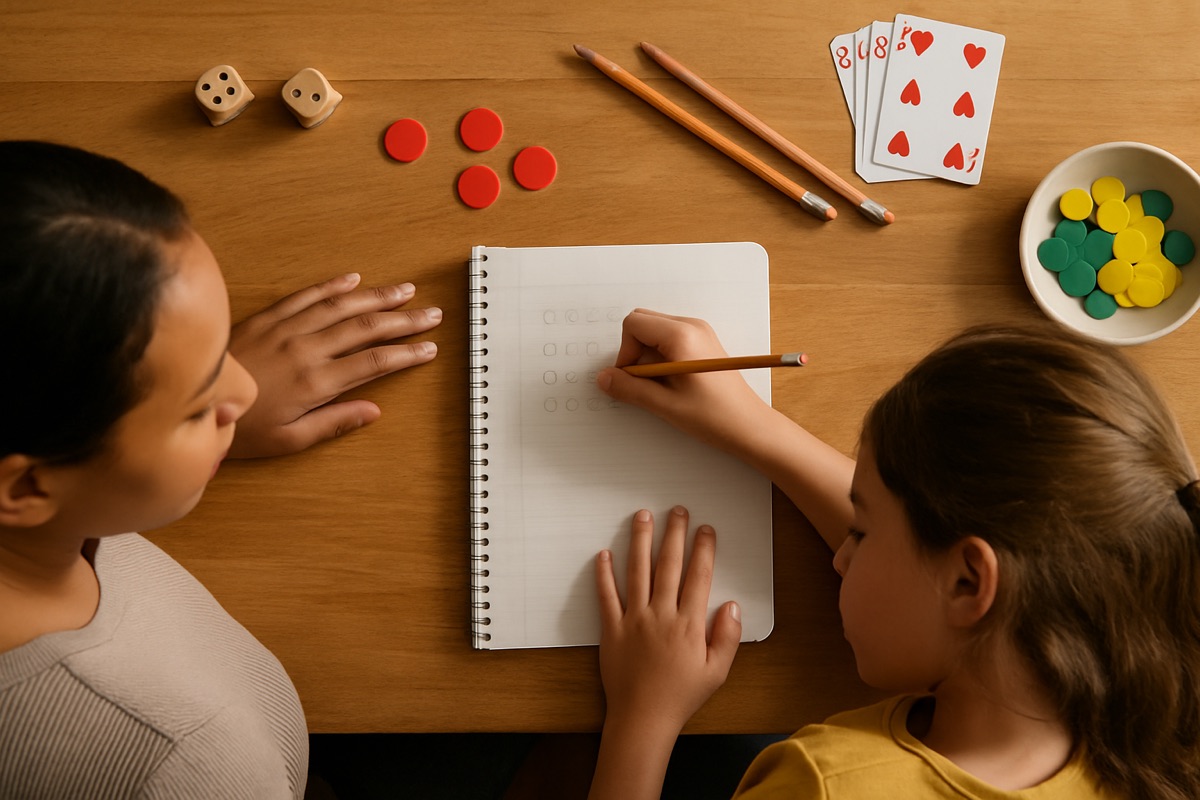
Games help too, because they change the emotional weather around the fact. A pair of dice, a deck of cards, anything that makes recall feel like play instead of a test. The reward that matters is the true one: the visible feeling of getting faster and needing to count less. When a child notices that on her own, you will not have to sell her on practicing.
Some kids get there in a few weeks and some take a few months. Both are fine. The one thing I would ask you to let go of is the idea that speed proves intelligence. It does not. A child who can reason her way to 8 x 7 in four seconds understands more than a child who blurts 56 with no idea why. The blurting comes eventually. The understanding is the part worth protecting.