The Power of 'Yet': Rewiring 'I Can't Do This' at the Kitchen Table
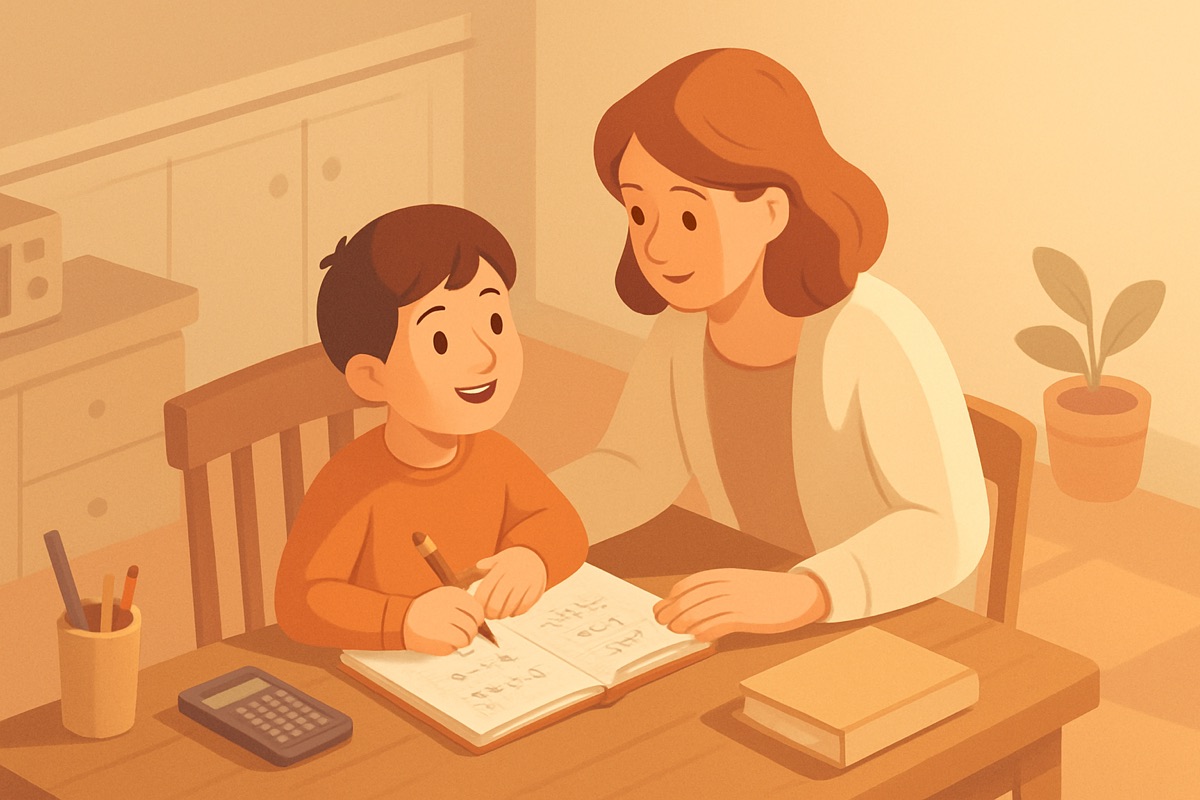
A pencil hits the floor
A third grader named Eli pushed his worksheet away, dropped his pencil, and said, flat and final, "I can't do this." Long division. He'd gotten two problems tangled and decided the whole thing was closed to him. His dad, sitting next to him, almost said the thing all of us want to say, which is "yes you can, it's easy." Instead he said something smaller. "You can't do this yet."
Eli picked the pencil back up. Not happily, not fixed, but the door that had just slammed opened a crack. That crack is the whole story. The growth mindset math not yet idea gets talked about like a poster slogan, but at a kitchen table it's a real tool, and it works because of how kids interpret a stuck moment.
What "I can't do this" really means
When a child says "I can't do this," they are almost never describing the math. They're describing themselves. What they mean is closer to "I am not a person who can do this." It's an identity statement wearing the costume of a fact.
That's the trap. If being stuck means I'm the kind of kid who can't, then trying harder is pointless, and quitting is the smart move. Why keep pushing at something your own nature won't allow? From inside that story, giving up isn't weakness. It's logic.
The word yet quietly rewrites the sentence. "I can't do this" is a verdict. "I can't do this yet" is a status update. One says the case is closed. The other says you're partway through something, and the ending hasn't been written. Same kid, same worksheet, completely different meaning.
Why one word does so much
Kids are extremely good at reading whether a struggle is temporary or permanent. That reading shapes what they do next. Researchers who study this, Carol Dweck's work being the best known, found that children who see ability as something that grows will push through a hard problem, while children who see ability as fixed tend to fold when it gets hard, because a hard problem feels like evidence against them.
Yet is a small crowbar that pries the struggle out of the permanent column. It tells the child, without a lecture, that being stuck is a stage and not a sentence. And here's the part I love as a teacher. You don't have to explain any of that to the kid. You just add the word. Their brain does the reframing on its own.
How to use it without sounding like a poster
The catch is that yet only works if the child believes you actually mean it. Kids have finely tuned radar for adult happy-talk. If yet becomes a chirpy tic you tack onto everything, it turns into noise. Here's how to keep it real.
- Pair it with a real next step. "You can't do this yet. Let's look at just the first line together." Yet plus a path is hope. Yet by itself can sound like a brush-off.
- Use it about your own struggles too. "I couldn't parallel park for years. I couldn't do it yet, and then one summer it clicked." That makes yet a family truth, not a thing adults say to kids.
- Point at old evidence. "Remember when you couldn't read a clock? That was a not-yet too, and now you don't even think about it." Nothing sells yet like a struggle they've already beaten.
Praise the road, not the destination
There's a companion habit that makes yet stick, and it's about how you praise. When Eli finally worked through a long division problem, the tempting thing to say was "you're so smart." Smart is a fixed trait. Praise it, and the next hard problem becomes a threat to the label, something to avoid.
His dad said instead, "you kept going after that pencil hit the floor." That praises the thing Eli actually controls. Effort, strategy, sticking with it. Kids praised for the process reach for harder problems, because the praise is attached to something they can do again on purpose. Kids praised for being smart start protecting the label by playing it safe.
You can hear the difference in a single sentence. "You're a math person" closes the identity. "You figured out a way through that" opens it back up.
One more thing about praise. Notice the effort even when the answer is wrong. If Eli tried three different approaches and still landed on the wrong number, "I saw you try three ways, that's exactly what mathematicians do" is more useful than silence. It tells him the trying was the win, which is the thing you want him to repeat tomorrow.
The slow part nobody mentions
I want to be honest, because the slogan version of this makes it sound instant. Adding yet once does not cure math anxiety. Eli still shoved worksheets away for a while after that first afternoon. The rewiring is real, but it's a hundred small moments, not one magic word.
What changes first is not the child's skill. It's the meaning of getting stuck. Before, a hard problem meant stop, this proves I can't. After, slowly, a hard problem starts to mean I'm not there yet, keep going. Once that shift takes hold, the kid does the heavy lifting themselves, over months, and your job shrinks to holding the door open with one small word every time it starts to swing shut.
Eli does long division now without drama. Not because someone convinced him it was easy. Because he stopped believing the verdict and started believing the status update.