The One Question to Ask at Every Parent Teacher Conference About Math
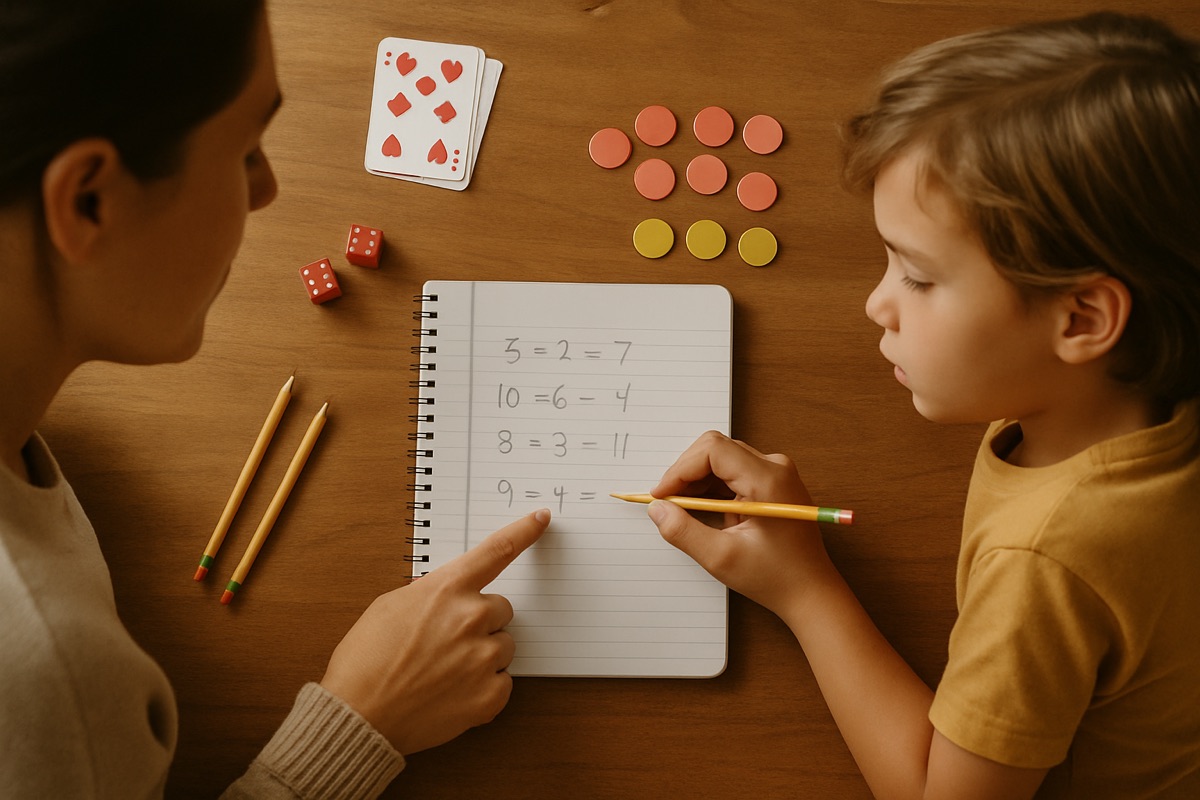
The fifteen minutes you get
You sit in the small chair. The teacher has a folder with your kid's name on it and a timer running in her head, because there are eleven more families in the hallway. You have about fifteen minutes, and half of it is going to disappear into pleasantries and a quick look at a graded worksheet. That leaves you with a handful of real questions, and most parents spend them on the wrong one.
The wrong one is "How is he doing in math?" It feels natural. It's also the easiest question in the world to answer without saying anything. "He's doing great, he's right where he should be" is what you'll hear, and you'll drive home relieved and no wiser. Good parent teacher conference math questions are the ones a teacher can't dodge with a smile. There's one I'd tell any parent to lead with, and I'll get to it. First, why the usual questions fail.
Why "how is she doing" gets you nothing
When I answer "how is she doing," I'm averaging. I'm blending your daughter's homework completion, her quiz scores, her behavior, and my general sense of her into one word. The average almost always comes out fine, because most kids are fine on average. A kid can be quietly lost in fractions and still land at "fine" because she aces the arithmetic parts and copies the rest from a friend.
The grade hides the same thing. An 88 in fourth grade math could mean she understands everything and rushes, or it could mean she's memorized the steps for problems that look a certain way and falls apart the second they're rearranged. Two kids with the same 88 can be in completely different trouble. The letter on the report card can't tell them apart. The teacher can, if you ask her the right way.
The question
Here it is:
"What is the specific math skill my child hasn't solidified yet, and what does that look like when she works?"
That's it. Two parts, and both matter.
The first part, "the specific skill she hasn't solidified," forces me off the average and onto one concrete thing. Not "she could focus more." Not "she's a little behind." A skill. Regrouping when subtracting across a zero. Knowing her sixes and sevens without counting up. Reading a word problem and figuring out whether it's asking her to add or multiply. When I have to name one skill, I have to actually think about your kid instead of reaching for a stock phrase.
The second part, "what does that look like when she works," is the one that turns a label into something you can use. Because "she struggles with multiplication" doesn't tell you what to do tonight. But "she gets the single digits fine, then freezes on anything times seven, and you can see her start counting on her fingers under the desk" tells you exactly where to spend twenty minutes. You know it's the sevens. You know it's automaticity, not concept. You go home and you know what to practice.
What a good answer sounds like
The point of the question is to get a picture concrete enough that you'd recognize the problem if you saw it at your own kitchen table. Compare these two answers to the same question.
- Vague: "He's a little shaky on his math facts, but he'll get there."
- Useful: "He knows addition and subtraction cold. Multiplication facts are the gap. He's solid up through the fives, but sixes, sevens, and eights he still has to reconstruct, so a two-step problem takes him three times as long and he runs out of time on the test before he runs out of ability."
The second answer hands you a plan. Practice the sixes, sevens, and eights until they're automatic, and the two-step problems stop being a time crunch. You didn't need a tutor or a curriculum. You needed one honest sentence, and you got it because you asked a question that couldn't be waved off.
If the answer you get is still vague, it's fair to gently push. "Can you give me an example of a problem he'd miss?" is a completely reasonable follow-up, and any teacher worth the chair will have one ready. If she genuinely can't name a specific skill, that tells you something too. It usually means your kid is doing fine and blending into a busy classroom, which is its own kind of answer.
A few questions to bring in your back pocket
You've got fifteen minutes. Lead with the big one, then keep two or three of these ready depending on what she says.
- "When he gets stuck, does he ask for help or does he go quiet?" This tells you whether the problem is math or confidence, and those need different fixes.
- "Is he behind, right on pace, or ahead, and how are you deciding that?" The "how" matters. It reveals whether she's comparing him to a standard or to the class.
- "If I had twenty minutes a night, what's the one thing worth practicing?" Teachers love this question because it's the one nobody asks, and they always have an answer.
Notice what these have in common. Every one of them asks for something specific and refuses the comfortable average. That's the whole trick.
What you do with the answer
The reason to get a concrete answer is so you can do something small and aimed, not something big and scattered. When a teacher tells me a kid has one specific gap, I don't want that parent buying a workbook and grinding every skill in the book. The gap is the sevens. Practice the sevens. Ten minutes of the actual missing thing beats an hour of general review, and it beats it badly, because the kid isn't drowning in stuff she already knows just to reach the one thing she doesn't.
That's the difference between practice that helps and practice that just fills time. Aimed at the real gap, twenty minutes a night closes it in a couple of weeks. Sprayed across everything, the same twenty minutes mostly rehearses skills your kid already had, and the actual weak spot barely gets touched. We used a math app with our own kids partly for this reason, because a good one keeps the practice pointed at the thing that isn't solid yet instead of whatever comes next in a fixed list. But the tool matters less than the aim. You could do it with a stack of index cards.
So walk in with the one question. Get the specific skill and what it looks like when she works. Then go home and spend your twenty minutes exactly where they'll count. That's a conference that was worth the small chair.