The Best Math Card Games Beyond War and Go Fish
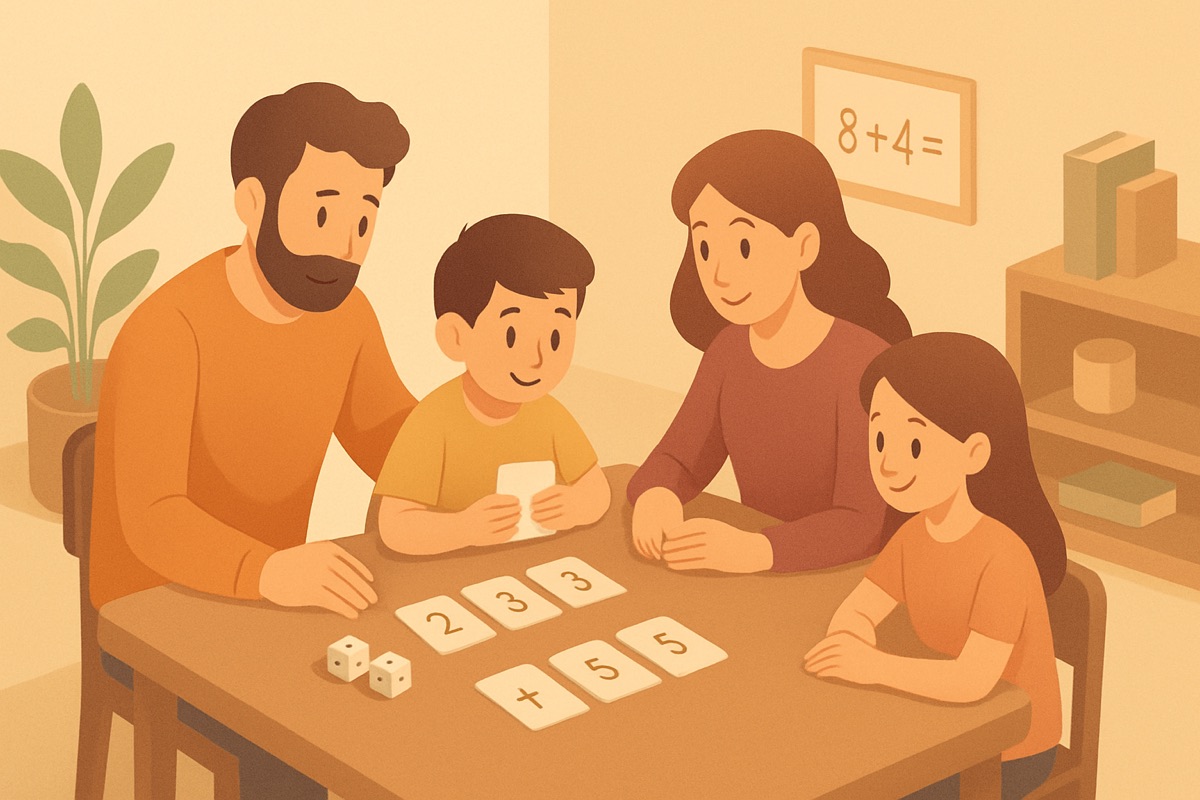
War is fine for about a week. Then the eight year old in your house has flipped ten thousand cards, the game never ends, and nobody has learned a thing except who has the patience of a saint. There are far better math card games for kids sitting in that same deck, games with real decisions and real number work, and most of them play in ten minutes. I've run all of these with students, and they hold up because kids have to think, not just flip.
You need one standard deck. I pull the face cards for younger kids so the deck tops out at ten, or I let Jack be 11, Queen 12, King 13, and Ace 1 for older ones. That's the only setup. Everything below builds a skill, and I've said which.
Games that build addition and subtraction
These are my go-to for first and second graders. Fast rounds, quick wins, and the arithmetic hides inside the fun.
Sum War. Deal the deck evenly. Both players flip two cards and add them. Higher sum takes all four cards. It's War with a brain, because every flip is an addition fact under a little pressure. My students who dreaded flashcards will play this for twenty minutes without noticing they're drilling.
Make Ten. Lay out ten cards face up. Players take turns grabbing any two (or more) cards that add to ten. Whoever clears the most cards wins. This one builds the make-a-ten instinct that makes all later addition faster, and it works a kid's brain harder than it looks.
Twenty-One, the kid version. Deal cards one at a time. The goal is to get as close to 21 as you can without going over, deciding each turn whether to take another card. This is running addition plus a real risk-and-reward choice, which kids love and which sneaks in some early probability sense.
Games that build multiplication
Once times tables are in the picture, the same deck turns into fact practice that doesn't feel like a worksheet.
Product War. Same as Sum War, but you multiply the two cards instead of adding. Higher product wins the pile. This is the single best flashcard replacement I know. A kid gets dozens of multiplication reps in a game they actually want to keep playing, and the competition does the motivating for you.
Multiplication Salute. This needs three people, and it's a favorite. Two players each hold a card to their forehead facing out, so they can see the other person's card but not their own. The third player calls out the product of the two cards. Each of the two has to figure out their own card by dividing. It quietly teaches that division is just multiplication run backward, which is a big idea packed into a silly game.
Games that build place value and comparing numbers
These help kids feel how numbers stack up, which is the foundation under everything from rounding to long addition.
- Build the Biggest Number. Each player draws three or four cards and arranges them into the largest number they can. Compare, biggest wins. Draw four cards and you're suddenly reasoning about thousands and which digit belongs in which spot.
- Closest to 100. Draw cards and place them as tens or ones (a 4 is either 40 or 4), trying to land as close to 100 as possible without a calculator. This forces real place-value thinking on every single turn.
- Card Golf. Play a few rounds of any of the above, keep score, and try for the lowest or highest total across rounds. The scorekeeping itself becomes multi-digit addition practice, which is a nice bonus nobody complains about.
Why the deck beats the screen for this
I say this as someone who thinks good learning apps have a place. For number sense at the kitchen table, a one dollar deck of cards often beats a slick app, and here's the honest reason. When two people play a card game, a kid has to do the math out loud, defend an answer, and handle losing a round to a parent. There's no reward wheel and no coins to chase. The reward is winning the hand, and the math is the only way to get there.
That's the anti-grinding point in a nutshell. A worksheet with forty problems trains endurance. A good card game makes a kid want the next turn, and every turn is a real problem they chose to solve. The learning is baked in, not bolted on top with prizes.
A few tips to keep it fun
A couple of things I've learned from playing these with a lot of different kids.
Let the kid win sometimes, but not always. A game they can never win gets abandoned, and a game they always win gets boring. Aim for genuine competition. When they miss a fact, don't turn it into a lesson mid-game. Just say the answer, keep the pace up, and let the repetition do the teaching over many rounds.
Keep sessions short. Ten or fifteen minutes of a card game most days beats a forced hour on Sunday every time. And keep the deck somewhere easy to grab, a kitchen drawer, the glove box, a backpack pocket. The best math card games for kids are the ones you actually reach for, and a deck buried in a closet never gets played.