Cooperative Math Games Where the Family Wins Together
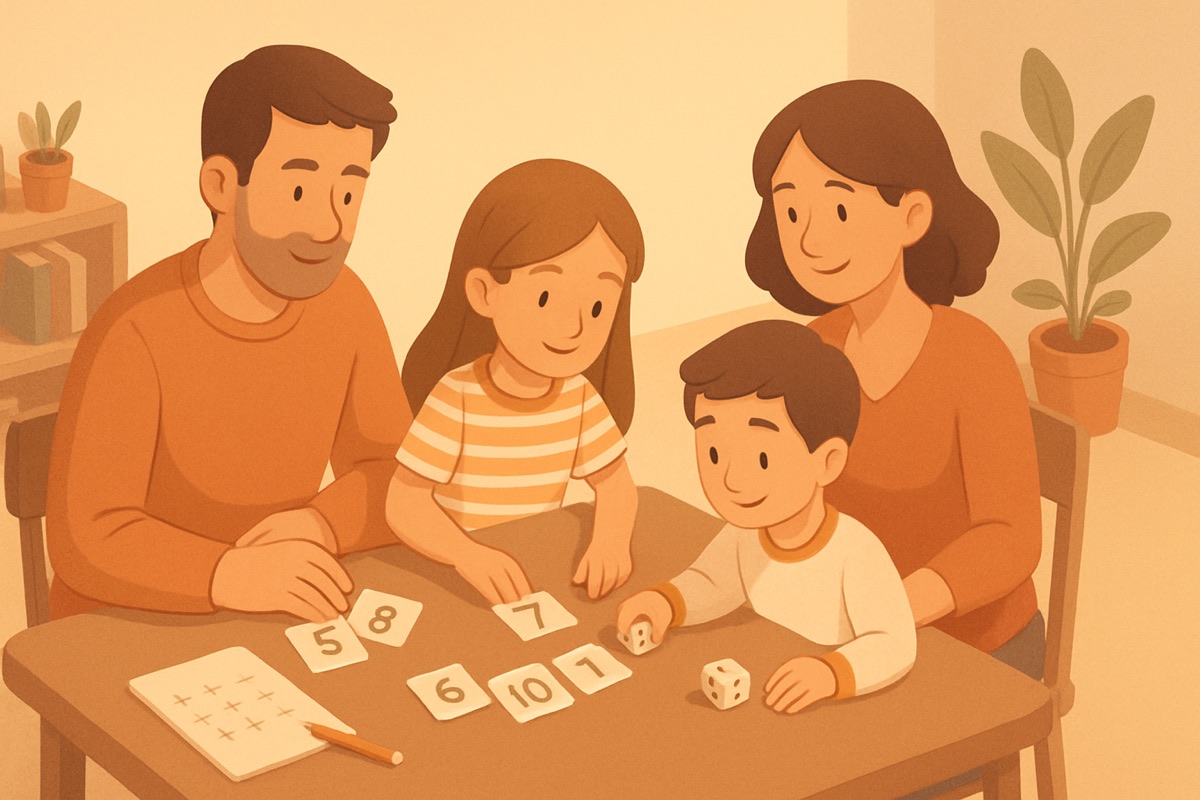
The last time my two nephews played a fast-facts card game, the older one won every hand, and the younger one, who's genuinely working hard at his sevens, ended up under the table refusing to come out. He wasn't sad about the game. He was sad about being the slow one in front of everyone. That's the built-in flaw of most competitive math games. Somebody has to lose, and it's almost always the same kid.
Cooperative math games for kids flip that. Instead of racing each other, everyone plays against the game itself, or toward a shared goal, so the family wins or loses as one team. The math still happens. The pressure that makes a struggling kid shut down mostly doesn't. Here's how these games work and a handful you can start tonight with things already in your house.
Why beating your sibling backfires
Competition can be great fuel for the kid who's already good. It's poison for the kid who isn't there yet. When math becomes a race, the child who's slower doesn't practice more. They practice quitting, because losing over and over teaches them that math is a thing they're bad at in public.
There's also a quieter problem. In a competitive game, once a kid falls behind, they check out for the rest of the round. No point trying if the win's already gone. So the kid who most needs the reps stops taking them. Cooperative games keep every player in it until the last turn, because the group hasn't won yet and every person's answer still counts.
What makes a game cooperative
The core swap is simple. Take a game where players race or compete and change the goal so everyone is pulling the same direction. A few ways that plays out:
- Beat the clock together. The family tries to answer 20 problems as a group before a timer runs out, taking turns. One shared score, one shared win.
- Play against the deck. Draw problems from a pile and try to clear the whole pile before the "trap" cards pile up. The deck is the opponent.
- Build something as a team. Every correct answer adds a piece to a shared tower or a path across the table. Wrong answers just mean try again, no piece lost by any one person.
- Hit a group target. "Let's earn 50 points as a family tonight." Nobody's points are separate. It's all one bucket.
Notice what's missing: nobody is ranked against anybody. A kid can be the weakest mathematician at the table and still be a full, useful member of a winning team.
Games you can play tonight
You don't need to buy anything. Here are a few that use a deck of cards, some dice, or paper.
Card pile clear. Deal the whole deck face down in the middle. Take turns flipping two cards and adding them (or multiplying, for older kids). Say it out loud, and the group agrees it's right before moving on. Goal: get through the whole deck as a family in under, say, six minutes. You're racing the clock, not each other. Younger kids can flip and add small cards while an older sibling handles the bigger ones, so everyone contributes at their own level.
Dice tower. Roll two dice, add or multiply them, and if the group gets it right you place one block on a shared tower. Roll a certain number and you have to remove a block. Can the family build a tower ten blocks high before it topples? Every player wants every other player to get it right, which is the exact opposite of a competitive game.
Twenty in a row. Pick an operation. As a family, try to answer twenty problems correctly in a row without a miss. One wrong answer resets the streak to zero and everyone groans together and starts again. The struggling kid isn't the reason you lost, because everyone shares the streak, and everyone's cheering for everyone's turn.
Store checkout. One person is the cashier, everyone else pools "money." Add up a pretend basket of groceries and figure the change together. Real-life math, and the win is just getting the total right as a group.
Keep the focus on getting it right, not getting it fast
The whole point of going cooperative is to take speed off the table, so don't sneak it back in. Resist timing individual kids or celebrating the fastest answer. What you want to praise is the thinking. "I like how you counted up from seven" beats "wow, that was quick" every time, because one of those a slower kid can actually earn.
This is also why I stay away from cooperative games that still crown a most valuable player at the end. The moment there's a secret winner, the struggling kid finds it, and you're back to the nephew under the table. Real cooperation means the answer to "who won?" is "we did," full stop. Any digital math game or app you bring in should follow the same rule, rewarding a kid for real progress at their own level rather than for beating a sibling to the buzzer.
The quiet payoff
The best part of playing on the same team shows up outside the game. My younger nephew, after a few weeks of dice-tower nights where nobody kept individual score, started volunteering to do the harder problems. Not because he'd suddenly gotten faster than his brother, but because the table had stopped being a place where he got measured against him. He could try a seven times eight, get it wrong, get a nudge, and get it the next time, with his brother rooting for him instead of waiting to win.
That's what you're really after. Not a kid who wins at math, and not even a kid who's fast at it. A kid who's willing to sit down and try, again and again, because trying stopped feeling like losing.