Dominoes Aren't Just a Game: Sneaky Math for Little Kids
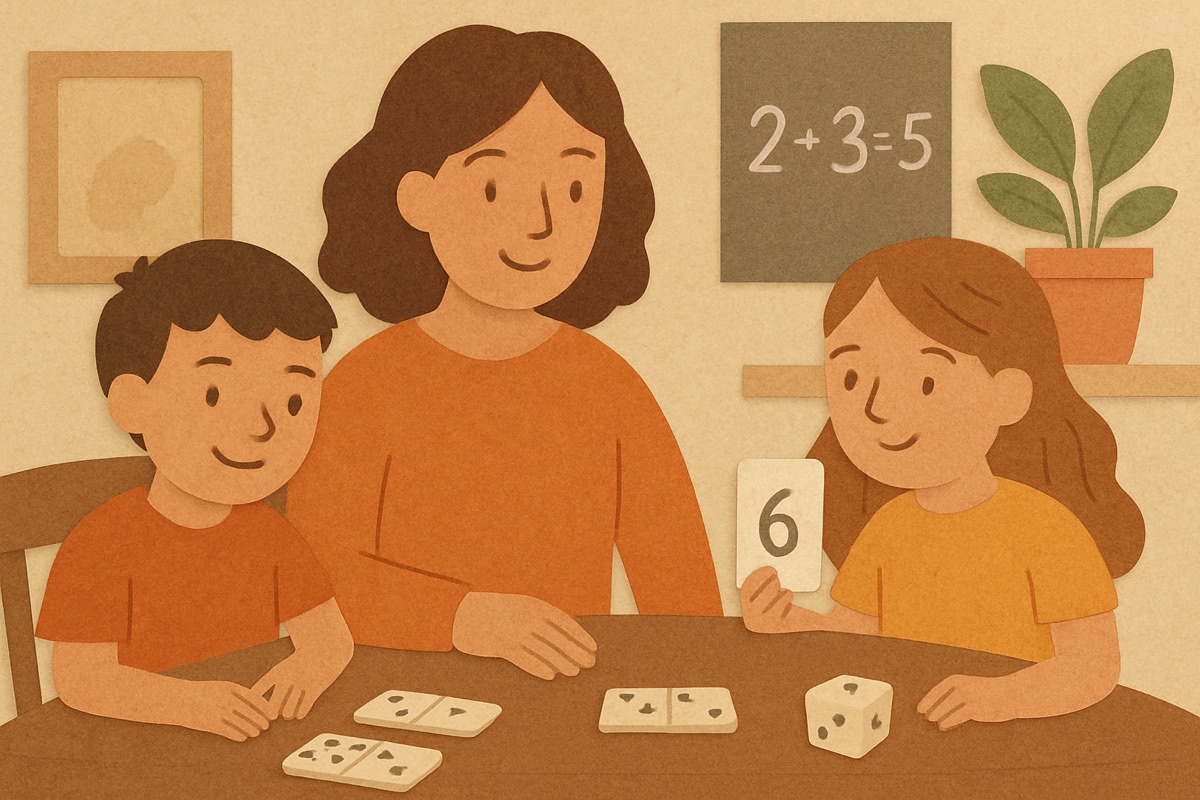
There's a beat-up box of dominoes in most houses, usually shoved in a closet behind the board games nobody finishes. I've used that exact box to teach more early math than half the fancy manipulatives that show up in a first grade classroom. Kids don't see a worksheet when they look at a domino. They see a game piece. That gap, between what they think they're doing and what they're actually practicing, is the whole reason domino math games work as well as they do.
A domino is a tiny math machine. It's got two ends, each with a number of dots from zero to six, and the dots are arranged the same way every time. That structure is doing quiet work. When a kid looks at the five side, they stop counting dots one by one after a while and just see five. That instant recognition is called subitizing, and it's one of the building blocks of real number sense. You can't teach it with a lecture. You teach it by having a kid look at dot patterns over and over in a way that doesn't feel like practice.
Why dots beat digits at this age
A five on a domino and the numeral "5" are not the same thing to a six-year-old. The numeral is an abstract symbol they have to translate. The dots are the actual quantity, sitting right there. For a kid still building the bridge between "amount" and "symbol," the dots are gold. They let the child work with real quantities before they're forced into the abstract stuff.
I had a first grader who could recite numbers to a hundred but genuinely did not understand that six was more than four. He'd memorized the word order like a song. Put two dominoes in front of him, one showing six and one showing four, and within a week he could tell you which was bigger and, better, how much bigger, by matching dots. The dots made the size real in a way the numerals never had.
Games for the youngest kids
Start dead simple. These work for a four to six year old and need nothing but the box.
- Bigger side wins. Each player flips a domino. Whoever's got more total dots keeps both. It's War, basically, and it forces quick comparison of quantities without any pressure.
- Find the match. Spread ten dominoes face up and call out a number. Your kid finds one with that many dots on one end. Then have them find a second one. Now they're seeing that five can look like a bunch of different pairings.
- Build a train. Play regular dominoes, matching ends. The matching itself is pattern work, and counting the dots to check a match is addition in disguise.
Keep these short. Five minutes at the kitchen table beats a long session that fizzles into frustration. The point is repeated exposure, not endurance.
Games that sneak in addition
Once a kid recognizes the dot patterns without counting, a domino turns into an addition problem all by itself. Each domino has two numbers on it. Add them.
Flip a domino and race to say the total. Six and three, that's nine. This is where the sneaky part really pays off, because a domino gives a kid a concrete reason to add. They're not adding because a worksheet told them to. They're adding to win the flip. Keep a little tally of who got the most totals right and you've got a whole game.
A good next step is what I call "make ten." Pull out all the dominoes and have your kid hunt for the ones whose two ends add up to ten. Six and four. Five and five. The double-six won't make it, and figuring out why is its own little lesson. Making ten is one of the most useful skills in early math, because so much later arithmetic leans on it, and hunting through a pile of dominoes is a far better way to drill it than a page of "10 = __ + __."
Keep it about the thinking, not the speed
Here's my one caution, and it's the same one I give about every math game. Don't turn dominoes into a speed drill. The temptation is to start timing your kid, pushing for faster totals, treating it like flash cards with dots. The moment it becomes about beating the clock, a lot of kids tense up and the thinking shuts down.
The good stuff happens when a kid has room to actually reason. When your child looks at a six and a three and you can see them think "six, then seven, eight, nine," that's the win. That's a strategy forming. If you rush them, they never build the strategy. They just guess and hope. Slow counting that leads to real understanding beats fast guessing every time. Let them count on their fingers. Let them pause. The dots aren't going anywhere.
When to change it up
You'll know your kid has outgrown a game when it gets boring, and boredom is just a signal to raise the challenge. Move from comparing single dominoes to adding two at once. Introduce subtraction by asking for the difference between the two ends instead of the total. Later, three dominoes and a running total turns into genuine mental math. The same little tiles carry a kid from "which is more" all the way to adding three numbers in their head, and it never once looks like homework.
That's the thing about that dusty box in the closet. It doesn't expire, it doesn't need batteries, and it grows with the kid. Pull it out on a rainy afternoon and play a few rounds. Your kid will think they're just beating you at a game. You'll know better.