The Best Board Games That Secretly Teach Elementary Math
The Tuesday I stopped assigning drills
I had a second grader named Priya who treated a math worksheet like a chore she'd been sentenced to. Twenty addition problems, and she'd sigh at problem three. Then one rainy Tuesday I pulled out a shopkeeper game where kids make change with plastic coins, and she played it for forty minutes straight. She was adding, subtracting, and counting up from a price the whole time. Same math. Completely different kid.
That's the quiet power of board games that teach math. The numbers stop feeling like a test and start feeling like the thing standing between you and winning. After sixteen years in elementary classrooms, I trust a good game more than a stack of drills, because the game makes a kid want to get the answer right. Here are the ones I keep coming back to, and why they work.
Why a game beats a worksheet
A worksheet asks a kid to do the same operation over and over with no reason attached. A game gives the math a job. When your daughter is counting spaces to land on the ladder and skip ahead, she isn't "practicing addition." She's trying to win, and the addition is just how you win. The motivation is baked in.
There's a second thing games do that worksheets can't. They make mistakes cheap and immediate. Miscount your move and you land in the wrong spot, and you feel it right away, with no red pen and no grade attached. Kids will re-check their own counting to avoid losing a turn far more carefully than they'll check it to avoid a mark. That self-correction, done for real reasons, is where number sense actually grows.
The classics that carry more math than they look
Some of the best math games are ones you probably already own. You don't need anything labeled "educational."
- Monopoly (or the junior version). This is money math disguised as a family fight. Kids count rent, make change from the bank, and add up what they owe. The junior edition keeps the numbers small enough for first and second graders. Let your kid be the banker. Being the banker is the whole lesson.
- Yahtzee. Five dice, and constant addition. Kids total their rolls, compare which category scores more, and start reasoning about odds without ever hearing the word probability. A first grader adding three fours to get twelve is doing real work and calling it fun.
- Sorry! and Trouble. Simple counting and spatial reasoning. Younger kids practice one-to-one counting as they move pieces, which sounds basic until you watch a five year old skip a square and lose the game.
- Chutes and Ladders. For the youngest ones, this is pure number recognition and counting to a hundred. The board itself teaches the shape of the number line.
None of these say "math" on the box. That's exactly why they work. The kid's guard is down.
The ones built for math that don't feel like it
A few games are designed around arithmetic but hide it well enough that kids don't mind.
Sum Swamp is a great starter for adding and subtracting. Kids roll two number dice and an operation die, then move that many spaces. My kindergarteners loved it and had no idea they were doing forty problems a game. Prime Climb is a step up, better for third grade and beyond, and it sneaks in multiplication and factoring through a clever board where you multiply and add to move your pawns. It looks like a strategy game. It is a strategy game. The math is the strategy.
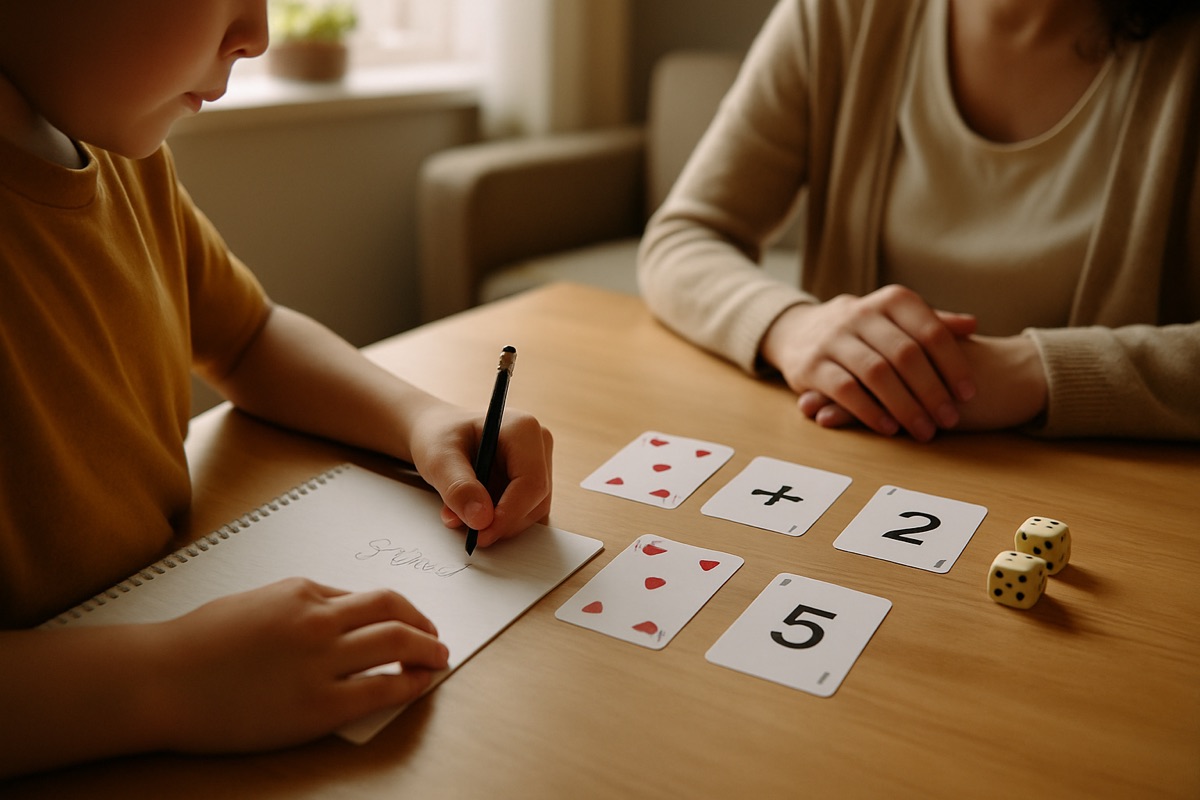
For fact fluency, plain playing cards beat almost anything. War, but each player flips two cards and multiplies them, and the bigger product takes the pile. A deck of cards costs a dollar and drills times tables harder than any app, because your kid is racing a sibling and doesn't want to lose.
How to play so the math actually sticks
The game does most of the work, but a few small moves make it do more.
- Make your kid do the counting out loud. If you count for them, you did the math. Slow down and let them count the spaces, add the dice, and make the change themselves, even when it's painful to watch.
- Let them be the banker or scorekeeper. Whoever tracks the numbers gets the most practice. Rotate that job so it lands on the kid who needs it.
- Don't correct instantly. When they miscount, let the board tell them. "Count again and see" beats "no, that's wrong" every time. The self-check is the skill.
- Keep it short and stop while it's fun. A forty-minute grind kills the goodwill. Twenty good minutes and a "let's finish tomorrow" leaves them wanting more.
Notice what these all have in common. The reward is winning the game, and winning comes from doing the math right. That's the opposite of grinding through problems for a sticker. The progress and the payoff are the same thing.
When the family game night runs out
Board games are wonderful, but they need a second player and a free evening, and real life doesn't always cooperate. That's the gap a well-made app can fill on a Tuesday when everyone's tired. Our own math app grew out of exactly this, wanting the game-night feeling on the nights we couldn't pull off game night. The rule I hold apps to is the same one I hold games to. Does the fun come from real thinking, or from mindless tapping? A good game and a good app both pass that test.
The real reason this works
Kids will do a stunning amount of math when the math is in service of something they care about. Priya didn't want to do twenty addition problems. She wanted to run her little plastic shop and not get shortchanged. So she did the twenty problems, and then twenty more, and never once called it math. Pull a game off the shelf this week and watch it happen. The numbers will be there. Your kid just won't notice, and that's the point.