Spring Break Math That Fits Around Actual Rest
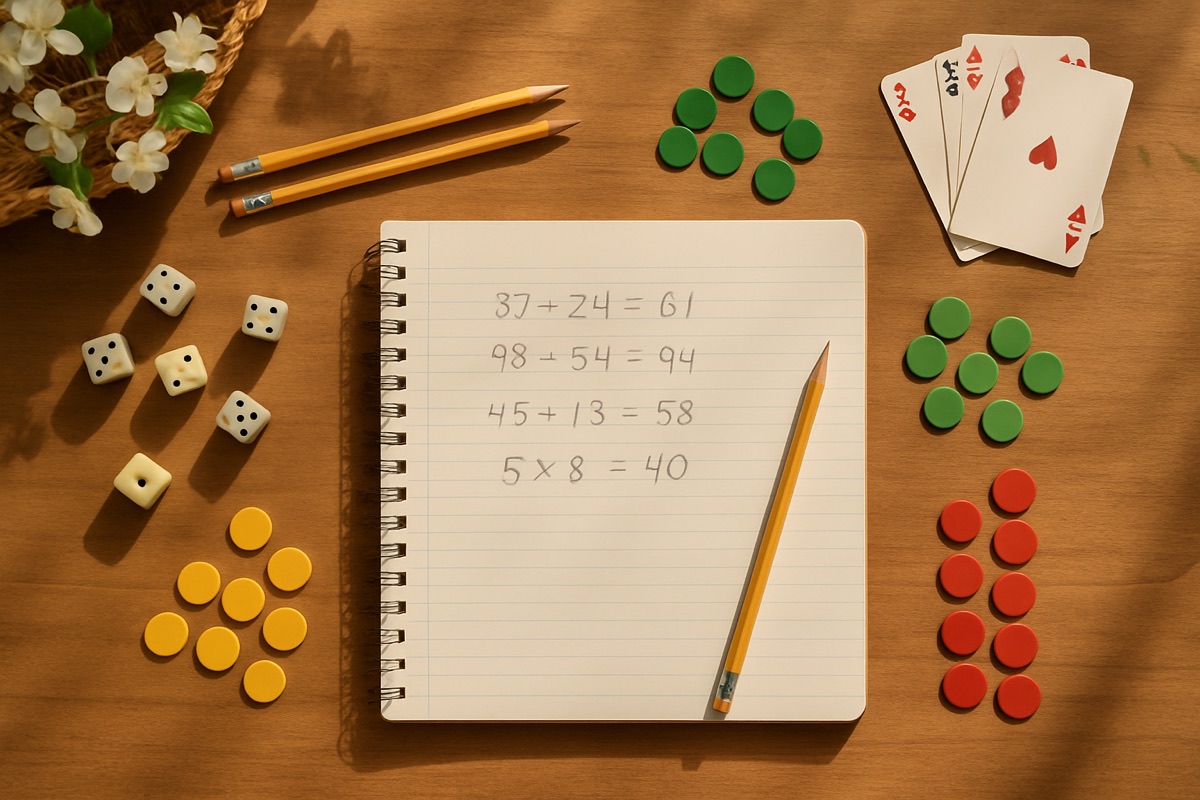
Spring break is a week off, and it should feel like one. I've never once told a parent to run a mini math camp at the kitchen table during vacation. Kids need the rest, and honestly so do you. But a full week with zero math has a small cost, especially for kids who are already shaky, because the facts get a little rusty and the first day back at school lands harder than it needs to. The fix is not worksheets. The fix is a handful of spring break math activities that hide inside a week you were going to have anyway.
The whole idea here is a few minutes a day, folded into things you're already doing, with no sitting-down-to-do-math energy at all. Rest comes first. Math rides along.
Cook something together and let the recipe do the teaching
A recipe is a math worksheet that ends in cookies, which is a much better deal than the usual kind. Doubling a batch is real multiplication. Cutting one in half is real fractions. Measuring three quarters of a cup means a kid has to actually reason about what three quarters means, with a measuring cup in their hand instead of a diagram on a page.
Pick one thing to bake over the week and let your kid run the numbers. "The recipe makes twelve muffins and we need twenty-four, so what do we do to every ingredient?" A second grader wrestling with doubling one and a half cups of flour is doing more honest math than a page of drills, and nobody feels like they're doing school. Then you eat the results, which no worksheet has ever offered.
Put small money in their hands
Vacation usually means a few small purchases, and small purchases are a quiet math gift. Hand your kid a five dollar bill at the store and let them figure out what they can get and how much change they should expect. Making change is subtraction that actually matters to them, because the answer is their own money.
For a younger kid, keep it to counting coins into a total. For an older one, add a wrinkle: "If it's two dollars each and you have seven dollars, how many can you buy, and what's left over?" That's division with a remainder, dressed up as a snack run. Some easy versions to keep in your back pocket:
- Count the change from a purchase and check it against the receipt
- Split a bill three ways at a casual lunch
- Figure out the total for two of something before you get to the register
- Compare two sizes and work out which is the better deal per unit
Use the trip itself, if you're going anywhere
Travel is packed with numbers if you point at them. How many hours until we get there, and if it's ten now, what time do we arrive? How many miles are left, and if we go about sixty an hour, roughly how long is that? A kid tracking the trip odometer and estimating arrival time is doing arithmetic and estimation without any idea that's what it is.
Even a staycation works. Playing card games at home is loaded with math. A game of War is pure comparing numbers. Blackjack, played for toothpicks, is fast mental addition your kid will do eagerly because they want to win. Yahtzee is addition and a little probability. A deck of cards on a rainy vacation afternoon does more for number sense than most apps, and it costs almost nothing.
Keep any formal practice tiny and optional
If your kid is one who benefits from staying warm on their facts, keep the formal part small and short. Five honest minutes a day, tops, and only on the days it fits. Not a marathon. Not a page they have to finish. The point over break is to keep the machinery from seizing up, not to teach new material.
Resist the urge to use the week to catch up by grinding, especially if your kid is behind. A week of forced drills over vacation mostly teaches a kid to resent both math and you. A few thoughtful problems a day, tied to real progress rather than to how many they cranked out, does far more good. If you lean on an app for those five minutes, pick one that rewards the click of understanding and not just time spent tapping. We built Math Prizes for our own kids partly for that reason, but a deck of cards or a batch of muffins covers most of what a break actually needs.
Let rest be the main event
Here is the part I most want parents to hear. The rest is not a math loss you have to make up for. A kid who comes back from spring break relaxed, who slept in and played and got a little bored and had to invent something to do, is in better shape to learn than one who was drilled through the break. Boredom is where a lot of good thinking gets born. Do not schedule it away.
So bake the muffins, hand over the five dollar bill, play the card game, and then genuinely let the rest of the week be rest. A few minutes of real-world math sprinkled across seven days is plenty to keep the facts from going cold. The vacation is the point. The math just gets to come along for the ride.