Productive Screen Time vs Junk Screen Time: How To Tell at a Glance
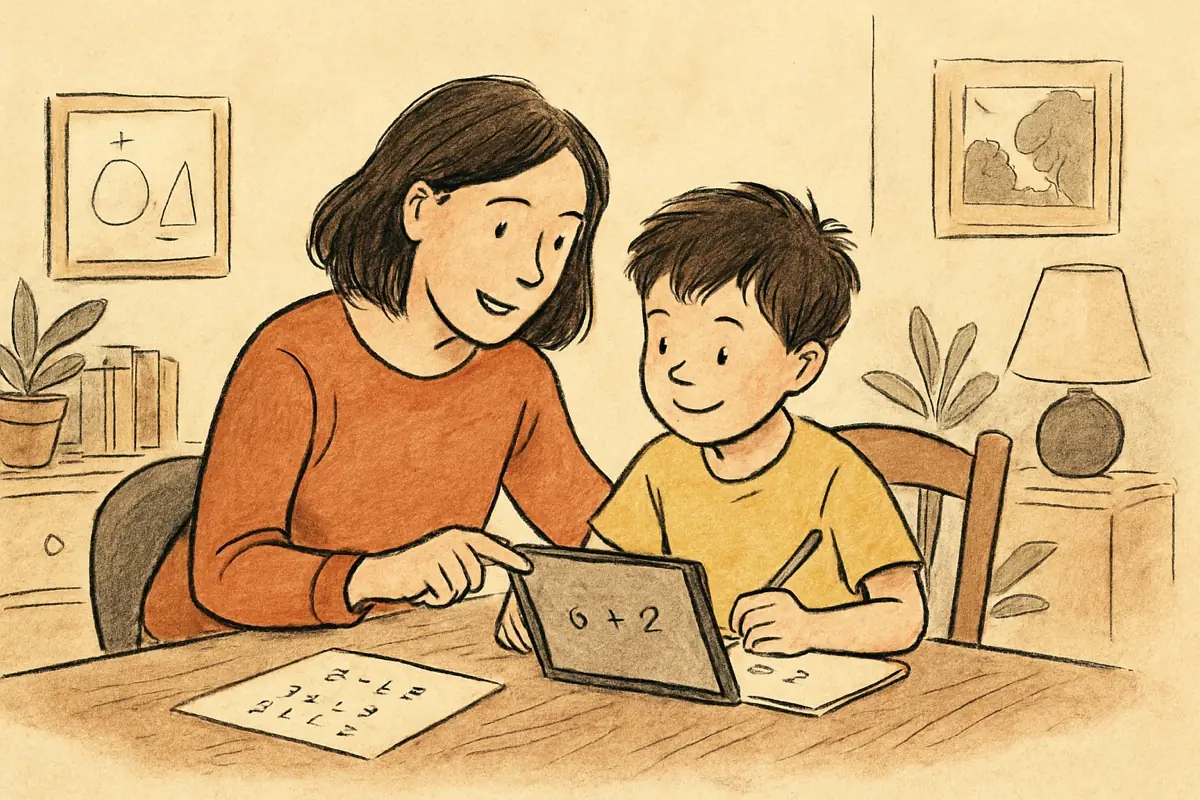
I watched a second grader named Marcus play a "math" game on a school iPad for eleven minutes one morning. He tapped a spinning wheel, collected coins, dressed up a cartoon fox, and answered exactly two addition problems the whole time. He was busy. He was smiling. He learned almost nothing. That gap, between looking busy and actually learning, is the whole difference between productive vs junk screen time, and after 16 years in a classroom I can usually spot it faster than the loading screen finishes.
I'm not anti-screen. I've used good apps to help kids who were stuck, and I've watched a well-made program do in a week what my worksheets could not. But I've also watched a lot of shiny junk. The trick is knowing what to look at.
What "productive" actually means
Productive screen time is time where your kid is doing the thinking, and the app is mostly getting out of the way. Junk screen time is the opposite. The app does the entertaining, and your kid mostly reacts.
Here is the plainest test I know. Watch your child use the app for two minutes and ask yourself: who is working harder, the kid or the software? If the screen is exploding with animation, sound, and rewards while your kid pokes at it now and then, that's junk. If your kid is quiet, a little furrowed, actually solving something, that's the good stuff. Real learning looks a bit boring from the outside. It looks like effort.
That's uncomfortable to hear, because the boring-looking apps are a harder sell to a seven year old. But the ones that feel like a party are usually a party and nothing else.
The signals I check first
I don't need to read reviews or a research summary to make a first call. I look for a handful of things, and I can spot most of them in about a minute.
- How often does a real question show up? Count the actual problems in the first two minutes. If it's two, like Marcus, that's a red flag. If it's fifteen, the app respects your kid's time.
- What happens after a wrong answer? A good app slows down and shows the child how to think about it. Junk just flashes a sad noise and moves on, or worse, gives the answer so the kid can tap through.
- Are the rewards tied to actual progress? Coins for solving hard problems, fine. Coins for logging in, spinning a wheel, or just tapping around, not fine. If a kid can earn the prize without learning, they will, every time.
- Can your kid get "stuck" in a good way? Productive apps let a problem be a little too hard, then help. Junk apps never let a kid feel challenged, because a bored kid closes the app and a frustrated kid closes the app, so they aim for a numb middle.
- Is there a timer or a wheel begging them to come back? Streak pressure and daily-spin gimmicks aren't there for your child. They're there for the app's numbers.
None of these require you to be a teacher. You just have to watch for a minute or two with a slightly skeptical eye.
The candy problem
I think about it like the snack cabinet. Candy isn't evil. But if my whole afternoon plan is candy, something's gone wrong, and if the candy is dressed up to look like broccoli, that's worse, because I stop paying attention.
A lot of apps are candy dressed as broccoli. They put the word "learning" on the box, then build the same loops a slot machine uses: near-misses, surprise rewards, a jackpot sound. Kids feel great and remember nothing. I had a parent last year tell me her daughter played a spelling app for forty minutes a day and still couldn't spell the week's words. When I looked at it, the "spelling" was three seconds of typing wrapped in five minutes of decorating a virtual bedroom. The bedroom was the point. The spelling was the excuse.
Once you notice the pattern, you can't unsee it. And that's a good thing. It means you can walk past the box and check what's actually inside.
A one-minute checkup you can do tonight
Grab whatever app your kid uses most and sit next to them. You don't need to announce an inspection. Just watch and count.
In sixty seconds, notice three things. How many real problems did they solve? What happened the one time they got something wrong? And could they have earned any reward without thinking hard? That's it. If the answers are "a bunch," "it helped them," and "no," you've found productive screen time. Keep it.
If the answers are "barely any," "it just moved on," and "sure, they just tapped," you've found junk. You don't have to ban it forever. But you can move it out of the learning slot and be honest with yourself that it's entertainment, which is fine as long as everyone knows that's what it is.
I'll say the quiet part too. When we built our own math app for our kids, the hardest design fights were exactly here, because the cheap tricks work. It is genuinely easier to keep a child tapping than to keep a child learning. We kept choosing the harder version, tying every reward to real progress instead of busywork, and it made the app less flashy. I've made my peace with that. A kid who earns a prize by actually mastering something walks away with two things, the prize and the skill. A kid who earns it by spinning a wheel walks away with a habit of spinning wheels.
What to do with the junk you already own
You probably have some junk apps. That's normal. I'd be a hypocrite to pretend my own kids don't have a couple.
The move isn't a big dramatic purge. It's just relabeling in your own head. Some screen time is learning, some is fun, and problems start when we let fun wear a learning costume and count it as school. Put the honest-fun apps in the fun budget. Protect the learning time for the things that actually ask your kid to think.
Marcus, the coin-collecting second grader, got switched to something quieter a few weeks later. The first day he complained it was "boring." By the end of the month he was racing himself on his addition facts and telling me his times. Nobody spun a wheel. He just got better at math, and getting better turned out to be its own kind of fun. It usually is, once we stop drowning it out.