Play Based Learning at Home: How Playing Math Beats Drilling It
Last spring I watched a first grader named Priya lose her mind over a worksheet of twenty addition problems, then twenty minutes later happily add up the "cost" of six plastic groceries in a cardboard store we'd set up in the corner. Same math. Same kid. Same day. The worksheet was a wall. The store was a game she didn't want to end. Nobody had to convince her that 4 plus 3 mattered when she was making change for a customer who was, in this case, a stuffed penguin.
That gap is the whole case for play based learning math at home. It's not that worksheets are evil. It's that a worksheet asks a kid to care about numbers with no reason attached, and a game gives the numbers a job to do. When the math has a job, the kid's brain treats it as real, and real things stick.
Why the brain holds on to play and lets go of drills
Here's what I've seen over sixteen years, and what the research keeps backing up. When a child does something with a purpose they can feel, they build a mental picture to go with the numbers. Priya wasn't just memorizing that 4 and 3 make 7. She was watching seven things pile up on a counter. That picture is what she reaches for later, in second grade, when the problems get harder and pure memorization runs out.
Drilling can build speed, and speed matters. Nobody wants a fourth grader still counting on fingers for 6 times 7. But speed built on top of a picture is sturdy, and speed built on nothing is a memorized trick that falls apart the first time the problem looks a little different. Play builds the picture first. That's the order that works, and it's the order most worksheets skip.
The math is already in your house
You don't need to buy anything or set up a classroom store like I did. The math is sitting in your kitchen right now. The trick is to notice it out loud and hand a piece of it to your kid.
- Cooking: doubling a recipe is fractions and multiplication, and the payoff is cookies. "We need half a cup twice, so how much is that?"
- Setting the table: "Five of us, so how many forks? How many if Grandma comes?"
- The grocery run: give a seven-year-old a small budget and let them figure out if two items fit inside it.
- Card games: War teaches greater-than and less-than in about four minutes with no explanation. A deck of Uno is a place-value lesson nobody notices.
None of that looks like school, which is exactly why it works. The kid isn't bracing for a math activity. They're just cooking, or playing, and the numbers ride along.
Dice, coins, and a jar of buttons
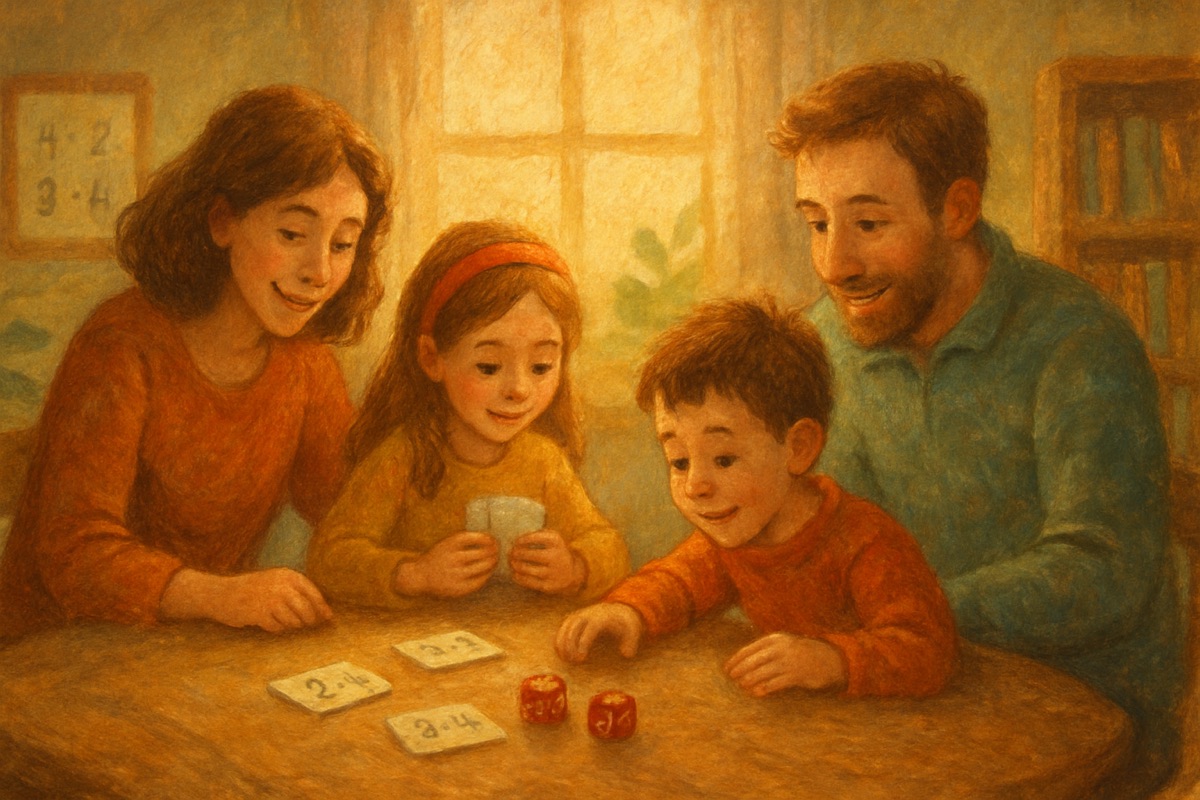
If you want something a little more deliberate, the cheapest tools beat the fancy ones. Two dice and a willingness to keep score will carry you a long way. Roll two, add them, and whoever hits fifty first wins. That's a real addition workout dressed up as a race, and a kid who groans at a worksheet will beg for one more round.
Coins are even better, because money is the most honest math a young kid meets. Dump a handful of change on the table and ask how many ways they can make thirty cents. There's no single worksheet answer. There are a dozen right ones, and the kid gets to find them. That open-ended feel, where the child is exploring instead of hunting for the one blank you want filled in, is the thing play does that drilling can't.
A jar of buttons or dry beans does the same job for grouping and early multiplication. "Make me four piles of five." Now they can see twenty. Later, when a worksheet says 4 times 5, they've got something real to point their memory at.
Keeping it play, not homework in disguise
There's a way to ruin all of this, and I've done it, so I'll warn you. The moment a game starts to feel like a test, the kid smells it and the fun drains out. If you're standing over them correcting every count and keeping a mental tally of their misses, you've turned the pretend store back into a worksheet with extra steps.
A few things keep it honest:
- Let them make mistakes and self-correct. If Priya gives too much change, the penguin can politely mention it. You don't have to be the red pen.
- Play alongside them, not at them. Roll your own dice. Lose sometimes, and lose for real.
- Don't tack on "so what did we learn today?" The learning happened. Naming it turns play into a lesson and breaks the spell.
- Follow their interest. A dinosaur kid will count dinosaurs forever. Use the dinosaurs.
This is also why I'm careful about screen based math, even the apps I like, including Math Prizes, which some of my families use at home. A good one rewards actual progress and understanding, not just tapping and grinding for points. A bad one is a worksheet with sound effects. If the game part is only a wrapper around drilling, the kid figures that out fast, and you're back where you started.
What to expect if you switch
Don't expect play to make your kid instantly faster at their times tables. It won't, and that's fine. What it builds is quieter and more important: a kid who isn't scared of numbers, who reaches for a mental picture instead of freezing, who thinks math is something you do rather than something that's done to you.
Priya still had to learn her facts cold eventually. Every kid does. But she learned them sitting on top of a year of pretend stores and dice races and counting groceries for a penguin, and that foundation held. Start with the play. The speed comes later, and it comes easier when there's something underneath it.