No Prep Math Games You Can Start in the Next 60 Seconds
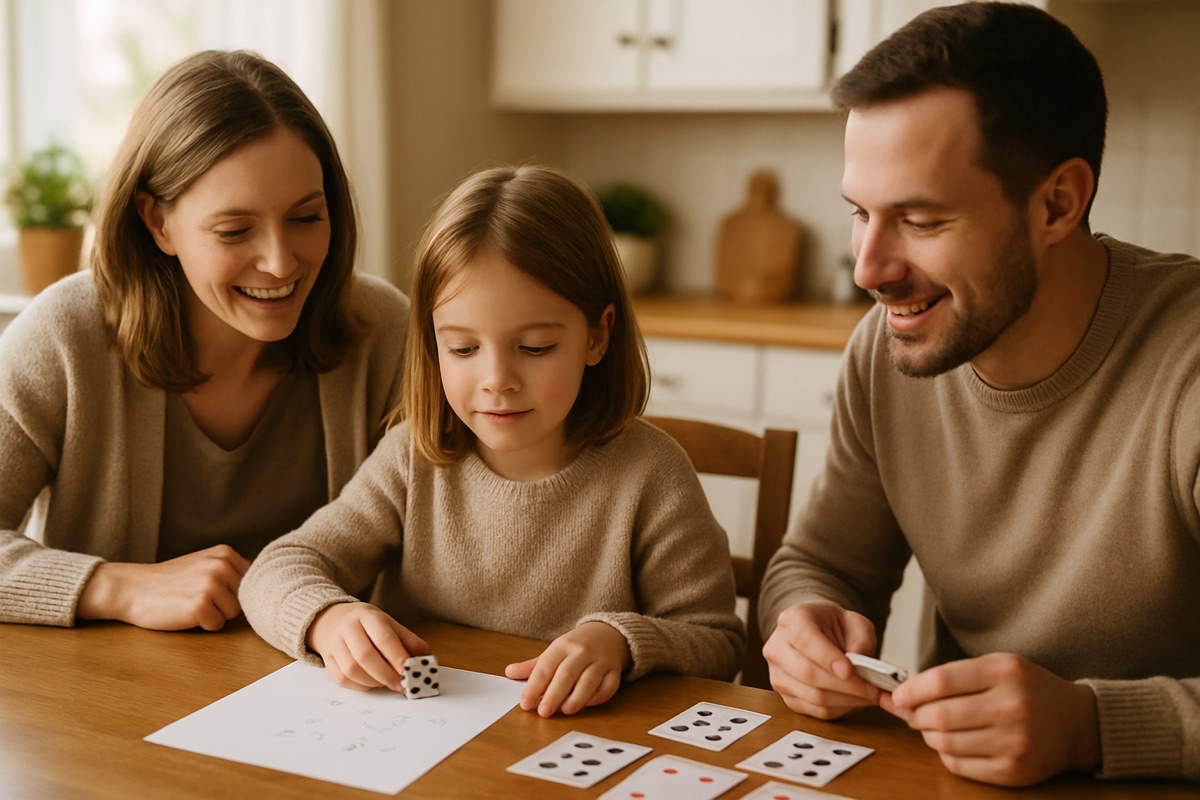
The pasta's boiling and you've got eight minutes
You've got a kid orbiting the kitchen, dinner's not ready, and you're not about to dig out a workbook. This is the exact moment no prep math games earn their keep. No printing, no laminating, no hunting for the dice that rolled under the couch three months ago. Just your voice, maybe a deck of cards, and a few minutes you were going to spend anyway.
I've taught elementary math for years, and the games I reach for most at home need nothing. That's the whole point. The best math practice is the kind that happens without anyone announcing it's practice time, because the second a kid hears "let's do some math," half of them shut down. These slide in sideways.
Games that need literally nothing but your voice
Start here, because you can play these in the car, in line at the store, or while brushing teeth.
- Guess My Number. You think of a number in a range. "I'm thinking of a number between 1 and 100." They guess, you say higher or lower. Kids figure out fast that guessing 50 first is smarter than guessing 3. That instinct, cutting the range in half, is real mathematical thinking they'll use for years.
- Counting by. "Let's count by 4s and see how high we get before the light turns green." Skip counting is the on-ramp to multiplication, and doing it out loud in the car costs you nothing.
- The answer is 12. Flip a normal fact question backward. Instead of asking "what's 6 times 2," you say "the answer is 12, give me a way to get there." Kids come up with 6 plus 6, 3 times 4, 24 divided by 2. This one problem has a dozen right answers, which is exactly why it builds flexible number sense instead of one memorized path.
- Would you rather, math edition. "Would you rather have 3 bags of 4 cookies, or 2 bags of 7?" They have to actually compute both to answer. Cookies make them care.
Grab a deck of cards and you've got ten more
A deck of cards is the single best math toy in your house and it's probably in a drawer right now. Pull the face cards or make them worth 10, your call.
- War, but you add. Both players flip two cards and add them. Higher sum takes all four. It's regular War with addition baked in, and kids will play it long past the point you're tired of it. For older kids, multiply the two cards instead.
- Make 10. Deal out cards face up and race to grab pairs that add to 10. Fast, loud, and it drills the number bonds that make mental math work later.
- Closest to 100. Each player draws four cards and arranges them into two two-digit numbers that add up as close to 100 as possible without going over. This one sneaks in place value and estimation, and it's genuinely fun to try to beat.
One deck. That's the whole supply list. If you don't have cards, a phone calculator app can generate numbers, but honestly the cards are better because there's something to hold.
Turn a real errand into the game board
The strongest math practice is tied to something the kid already cares about, so let the actual world be the game.
At the grocery store, hand a kid a rough budget and a job. "We need apples, and we've got five dollars for them. Figure out how many we can get." Suddenly they're doing division and estimation because it decides whether they get the apples. In the car, license plates are a goldmine: add the digits, or ask whether the sum is even or odd, or find a plate whose numbers make 20. Setting the table is counting and division without a worksheet in sight ("we've got 6 people and 24 forks, how many does each person get if we split them even?").
None of this requires you to prep anything. The errand was happening regardless. You're just narrating the math already inside it.
Why no prep often beats the fancy stuff
Here's something I've watched play out for years. Parents buy the beautiful boxed math game, play it twice, and it moves to the top of a closet. The games that actually stick are the ones with zero setup cost, because the barrier to starting is what kills a good habit, not the quality of the game.
There's also a deeper reason the simple ones work. A lot of flashy math products are really about volume, do 40 problems, tap 40 times, earn a badge. That's grinding, and kids can smell that it's busywork. A single round of Guess My Number, where a kid is genuinely reasoning about how to narrow a range, does more for their actual thinking than a stack of identical problems. Real understanding comes from wrestling with a small number of interesting questions, not racing through a big pile of dull ones.
If a screen game fits your night, that's fine too, and it's part of why we built our own with the anti-grinding idea in mind. But you don't need any app to get today's practice in. You need sixty seconds and a question.
Keep the bar low and the fun real
The trap with any of this is turning it into a chore. The moment "one more round" becomes "you have to do five more," you've lost the thing that made it work. Play until it stops being fun, then stop. Five good minutes beats twenty grudging ones, every time.
You don't need a plan or a printout. Next time you're stuck waiting on something with a bored kid nearby, pick one of these and just start. "I'm thinking of a number between 1 and 50." That's it. You're already playing.