My Second Grader Still Counts On Fingers: Is That a Problem?
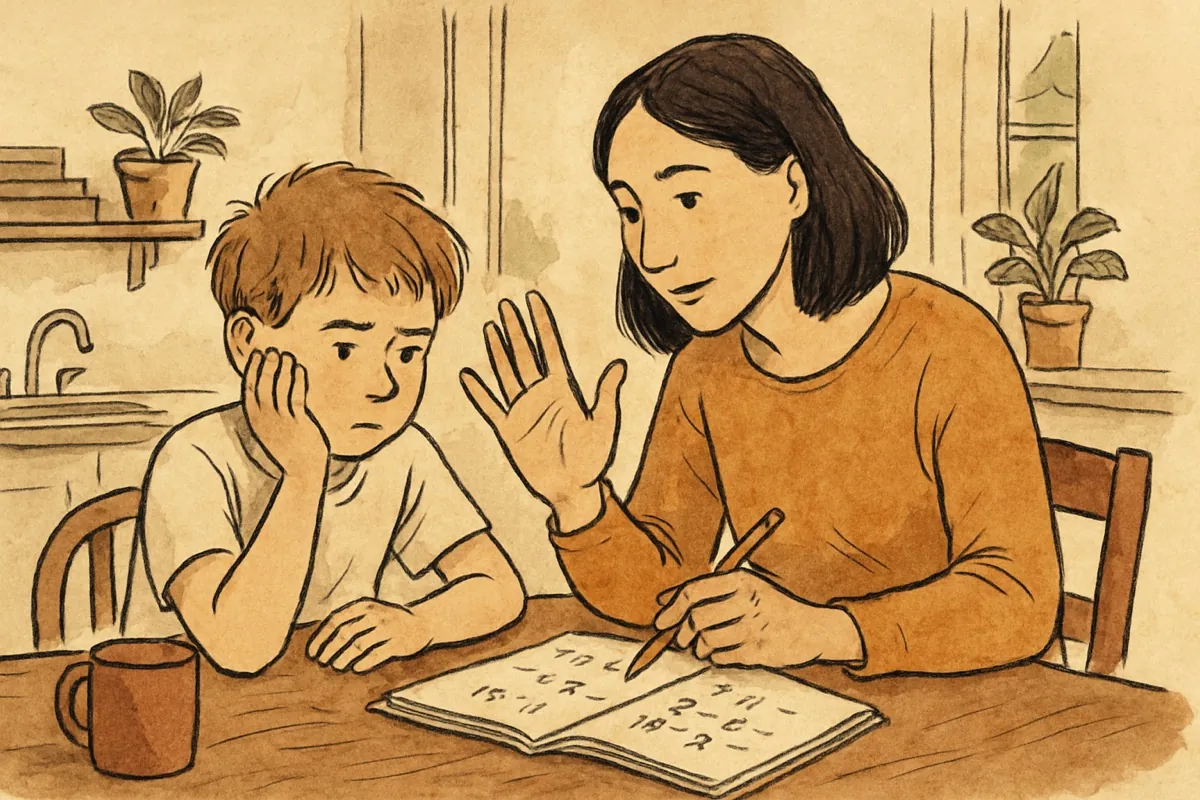
A mom stopped me at pickup last spring, half embarrassed, and asked if she should be worried. Her second grader, Ella, still counted on her fingers for everything. Six plus five, she'd tuck her thumb, count up, come out with eleven. Every single time. The mom had noticed other kids just knew it, and she was quietly panicking that she'd missed something.
I told her what I'll tell you. A child counting on fingers for math in second grade is usually not a problem. It's a stage. Fingers are the first calculator every human is issued, and they've been helping kids figure out numbers for a very long time. The real question isn't whether your kid uses fingers. It's what the fingers are doing.
Fingers are a tool, not a crutch
There's an old idea that finger counting is a bad habit to be stamped out. Most teachers I know disagree, and the research leans our way. Fingers give a kid something to see and touch while abstract number ideas are still forming. A five-year-old who counts on fingers is building the exact foundation they'll later stand on without them.
Think about how you learned to ride a bike. Training wheels weren't the goal, but taking them off too early just meant scraped knees and a kid who hated the bike. The wheels came off when the balance was ready. Fingers are the training wheels of arithmetic. The plan is to outgrow them, not to yank them away on a schedule.
So the presence of fingers isn't the alarm. What matters is whether the kid is slowly needing them less.
The difference between using fingers and depending on them
Here's the distinction I actually watch for in my classroom.
A kid who's on track uses fingers as a backup. They know a bunch of facts cold, and they reach for fingers only on the hard ones or the ones they haven't practiced yet. Six plus six might be instant while six plus seven still gets a finger check. That's a kid in the middle of the process, right where they should be. The facts are converting from "count it out" to "just know it," one at a time.
A kid I'd look at harder is one who counts everything, every time, with no facts sticking at all. Two plus two gets the full finger treatment in March the same as it did in September. There's no shift toward remembering. That's not a finger problem, it's a sign the facts aren't getting stored, and that's worth attention.
- On track: fingers for the hard ones, instant recall for the easy ones, and the "instant" pile slowly growing.
- Worth watching: fingers for everything, no facts becoming automatic, no change month to month.
Ella, it turned out, was the first kind. When I tested her, she rattled off the doubles and the pairs that make ten without hesitation. She only reached for fingers on the trickier combinations. She was fine. Her mom relaxed on the spot.
What actually helps facts stick
If you want to gently move a kid off fingers, the answer isn't "stop using fingers." It's to build so much fact fluency that the fingers become unnecessary. When six plus five is just known, nobody counts it. The counting stops on its own.
The way facts stick is spaced, low-pressure repetition. Not a hundred problems on Sunday, but a little bit most days. Five minutes of the right practice beats an hour of grinding, because a tired, frustrated brain doesn't file anything away.
A few things that work at home:
- Attack the doubles and the tens. Six plus six, seven plus seven, and the pairs that make ten (eight and two, six and four) are the anchor facts. Once a kid owns these, they can build the neighbors fast. Seven plus eight is just seven plus seven plus one.
- Play, don't drill. War with a deck of cards, where you flip two and add, gives a kid dozens of reps and feels like a game. Dice do the same. The math is identical to a worksheet, but the feeling is completely different, and the feeling decides whether they come back.
- Keep it short and daily. Ten minutes, then stop while it's still easy. Ending on a win is what makes a kid willing to sit down again tomorrow.
- Never shame the fingers. The fastest way to make a kid hate math is to make them feel dumb for how they're doing it. If a kid feels watched and judged, they tense up, and a tense brain counts slower, not faster.
That last point is the big one. A kid who's anxious about being caught counting will hide it, guess to avoid the shame, and learn less. Let the fingers be. Focus on building the facts underneath, and the fingers retire themselves.
When it's worth asking for help
Most finger counting sorts itself out. But there are a few patterns where I'd talk to the teacher, not to panic, just to get more eyes on it.
If a kid is well into third grade and still counting every basic fact with no recall building at all, that's worth a conversation. If they lose track while counting, count the same fingers twice, or can't tell that seven is more than five without counting up, those point to something more foundational than slow facts. And if math is producing real distress, tears, stomachaches, "I'm just dumb," the feeling needs addressing before any drill will help.
None of these mean disaster. They mean it's time to ask a teacher, who can check whether it's a fluency gap that practice fixes or something like dyscalculia that deserves a closer look. Asking early is always better than waiting and hoping.
The short answer
Your second grader counting on fingers is almost certainly fine. Fingers are how young kids do math while the facts are still moving into memory, and that move happens on its own timeline, a little slower for some kids than others. Watch for the trend, not the tool. If the pile of "just knows it" facts is quietly growing, you're watching learning happen, one finger at a time. If you ever gave Ella's mom a peek at the spring, she'd tell you the fingers were gone by summer, and nobody ever made a thing of it.