7 Real Signs Your Child Is Struggling With Math (Not Just Being Lazy)
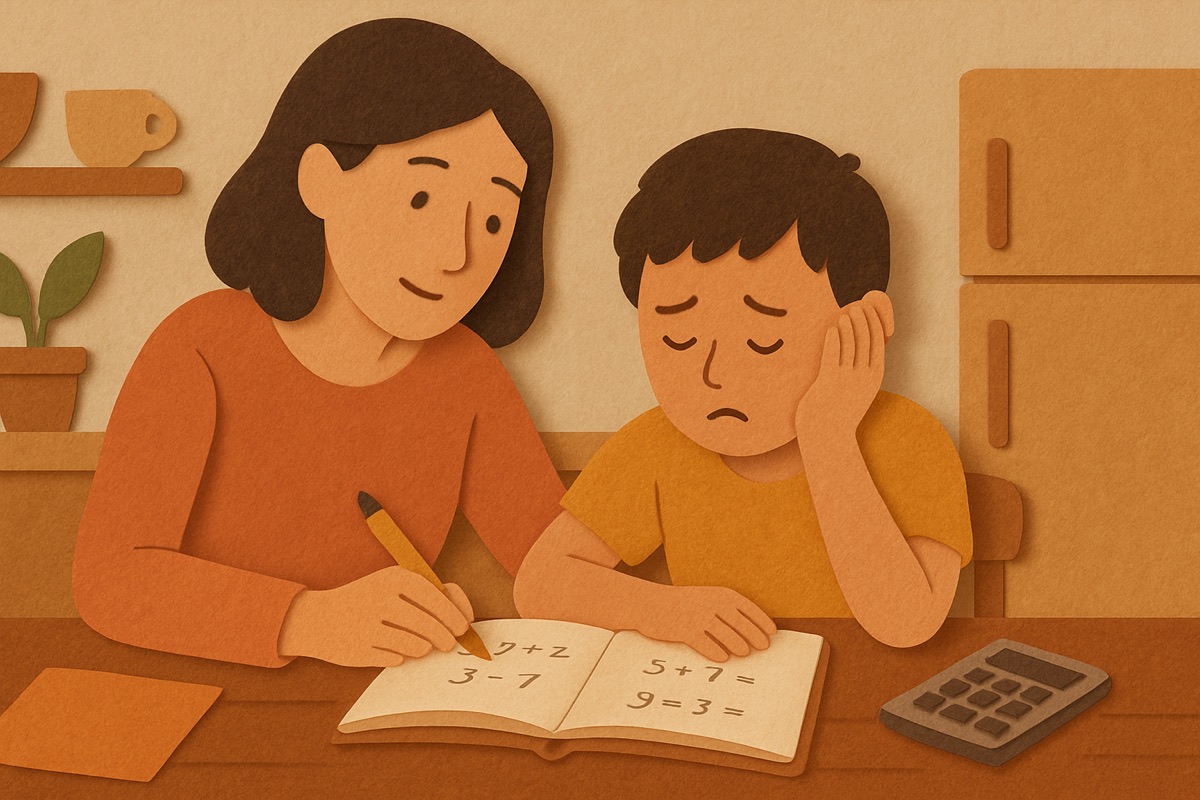
I once had a third grader named Marcus who could tell you the plot of every book he read but would put his head down the second I handed out a math page. His mom thought he was being lazy. He wasn't. He couldn't hold the steps of a two-digit subtraction problem in his head long enough to finish one, so every page felt like starting a race he'd already lost. The behavior looked like an attitude problem. It was actually a skill problem wearing a costume.
That's the thing about the signs a child is struggling with math. They almost never show up as "I don't understand this." They show up as avoidance, or slowness, or a kid who suddenly hates a subject he liked in September. After sixteen years in elementary classrooms, here's what I actually watch for.
1. Homework takes way too long for what it is
Ten problems should not take an hour. If your kid is spending forty-five minutes on something a classmate finishes in ten, that gap is information. It usually means the basic facts aren't automatic yet. When a child has to stop and count on fingers for 7 plus 8 in the middle of a bigger problem, the whole thing grinds to a halt.
Time is one of the clearest signals because it's easy to measure. Set a quiet timer for a normal assignment once and just watch. You're not looking to rush them. You're checking whether the machinery underneath is running smooth or seizing up.
2. They avoid it before they even try
Marcus put his head down. Other kids get a stomachache at exactly 6:40 when math homework comes out. Some sharpen every pencil in the house. Avoidance is rarely about laziness. Laziness is pretty even across subjects. When a kid will happily read for an hour but treats a single math page like a trip to the dentist, that's targeted, and targeted avoidance almost always means the thing feels unsafe.
Kids protect themselves from feeling dumb. Refusing to start is a way of never being wrong. If you see effort everywhere except math, believe the pattern, not the excuse.
3. They can get the answer but can't explain it
This one fools a lot of parents because the paper looks fine. Ask your child how they got 24, and if the answer is "I don't know, I just did it," pay attention. Real understanding comes with a story. "I counted by sixes" or "I knew ten fives was fifty so I took one away." A kid who can only produce the number, with no path behind it, is often copying a procedure they don't actually own.
Procedures fall apart the moment the numbers change. Understanding travels. That's why I'd rather a kid explain a wrong answer with good reasoning than nail a right one they can't account for.
4. Old skills keep leaking out
You'd swear they knew this last month. Then it's gone. If your child masters something and it evaporates a few weeks later, over and over, that's a sign the skill never really set. It got memorized for a quiz and then washed out.
Math stacks. Everything sits on the thing before it. So when the floor keeps disappearing, the kid isn't being careless. The foundation was thinner than it looked. Some things to notice:
- Facts that were "known" now need finger counting again
- A method taught in class that they can't reproduce at home two days later
- Confusion between operations, like adding when the problem calls for multiplying
5. Word problems shut them down completely
I've watched sharp readers freeze solid on word problems. They can decode every word on the page and still have no idea what the problem is asking them to do. That's not a reading issue. It's that nobody ever taught them how to translate a sentence into an operation.
If your kid does fine with 45 minus 18 written plainly but panics when it's dressed up as a story about apples, the gap is in the translating, not the arithmetic. That's actually good news, because it's a specific, teachable thing.
6. The self-talk turns dark
"I'm just not a math person." "I'm dumb at this." "I always get these wrong." When a child starts narrating their own failure, the struggle has moved from the paper into how they see themselves, and that's the version that does lasting damage.
A kid who has decided they're bad at math stops trying, and a kid who stops trying falls further behind, which seems to prove the story true. Breaking that loop matters more than any single skill, because the belief is what keeps the door shut. Watch for the language. It tells you how deep things have gone.
7. Grades slip in one subject while everything else holds
If reading, science, and writing are all steady and math is the one line heading down, that's a clean signal. A struggling child isn't struggling everywhere. Laziness or a rough patch at home tends to spread across the board. A dip in a single subject points to something specific inside that subject.
Report cards are blunt tools, but a consistent gap between math and everything else is worth taking seriously. It's the difference between "my kid is having a hard year" and "my kid has a hole in math that needs filling."
What to do once you see it
The mistake I see most is more of the same. A kid struggles with a worksheet, so the answer is another worksheet just like it. That's grinding, and grinding on a shaky foundation mostly teaches a kid to hate math faster.
Instead, drop down a level. Find the last thing they truly understood and rebuild from there. If a fourth grader can't do long division, check the multiplication facts underneath it first. Nine times out of ten the real work is a year or two below where the tears are happening. Keep the practice short. Ten honest minutes a day beats an hour of frustration, and tie any reward to real progress, not to how many problems got scribbled down. We built Math Prizes for our own kids partly for this reason, so the payoff lands when a skill actually clicks, not when a box gets checked.
And say the thing out loud that they need to hear. Struggling with math is not a character flaw and it isn't permanent. Marcus got there. By spring he was raising his hand. The head-down kid became the kid who wanted to show me his work. Nothing about him changed except that we found the real gap and filled it, and he found out he could.