Grocery Store Math: Turning a Shopping Trip Into a Lesson
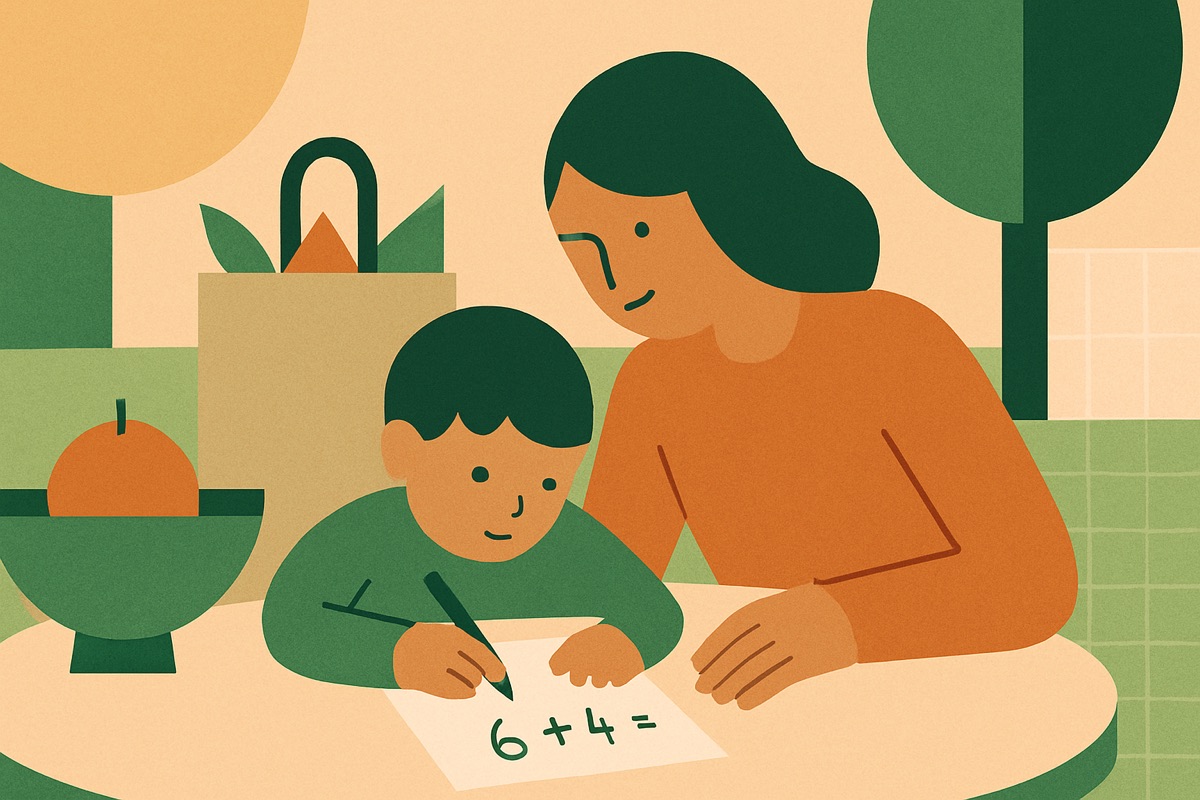
My grandmother taught me more math in the grocery store than I learned in some full years of school, though I doubt she'd have called it teaching. She'd hand me two cans of tomatoes and ask which was the better deal, and stand there, cart parked, until I worked it out. I hated it a little at the time. But grocery store math for kids is one of the best deals going, because the numbers are real, the stakes are real (we actually bought the cheaper can), and nobody has to pretend to care about a made-up train leaving a station.
School math can feel abstract to a kid. The store makes it concrete. Prices, weights, quantities, and a running total are all just math wearing an apron. And you're already there every week, so it costs you nothing but a little patience and a slower trip down the aisle.
Why the store beats a worksheet
The reason this works isn't that a store is more fun than a worksheet, though it usually is. It's that the math has a point. When your kid figures out that the 24-ounce jar is cheaper per ounce than the 16-ounce, and you actually put it in the cart, she's learned that math is a tool for getting something she wants, not a hoop to jump through.
That shift matters more than any single skill. A kid who sees math as useful keeps doing it. A kid who sees it as a chore looks for the exit. The produce section quietly makes the case that numbers pay off, and it makes that case better than I ever could standing at a whiteboard.
There's also no grinding here. You're not asking for forty problems. You're asking for one real question at a time, spread across a normal trip. That's exactly the kind of short, thoughtful practice that actually sticks.
Real things to try, by rough age
You don't need a plan. You need a handful of go-to questions you can pull out while you shop. Match them loosely to where your kid is.
For the younger crowd (roughly K through second grade):
- Counting with a purpose. "We need six apples. Can you put six in the bag?" Then have her count them back to check.
- Simple sorting and comparing. "Which pile of oranges is bigger?" "Are there more red peppers or green?"
- Coins and small totals. Let her hand over the cash for one item and count the change with you.
For the middle grades (roughly third through fifth):
- Unit price, the classic. "This box is $4.00 for 8, and this one's $5.50 for 12. Which is the better deal per item?" This is division and reasoning in one shot.
- Running estimate. Have her keep a rough total in her head as you shop and guess the final number before checkout. Estimation is a real skill and stores are built to practice it.
- Weight and money together. "Grapes are $2.49 a pound and we've got about two pounds. Roughly what's that?"
For older kids who can take more:
- Percentages off. "This is 30 percent off $20. What do we pay?" The sale signs do the setup for you.
- Sales tax and the true total. Have her add the tax and predict the receipt.
- Comparing across units. Cost per ounce versus cost per serving, when the packages play games with sizing.
Make it a real question, not a pop quiz
Here's the part that decides whether this works or turns into a fight. Ask like you actually want to know, not like you're testing her.
There's a real difference between "Quick, what's 30 percent off twelve dollars?" fired across the cart and "Huh, I can't tell if this sale is actually a good deal, what do you think?" The second one invites your kid in as a partner. The first one feels like school ambushing her at the store, and kids can smell a pop quiz from the cereal aisle.
Let her use a strategy that isn't yours. If she rounds $2.49 to $2.50 to make the math easier, that's not cheating, that's exactly what good math thinkers do. If she gets it wrong, resist fixing it instantly. Ask "how'd you get there?" and let her find her own mistake. That's where the actual learning lives, in the figuring, not in the answer you hand her.
Keep it light, keep it short
One warning, because I've seen parents overdo this and sour the whole thing. Don't turn every single item into a math problem. If your kid has to solve an equation to earn each thing that goes in the cart, the store becomes a worksheet with a shopping cart, and she'll dread it. Grinding is grinding, whether it's on paper or in aisle seven.
Pick two or three moments a trip. Let the rest just be shopping. The goal isn't to squeeze in maximum reps, it's to keep the math feeling like a natural part of real life, the kind of thing a capable person just does. A little, done often and done lightly, builds number sense that no packet of problems can touch.
My grandmother never kept score. She just parked the cart, asked the question, and waited. Somewhere between the tomatoes and the checkout, I stopped being scared of numbers, because I kept quietly finding out I could handle them. That's the whole trick, and it's sitting there in your local store every week, waiting for you to slow down and use it.