Cooking Is a Math Class: Fractions, Doubling, and Time in the Kitchen
The measuring cup does the teaching
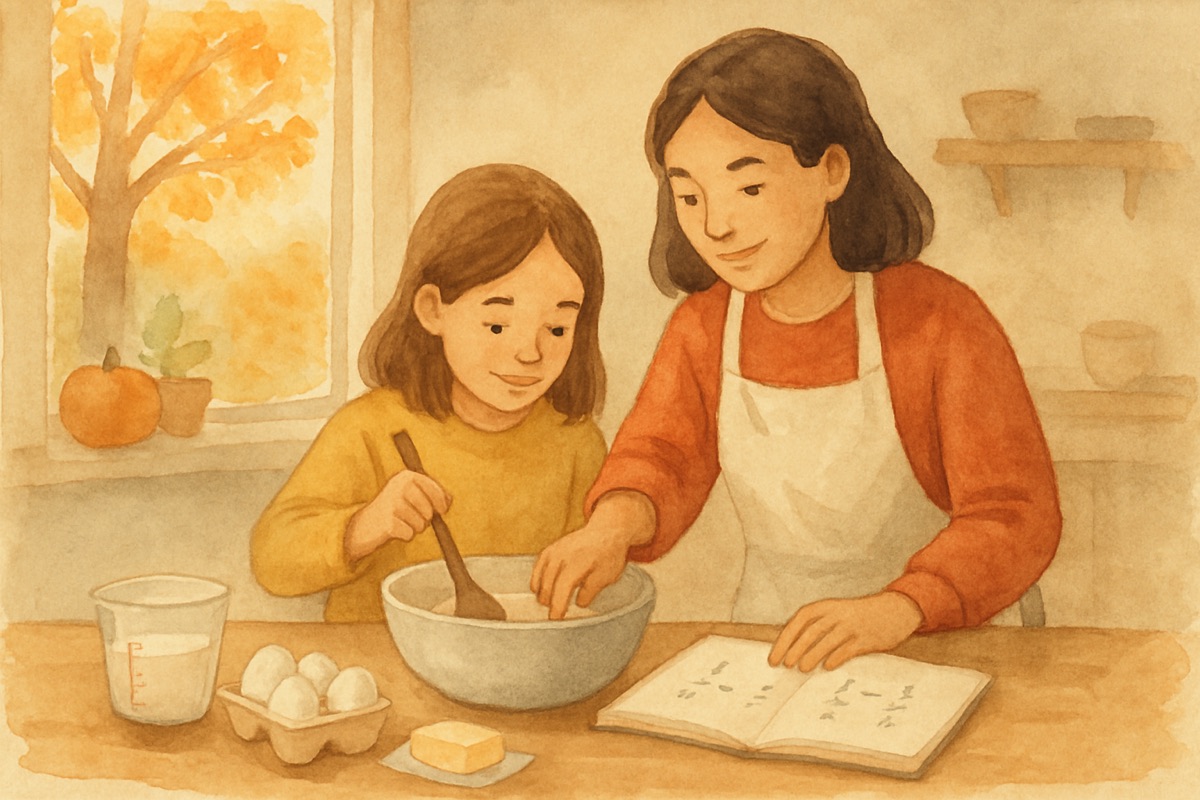
My daughter learned that two one-third cups make two-thirds standing on a step stool at the counter, flour on her sleeve, trying to figure out how to measure two-thirds of a cup when the only clean measuring cup left was the one-third. She poured it in, said "one," poured again, said "two," and then looked at me and said "so that's two-thirds." Nobody made her write it down. She needed the flour to make the muffins, and the math was just how you got the flour.
That's the thing about cooking math activities for kids. The math isn't bolted on. It's load-bearing. If you get the fraction wrong, the muffins are wrong, and the kid can taste the difference between too much salt and the right amount. Real stakes, real feedback, no red pen. A worksheet on fractions is abstract. A doubled batch of pancakes is a fraction problem your kid actually wants to solve.
Fractions you can hold
Fractions confuse kids on paper because there's nothing to hold. One-half of what? Half of a number floating in space. In the kitchen there's always a "what." Half a cup. A quarter teaspoon. Three-quarters of a stick of butter, which comes helpfully pre-marked in tablespoons so your kid can count them.
Try this the next time you bake. Hide the half-cup measure. Tell your kid the recipe needs a half cup of sugar and the only tools are the one-quarter cup and the one-third cup. Now they have to figure out that two quarter-cups make the half. They'll dump one in, look at it, and reach for the second one on their own. That's addition of fractions with a physical object, and it lands harder than any diagram of a pie ever did.
A few fraction moments that show up in almost every recipe:
- Two half-cups make a whole cup, so if the recipe calls for one cup and you only have the half, you scoop twice.
- Three teaspoons make a tablespoon, which is a fact kids find genuinely surprising and then never forget.
- A stick of butter is half a cup, so half a stick is a quarter cup, and now they've divided a fraction by two without knowing that's the scary name for it.
Doubling is multiplication with a reason
Here's where it gets good. You're making cookies for a class party and the recipe makes a dozen. You need two dozen. Everything on the list has to double, and your kid is now the one holding the recipe card doing the math.
Two eggs becomes four. Easy. Three-quarters of a cup of brown sugar becomes a cup and a half, which is not easy, and that's exactly the point. Doubling three-quarters is where a kid runs into the wall that separates "I can memorize times tables" from "I understand what multiplication does." Three-quarters plus three-quarters is six-quarters, and six-quarters is a cup and a half, and watching a kid work that out with two measuring cups in front of them is watching real understanding happen instead of memorized steps.
Halving is the same skill going the other direction, and honestly it's the harder one. You've got a recipe for eight and you're cooking for four. Now one and a half cups of flour has to become three-quarters, and one egg has to become, well, that's a whole conversation about what half an egg means and why we crack it into a bowl and eyeball it. Kids love that problem. It feels like a trick and it isn't.
Time is the sneaky one
The part of kitchen math nobody plans and everybody uses is time. Dinner has to be ready at 6:00. The chicken takes 40 minutes. The rice takes 20. The broccoli takes 10. When does each thing go in?
That's a real problem with a real deadline, and it's the kind of backward reasoning that shows up on tests as "elapsed time" and makes kids groan. In the kitchen it's not elapsed time, it's "when do I start the chicken so we're not eating at 6:40." Chicken at 5:20. Rice at 5:40. Broccoli at 5:50. Your kid can figure that out, and once they've done it for dinner a few times, the word problem on the test stops being a foreign language.
Give them the clock and the deadline and let them work backward. "We need to leave for practice at 6:30 and this needs to bake 25 minutes and rest 5. Latest we can put it in the oven?" That's subtraction with a purpose. They'll get it wrong once, dinner will run a little late, and the correction sticks better than any explanation from me ever would.
Why the kitchen beats the worksheet
The reason this works isn't that cooking is sneaky enough to trick kids into learning. It's that the math has a point. On a worksheet, the answer to problem seven is just the answer to problem seven. In the kitchen, the answer is muffins. A kid who couldn't care less whether two-thirds is bigger than one-half suddenly cares a great deal when it's the difference between enough batter and not enough.
There's also no busywork. A worksheet gives you thirty fraction problems whether you needed the practice or not. A recipe gives you exactly the fractions the recipe needs, which means every calculation your kid does is one that actually mattered. That's the kind of practice I want for a kid, the kind tied to something real, not the kind measured by how many boxes got filled in.
You don't need a special project or a designated "math day." You need a Saturday, a recipe you're making anyway, and the willingness to hand your kid the measuring cups and let them do the arithmetic instead of doing it for them. Halve the pancakes. Double the cookies. Let them figure out when to start the chicken. The flour on the sleeve is part of it.