Grade-Level Math Milestones: A Year-by-Year Cheat Sheet for Parents
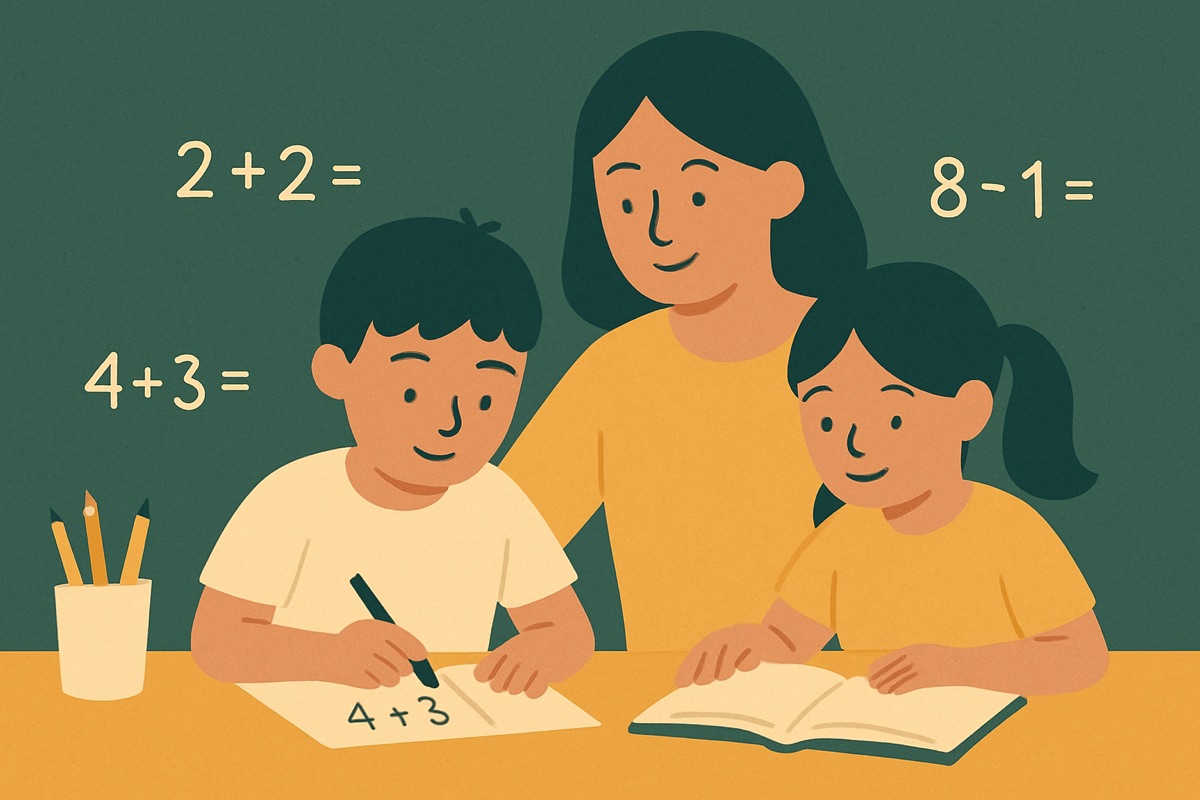
A dad stopped me at pickup once, worried sick because his first grader couldn't do multiplication. His neighbor's kid apparently could, and now he was convinced his own son was behind. I told him the truth. First graders are not supposed to multiply. His kid was exactly where he should be, and the neighbor's kid had just memorized a party trick without understanding it. That conversation happens more than you'd think, and it's why I keep a rough map of math milestones by grade in my head at all times.
Here is that map, laid out plainly. These are the big things kids pick up each year in most American schools. Every child wobbles, and a kid can be a few months ahead in one area and a few behind in another. That's normal. Use this to spot real gaps, not to panic over a single rough week.
Kindergarten: counting is the whole job
The entire year is about numbers being real, countable things. By spring, most kindergartners can count to 100, count a small pile of objects and land on the right total, recognize written numbers, and understand that seven is more than four. They start adding and subtracting within ten, usually with fingers or blocks, and that's exactly right. The fingers are not a crutch. They're the tool.
What matters most here is that counting means something. A kid who can rattle off "one two three four five" but can't hand you exactly five crackers hasn't connected the words to the amounts yet. That connection is the real milestone, not the recitation.
First grade: adding and subtracting within twenty
First grade takes those early number ideas and builds fluency. By the end of the year most kids can add and subtract within twenty, understand place value enough to know that 34 means three tens and four ones, and start telling time to the hour and half hour. They also begin seeing the relationship between adding and subtracting, that 8 plus 5 and 13 minus 5 are the same fact family.
Speed starts to matter a little here, but understanding still comes first. A first grader who counts up from eight to get thirteen is doing real math. It just needs to get faster over the year through use, not through drilling them into misery.
Second grade: place value and bigger numbers
Second grade is where numbers get bigger and place value gets serious. Kids work with hundreds, add and subtract two-digit and three-digit numbers, and hit the moment every parent remembers: regrouping. Carrying and borrowing. This is often the first time a kid meets a procedure that doesn't make sense until someone shows them the tens underneath it.
Second graders also start skip counting by 2s, 5s, and 10s, which quietly lays the track for multiplication next year. If you want one thing to reinforce at home this year, make it place value. A kid who truly gets that 253 is two hundreds, five tens, and three ones sails through the years after this. A kid who's just memorizing carrying steps hits a wall.
Third grade: multiplication and division arrive
This is the big year. Multiplication and division become the main event, and by spring most third graders can multiply and divide within 100 and know their times tables reasonably well. Fractions show up too, usually as parts of a whole, like recognizing that a pizza cut in four and one slice taken is one fourth.
Here's my honest advice for third grade. Understanding beats memorizing, but the facts still have to become automatic, because everything in fourth and fifth grade sits on top of them. A kid who understands that 6 times 4 is four groups of six but still counts them out one by one every time will drown in long division next year. Both things are true at once. Understand it, then practice until it's fast. Some milestones for the year:
- Times tables through 10, ideally reachable without counting
- Division seen as the flip side of multiplication
- Basic fractions of a shape or a set
- Multi-step word problems that combine two operations
Fourth grade: multi-digit operations and real fractions
Fourth grade scales everything up. Kids multiply multi-digit numbers, tackle long division, and go deeper into fractions, comparing them, adding fractions with the same denominator, and understanding equivalent fractions like one half equaling two fourths. Decimals often make their first appearance, tied to money and place value.
Fourth grade is where the earlier gaps come due. If multiplication facts never got automatic in third grade, long division becomes agony, because every single step requires a fact the kid doesn't have on hand. When a fourth grader is struggling, I almost always find the real problem a year or two below where the tears are happening. Fix the foundation, not the symptom.
Fifth grade: the bridge to middle school
Fifth grade pulls it all together and points at algebra. Kids add and subtract fractions with different denominators, multiply and divide fractions and decimals, work with volume, and meet the order of operations. They start handling expressions with more than one step, where you have to decide what to do first.
By the end of fifth grade, a kid who is on track can reason through a multi-step problem, explain why their answer makes sense, and move between fractions, decimals, and whole numbers without freezing. That flexibility is the real milestone, more than any single skill on the list.
How to actually use this
Read these as a rough current, not a rigid schedule. A child who is a grade behind in one narrow area and solid everywhere else usually just has a specific gap to fill, not a general problem. What worries me is not a single missing skill. It's a pattern, a kid who is behind across the board and slipping further, or one whose old skills keep leaking out a few weeks after they seemed learned.
If you spot a real gap, don't answer it with more grinding on the same frustrating page. Drop down to the last thing your kid truly understood and rebuild from there, ten honest minutes at a time. The map tells you where they should be. It doesn't tell you to rush. Kids arrive at these milestones on slightly different days, and almost all of them arrive.