Counting Coins and Making Change: Money Math That Sticks
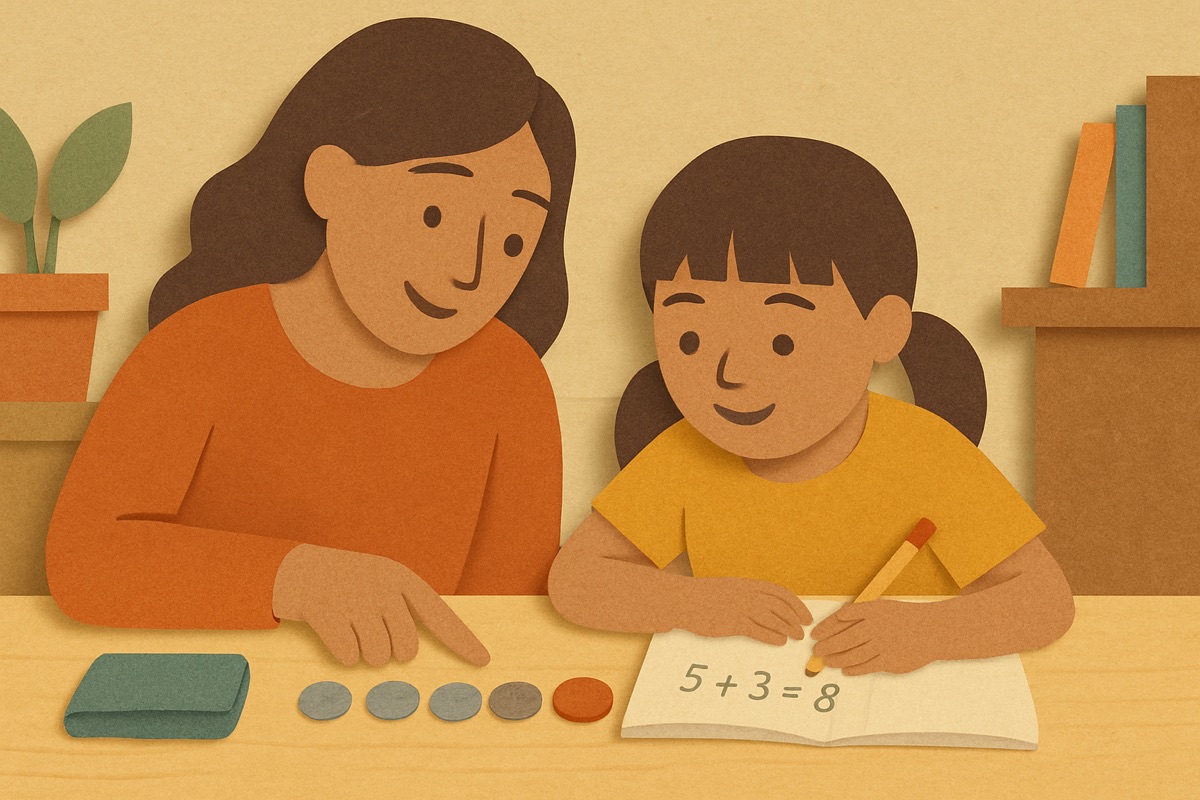
The nickel that's bigger but worth less
I watched a first grader named Ellie sort a pile of coins into stacks once, and she put the biggest coins in the tallest stack because, in her words, "these are the most money." The biggest coins were nickels. She'd built a beautiful, confident tower of the second-least-valuable coin in the pile. It made perfect sense to her, and it's the single most common reason kids struggle when you try to teach them to count money.
Everywhere else in a young kid's life, bigger means more. A bigger cookie is more cookie. A bigger cup holds more juice. Then coins show up and break the rule. The dime is smaller than the nickel and worth twice as much. The penny is bigger than the dime and worth a tenth as much. To count money, a child has to override an instinct they've spent their whole life building. That's not a small ask, and it's why coins deserve real, patient practice instead of one page in a workbook.
Start with knowing the coins cold
Before a kid can count money, they have to instantly recognize each coin and know its value without counting up to it. This sounds obvious, but it's the step most people rush.
Sit down with real coins, not pictures. The weight and the ridged edges and the different faces are part of how kids remember them. Go one at a time.
- Penny, one cent, copper colored, Lincoln on the front.
- Nickel, five cents, bigger and thicker, Jefferson on the front.
- Dime, ten cents, the little one, and yes, it's smaller even though it's worth more.
- Quarter, twenty-five cents, the big one everybody wants.
Spend a few days just on recognition. Hold one up, have them name it and say its value. Mix them in a cup and have them pull out "a dime" or "the coin worth twenty-five cents." Until this is automatic, counting a handful of mixed coins is going to be a slog, because they'll be stuck re-figuring each coin's value every single time.
Counting mixed coins is a skip counting problem
Here's where it connects to the math your kid is already doing. Counting a pile of coins is really just skip counting, then switching gears. You count the quarters by twenty-fives, then switch and count the dimes by tens, then the nickels by fives, then add the pennies one at a time.
The trick that makes it click is ordering. Teach your child to sort first, biggest value to smallest, then count from the biggest down. Quarters, then dimes, then nickels, then pennies. Counting 25, 50, 75, then jumping to 85, 95, then 96, 97, 98 is manageable. Counting a random jumble in whatever order you grab them is how kids lose track and give up.
If your child's skip counting by fives and tens is shaky, coins are a great reason to firm it up. Money gives the practice a point, and kids work harder when the numbers stand for something they'd actually want.
Making change is the harder, more useful skill
Counting a pile is one thing. Making change is where money math gets genuinely useful and, honestly, where a lot of adults are still a little fuzzy. The mistake is thinking of it as subtraction, because that's not how anybody actually does it in real life.
The real method is counting up. If something costs 65 cents and your kid hands over a dollar, you don't subtract 65 from 100 in your head. You start at 65 and count up to 100 using coins. "Sixty-five, plus a dime is seventy-five, plus a quarter is a dollar." Done. The change is a dime and a quarter, and your kid never had to borrow across a zero.
Counting up is more forgiving and it's how change actually gets made at a register. Practice it as its own thing. Say a price, hand them a dollar, and have them count up to it out loud with real coins.
Where the practice actually sticks
None of this sticks from a worksheet alone. It sticks when the money is real and something's on the line, even a tiny something. Here's what worked with my students and my own kids.
- Run a pretend store. Price a few things from the pantry, give your kid a coin bank as the register, and take turns buying and making change. Swap roles so they practice both counting a payment and giving change back.
- Let them pay for real. At the store, hand them the coins and let them count out the exact amount, or hand over a dollar and figure the change. It's slower. Let it be slower. The cashier will survive.
- Save toward something concrete. A kid counting their own coins toward a four-dollar toy is doing more math, more willingly, than any worksheet will get out of them. Real progress toward a real goal beats busywork every time.
- Use a jar with a line drawn on it. Watching the pile grow toward a goal turns counting into something they want to do, not something you make them do.
That last point matters to me. Money math is one of the first places a kid sees that arithmetic buys real things, and if you tie the practice to something they actually care about, the skill lands and stays. Grinding through coin worksheets teaches them to hate coins. Saving up for the toy teaches them what money is for.
Be patient with the backwards-feeling parts
The dime being smaller than the nickel will trip your kid up more than once, even after they "know" it. That's normal. They're overriding years of bigger-means-more, and that takes repetition, not a single explanation. Every time they meet real coins, the override gets a little stronger.
Ellie sorted coins by value by the end of that year, dimes and all. It wasn't because I explained the sizes better. It was because she'd handled real money enough times, paying for real things, that the values finally beat the instinct. That's the whole game. Give them the coins, give them a reason to count, and let the real world do the teaching.