Building a Home Math Corner With Stuff You Already Own
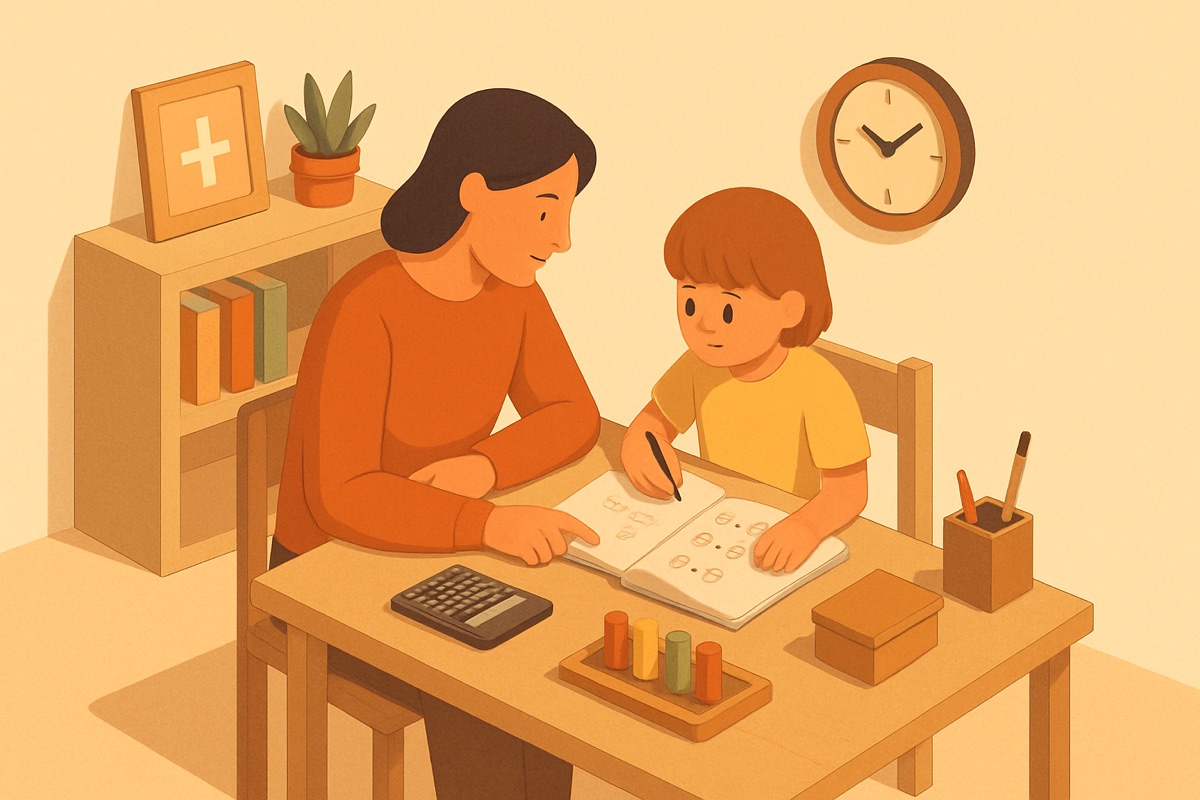
The best set of math tools I ever used in my classroom cost about four dollars. It was a coffee can full of dried lima beans. Kids grouped them, split them, traded ten for a paper "ten stick," and lined them up to count. When parents ask me what to buy for math manipulatives at home, I usually tell them to save their money and look in the kitchen first.
A home math corner isn't a store display. It's a small, reliable spot where the physical stuff lives so a kid can grab it without a hunt. That's the whole trick. Kids use the thing that's already out and easy. They skip the thing buried in a closet.
Why the physical stuff matters in the first place
Before I list objects, here's the reason any of this is worth doing.
Numbers are abstract. Six doesn't look like anything. But six buttons in your hand is a thing you can split into a pile of four and a pile of two, and suddenly the fact "4 + 2 = 6" isn't a sentence to memorize. It's a description of something the kid just did with his fingers.
Manipulatives let a kid test an idea before it becomes a rule. That order matters. When a child stacks two rows of five blocks and counts ten, then does it again, then a third time, he's building the idea that "five taken twice is ten" out of his own hands. The written fact comes later and it sticks, because it's describing something real instead of floating on its own.
The goal isn't to keep a kid on beans forever. It's to give the beans long enough to build understanding, then let them fade out once the idea holds. That's the difference between real learning and grinding through flashcards that never connected to anything.
What to raid from around the house
Here's what I'd actually gather. None of it needs a purchase.
- Small counters. Dried beans, buttons, pennies, LEGO, pasta, cereal. Anything you have forty or fifty of. These are your all-purpose counting and grouping tools.
- Coins. Real ones if you can spare a small jar. Pennies, nickels, dimes, quarters teach place value and skip-counting better than most worksheets, because the value is baked into the object.
- A deck of cards. Pull the face cards. Now you have number cards 1 through 10 for comparing, adding, and a hundred quick games.
- Measuring cups and a tape measure. Fractions live here. So does the word "estimate."
- An egg carton or ice cube tray. Instant ten-frames or grouping trays. Twelve little cups organize counting fast.
- Graph paper or any grid. For drawing arrays, which is the visual root of multiplication.
- A whiteboard or a stack of scrap paper. Kids write more when the writing feels erasable and low stakes.
That's it. If you own a kitchen and a junk drawer, you own a math kit.
Setting up the corner so it actually gets used
The setup is where most good intentions die. A pile of stuff on a shelf becomes clutter, and clutter gets ignored.
Pick one container and one spot. A shoebox on the bottom of a bookshelf works. A plastic bin under the coffee table works. The rule is that it lives at kid height, in a room where the kid already spends time, and it comes out without asking permission. If a seven-year-old has to request the math box from a high cabinet, he won't. If he can reach it while you're making dinner, he might.
Keep it small. A dozen items a child understands beats a bin of forty gadgets he never touches. I'd rather a kid know exactly what the beans and the coins are for than own an expensive set with pieces he can't name.
And leave a little something out on purpose. A tray of coins on the counter, a deck of cards by the couch. Kids fiddle with what's in front of them. A jar of pennies within arm's reach turns into skip-counting the way a bowl of chips turns into a snack.
A few things to actually do with it
Having the corner is step one. Using it lightly and often is step two. You don't need lesson plans.
Say your third grader is stuck on 8 x 3. Skip the reminder to "just memorize it." Hand her the graph paper and have her draw 8 rows of 3 squares, then count. She'll get 24, and she'll have made the fact instead of guessing at it. Do that a few times across a week and the array becomes a picture she can call up in her head.
Or you're counting change at the counter. Ask your kid how many ways he can make 30 cents. Real coins on the table, no pressure, no timer. That's place value, addition, and problem-solving folded into two minutes while you find your keys.
The tape measure is a favorite of mine. Measure the couch, the kid, the dog. Ask which is longer and by how much. Subtraction stops being a worksheet and becomes a real question with a real answer sitting in front of you.
Keep it low pressure, and let the tools retire
One warning from years of watching this play out. The corner works when it feels like tinkering, not testing. The minute it turns into a daily drill with a stopwatch, kids start avoiding the bin. Keep the tone closer to "let's see" than "let's check if you know this."
Watch for the moment a tool has done its job, too. When your kid can find 6 + 7 in his head and reaches for the beans out of habit rather than need, gently point that out. "You've got that one now. Save the beans for the hard ones." That's the arc you want. The physical stuff scaffolds the idea, then steps back once the idea can stand on its own.
If you ever move some of this practice onto a screen, the same principle holds. The tools should serve understanding, and the rewards should follow real progress, not the number of taps. That's the bar we set when we built Math Prizes, and it's the same bar a shoebox of beans has to clear.
A home math corner is small, cheap, and quietly powerful. It puts real objects in a kid's hands and lets math be something he does with them, not just something he's told. Grab a box, fill it with what you have, put it where he can reach it, and let him tinker.