Adding and Subtracting Fractions Without the Tears
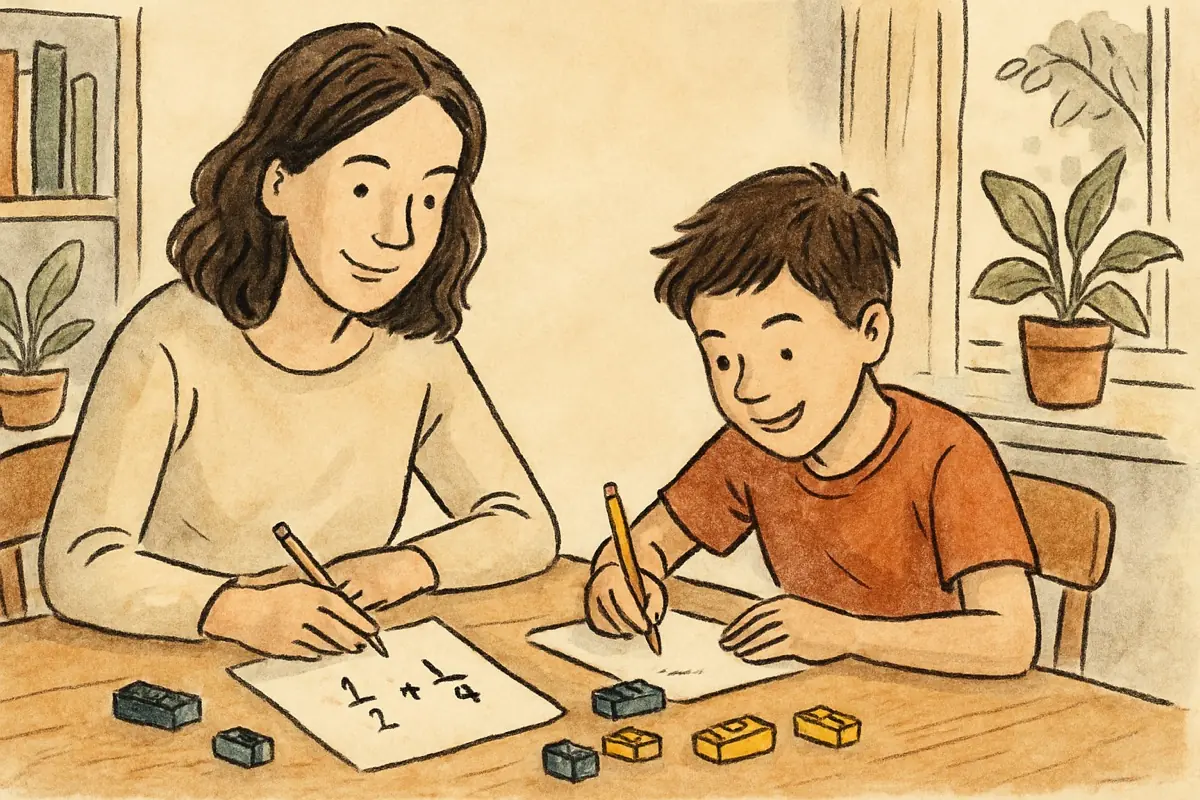
The night my nephew hit fractions homework, he wrote down that one half plus one third equals two fifths. Add the tops, add the bottoms, done. It's a completely reasonable guess. It's also wrong, and when his mom told him so, he melted, because he'd followed a rule and the rule betrayed him. That's the moment most fraction tears start. Not from the math being hard, but from a kid applying a pattern that works everywhere else and finding out fractions don't play by it.
If you want to teach your kid how to add and subtract fractions without that meltdown, the trick is to start with why the obvious method fails. Once a kid sees why you can't just add the bottoms, the actual steps stop feeling like arbitrary hoops.
Start with pizza, not numbers
Before any pencils, get concrete. A fraction is just a number of pieces and how big those pieces are. The bottom number, the denominator, tells you the size of the piece. Fourths are bigger pieces than eighths, because if you cut a pizza into four you get bigger slices than if you cut it into eight.
Draw two identical pizzas. Shade half of one. Shade a third of the other. Now ask your kid to combine them into one amount. They'll quickly see the halves and the thirds are different-sized slices, and you can't just count them together and get a clean answer. One slice plus one slice does not equal two of anything, because the slices aren't the same size.
That's the whole problem in one picture. You can't add pieces that are different sizes until you cut them so they match. Kids get this from pizza in a way they never get it from a rule.
The one rule that prevents most tears
Here's the sentence to say out loud, over and over, until it's automatic: you can only add or subtract fractions when the bottom numbers are the same.
Same denominator, and the job is easy. Three eighths plus two eighths is five eighths. The pieces are already the same size, so you just count them. The bottom number does not change, because the size of the pieces didn't change. This is where kids trip, so make a big deal of it. When you add three eighths and two eighths, the answer is five eighths, not five sixteenths. You're counting slices, not resizing them.
Have your kid do a handful of these same-bottom problems first, adding and subtracting, until it's boring. Boring is good here. You want the easy case rock solid before you touch the hard case.
When the bottoms don't match
Now the real skill. Most of the time the denominators are different, like that one half plus one third. The move is to re-cut both pizzas so every slice is the same size. In math words, you find a common denominator.
Here's the plain version of the steps:
- Look at the two bottom numbers. For halves and thirds, that's 2 and 3.
- Find a number both of them divide into. Sixths work, because 2 and 3 both go into 6. (You can always just multiply the two bottoms together if you're stuck. Two times three is six.)
- Re-cut each fraction into sixths. One half is three sixths. One third is two sixths.
- Now the bottoms match, so add the tops. Three sixths plus two sixths is five sixths.
Go back to the drawing. Cut the first pizza's half into three equal pieces and the second pizza's third into two equal pieces. Suddenly both pizzas are in sixths, and you can just count. Three shaded plus two shaded is five shaded, out of six. Five sixths. The picture and the numbers finally agree, and that agreement is what makes it click.
The part kids forget is that when you re-cut a fraction, you change the top number too. One half becoming three sixths isn't magic. You cut each piece into three, so one piece became three pieces, and the whole became six. Both numbers get multiplied by the same thing. Have them say why the top changed, not just that it did.
Where kids actually get stuck
A few predictable snags, and what to do about each.
They add the bottoms. The classic. Send them straight back to the pizza. Ask, "Did the slices get smaller when you combined them? Then why did the bottom number get bigger?" Let the picture correct it, not you.
They find a common denominator but forget to change the top. They'll write one half as three sixths but leave the numerator as one. Slow down and re-cut the actual drawing so they see one slice literally become three.
They panic at "least common denominator." Ignore the word "least" at first. Any common denominator gives a correct answer. You can simplify later. Multiplying the two bottoms together always works and takes the pressure off. Get the concept solid, then worry about the tidiest choice.
Subtraction feels scarier than it is. It's the same process. Match the bottoms, then subtract the tops. Five sixths minus two sixths is three sixths. The re-cutting step is identical, which is worth pointing out so subtraction doesn't feel like a whole new monster.
Keep the sessions short and the pizzas coming
Fractions reward understanding over speed, so don't rush to drill. A kid who can explain why the bottoms have to match will handle a hundred problems later. A kid who memorized steps with no picture behind them will fall apart the first time a problem looks a little different.
Do a few problems, keep drawing when they get stuck, and stop before frustration sets in. Real cooking helps too. Doubling a recipe that calls for a third of a cup, or figuring out how much is left when you've used two eighths of the butter, turns fractions into something with stakes a kid can taste. My nephew got it in the end, and it wasn't more worksheets that did it. It was one afternoon and an actual, foldable paper pizza on the kitchen table.