5 Things To Say Instead of 'It's Easy, Just Try' During Math
A dad once told me, right in front of his third grader, "Come on, it's easy, you just have to try." He meant it kindly. He wanted her to feel like the problem was small and within reach. But I watched her face close up the second he said it, because to her the message wasn't "this is easy." The message was "this is easy, so if you can't do it, something's wrong with you."
That's the trap with "it's easy, just try." When a kid is already stuck, calling the thing easy doesn't shrink the problem. It shrinks the kid. If you've been reaching for that line and wondering why it backfires, here's what to say to a child struggling with math instead. Five phrases, and why each one lands better.
1. "Where did it stop making sense?"
"Just try" assumes the kid isn't trying. Usually they are, and they've hit a wall somewhere specific. This question treats the struggle as a normal, locatable thing instead of a character flaw.
It also does something useful for you. It tells you where the actual gap is. A kid working on a two-step problem might understand the whole thing except one step. When my students answer this, I often hear something like, "I got the first part, but then I didn't know what to do with the leftover." Now we both know exactly where to look. "Just try" would have skipped right past that.
2. "Let's look at this one together."
Struggling with math is lonely. The kid feels like everyone else gets it and they're the only one lost, and being told to "just try" leaves them alone with that feeling. Sitting down next to them changes the whole shape of the moment.
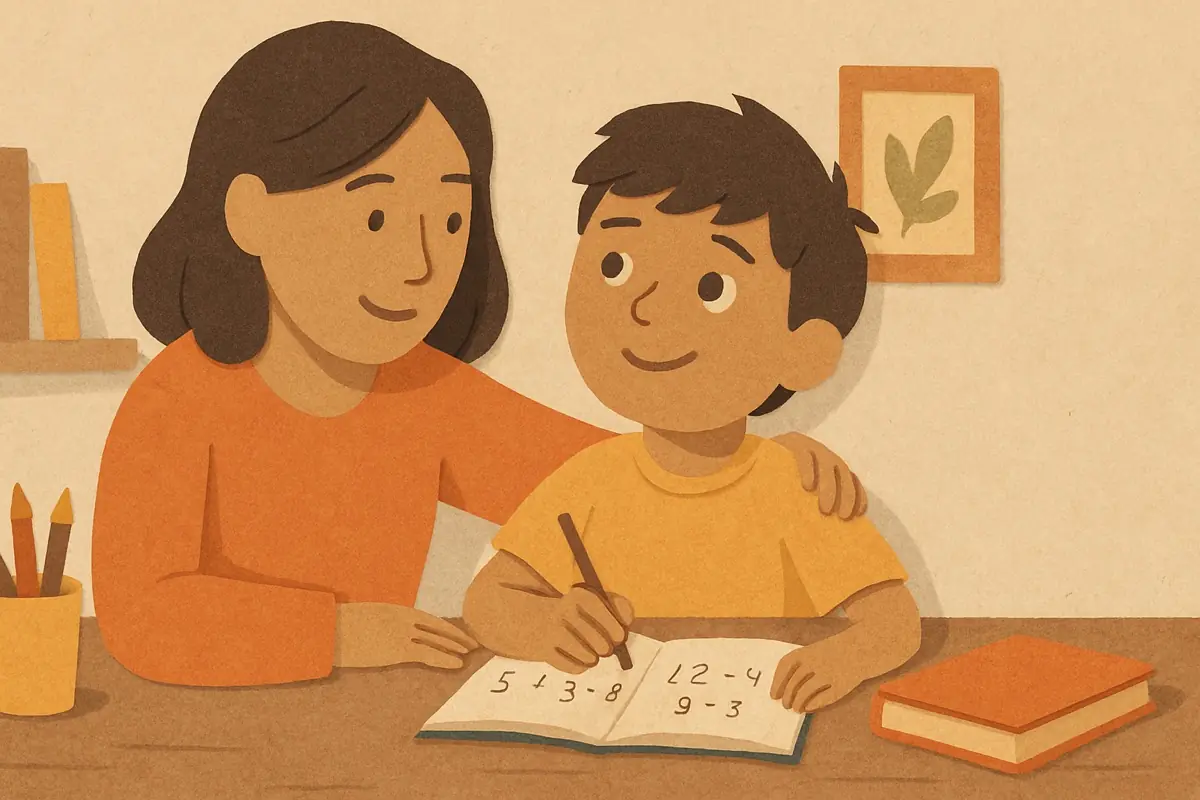
You're not solving it for them. You're being in it with them. Pull your chair over, read the problem out loud together, and let them drive while you ride along. The pressure drops when a kid isn't facing the page by themselves. I've seen children who were frozen solid start moving the moment an adult simply sat down beside them, before a single hint was given.
3. "It's supposed to be hard right now. That's how it works."
Kids carry a quiet belief that if they were smart, math would feel easy, and the effort itself is proof they're not smart. That belief is poison, and "it's easy" pours more of it in. So say the opposite, plainly.
Tell them the struggle is the work, not a sign they're failing at the work. Muscles get stronger when they strain. Brains do the same. When something feels hard, that's the exact moment learning is happening, and the discomfort means it's working, not breaking. A kid who understands this stops reading difficulty as a verdict and starts reading it as normal.
4. "What have you tried so far?"
This one flips the whole interaction. Instead of you handing over the answer, you're asking them to walk you through their thinking. It respects that they've been working, and it often gets them unstuck without any help from you at all.
Half the time, kids solve it mid-sentence. They start explaining what they tried, hear the flaw as they say it out loud, and go, "oh, wait." That's the goal. You want the answer coming out of their head, not yours. A few things this phrase does well:
- It makes them the expert on their own attempt instead of a passive kid waiting for rescue
- It shows you their reasoning, so you can spot the exact wrong turn
- It reinforces that trying things, even wrong things, is what math actually is
5. "Let's take a break and come back to it."
Sometimes the kindest and smartest thing to say is that we're stopping for now. A brain that's flooded with frustration cannot learn. The working memory a kid needs to think gets eaten up by the stress of being stuck, so pushing harder in that moment just deepens the hole.
Walk away. Get water. Shoot a basket. Come back in ten minutes. It's amazing how often a problem that was impossible before the break is suddenly doable after it, because the panic has drained out and the thinking space is clear again. "Just try" in a flooded moment is like telling someone to read in the dark. Turn the lights back on first.
The thread running through all five
Notice what none of these say. None of them call the math easy, and none of them make the child's worth depend on getting it. That's the real problem with "it's easy, just try." It quietly ties the kid's value to a fast right answer, so a wrong or slow answer feels like a failing grade on themselves.
The phrases that work do the reverse. They separate the kid from the struggle. The problem is hard, the problem is locatable, we'll face it together, and if we're fried we'll come back later. The child stays whole through all of it. That's what lets them keep trying tomorrow, which is the only thing that ever actually builds a mathematician.
You'll slip and say "just try" again. Everyone does. But swap in even one of these when you can, and watch the difference in whether your kid leans in or shuts down. The words we use around math become the voice they hear in their own head years later. Worth choosing them with a little care.