The Speed Trap: Why Fast Math Doesn't Mean Smart Math
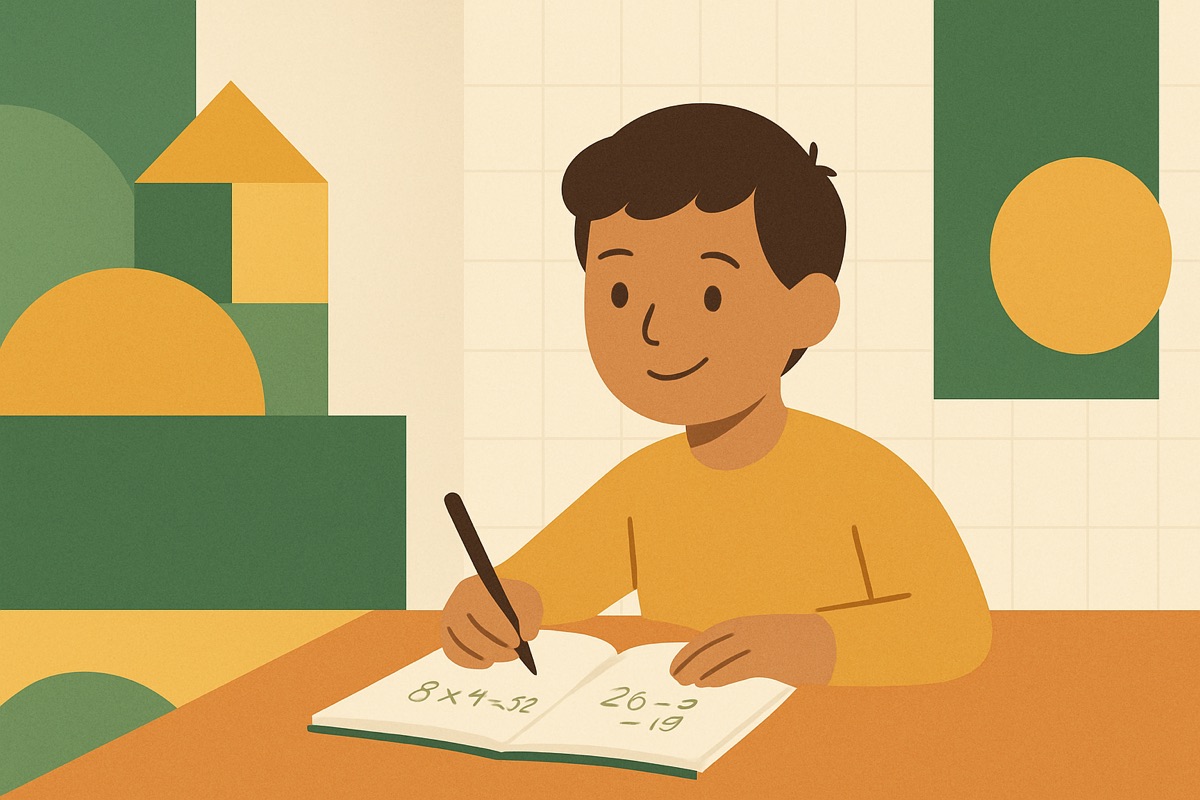
The girl who counted the clock
I had a third grader named Priya who could explain place value better than some adults I know. Ask her why you carry the one, she'd tell you. Ask her to estimate whether 38 plus 47 was closer to 80 or 90, she'd nod and say 90 before you finished the sentence. Then I'd hand out a one-minute timed test of one hundred facts, and she'd fall apart. Not because she didn't know them. Because the second that timer started, she stopped watching the math and started watching the clock.
That is the heart of timed math tests anxiety, and it's more common than most parents realize. We treat speed as proof of mastery. A kid who answers fast must understand, and a kid who's slow must be behind. But those two things come apart all the time, and when we don't notice, we punish exactly the kid who's thinking the hardest.
Speed measures recall, not thinking
Here's the thing a stopwatch actually tests: can you pull a memorized fact out of long-term memory in under a couple of seconds. That's it. It's a real skill and a useful one. Automatic recall of 7 times 8 frees up a kid's brain to tackle the bigger problem it's buried inside. Nobody wants a fifth grader counting on fingers through a long-division step.
But recall speed and mathematical understanding live in different rooms. A kid can memorize that 6 times 4 is 24 and have no idea it means six groups of four. Another kid can build 24 out of six groups every single time, slowly, correctly, with full understanding, and still bomb the timer. Speed tells you the first kid is fast. It tells you nothing about whether either one actually gets it.
When we let the fast answer stand in for the smart answer, we send a quiet message: the point of math is to be quick, not to be right for reasons you understand. Kids absorb that message fast, and it's the wrong one.
What the timer does to a nervous kid
There's a physical thing that happens under time pressure. Working memory, the little mental scratchpad where a kid holds numbers while they operate on them, shrinks when they're anxious. So the timer doesn't just measure the fear. It creates a condition that makes the math genuinely harder in that moment. Priya wasn't imagining her struggle. Her scratchpad had actually gotten smaller.
You can spot a kid in the speed trap:
- They know the material at home but freeze on the classroom test.
- They rush and make careless errors they'd never make with time to breathe.
- They start saying "I'm just bad at math" even though their reasoning is solid.
- They dread math on the specific days a timed drill is scheduled.
Once a kid decides they're bad at math, that belief does more damage than any single missed fact. It follows them for years. I have met high schoolers still carrying a story about themselves that started with a one-minute drill in second grade.
Fluency without the stopwatch
None of this means facts don't matter. They do. A kid who has to reconstruct 8 plus 7 every time will struggle later, plain and simple. The goal is real fluency: knowing facts well enough that they come easily. But easily is not the same as under-a-timer-in-front-of-the-whole-class.
You build that kind of fluency through short, low-pressure repetition spread over time. Five minutes of flash cards on the couch, no clock. A quick round of a dice game where getting the sum right is the whole job and nobody's racing. Facts practiced this way stick better anyway, because the kid isn't spending half their brain managing panic.
I tell parents to watch for the moment a fact goes from "I can figure it out" to "I just know it." That transition is what you're after. It happens on its own with enough friendly reps. It does not happen faster because you added stress. If anything, stress slows it down.
Ask better questions than "how fast"
When you sit down with your kid, resist the urge to time them. Ask the questions a stopwatch can't. "How did you figure that out?" "Is there another way to get there?" "Does that answer make sense, or is it way too big?" A kid who can answer those is doing the actual work of mathematics, the reasoning part that lasts.
I had a boy who solved 6 times 9 by doing 6 times 10 and subtracting 6. Slower than pure recall, sure. But that's a genuinely clever move, and it shows he understands what multiplication is. If I'd only ever handed him a timer, I'd have marked him as struggling and never seen the thinking. That kind of flexible reasoning is worth more than a fast finger, and it's the thing that carries a kid into fractions, ratios, and algebra where memorized speed runs out fast.
Good math apps get this right by rewarding correct reasoning and steady progress instead of raw milliseconds. That's the whole idea behind how we built Math Prizes: earn your way forward by actually getting it, not by beating a clock. Progress you can trust beats a fast number every time.
What to do if your kid is already scared
If timed tests are already a source of dread, don't pretend they aren't. Name it. Tell your kid plainly that being fast and being good at math are not the same thing, and that plenty of strong mathematicians think slowly and carefully. Take the clock out of your home practice entirely. Let them rebuild the belief that they can do this, one unhurried problem at a time.
Priya's story ended fine, by the way. Once we practiced facts without the timer and I stopped treating speed as the scoreboard, the recall caught up on its own, and the panic faded. But the part I remember is the day she explained a place-value idea to a classmate who was stuck. She was slow on the drill and the best thinker in the room. Those were never in conflict. We just kept measuring the wrong one.