Building a Math Wins Board: A Home Ritual for Confidence
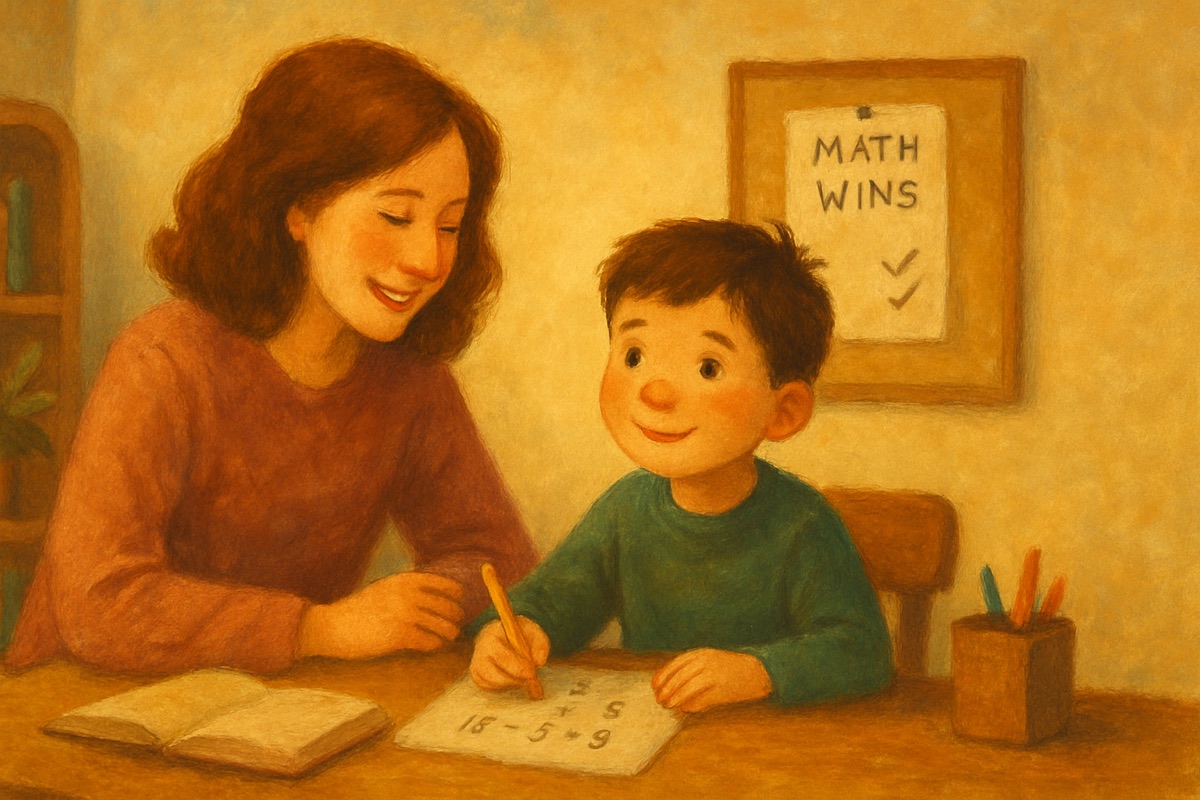
One of my third graders, a kid who cried during a subtraction quiz in September, walked into class in April and told me she was "kind of good at math now." Nothing magic happened in between. Her mom had put a small corkboard by the fridge and started pinning up index cards. Each card had one thing the kid had figured out that week. That's it. By spring the board was full, and she'd read it every morning while she ate her cereal.
That board is one of the best tools I know for how to build math confidence at home, and it costs about four dollars. The idea is simple. Kids who struggle with math usually have a very good memory for the times they got things wrong and a terrible memory for the times they got things right. A wins board fixes the balance. It gives the brain physical proof that progress is happening, even on weeks that feel like nothing is happening.
Why a board beats a sticker chart
Sticker charts reward showing up. You did ten minutes, here's a sticker, do it again tomorrow. That's fine for building a habit, but it doesn't do anything for confidence, because the sticker is about attendance, not understanding. A kid can earn a full row of stickers and still believe she's bad at math.
A wins board is different. It only records things the child actually learned or did. Not "practiced for fifteen minutes." Instead, "figured out that 7 x 8 is the same as 7 x 4 doubled." The distinction matters. One is busywork you can fake your way through. The other is real progress, and real progress is the only thing that changes how a kid sees herself.
I'm skeptical of any reward system that pays kids for grinding through repetition. You end up teaching them that math is a chore to be endured for a prize. A wins board flips it. The win is the point, and writing it down is just how you notice it.
What goes on the board
The trick is to make the wins concrete and specific. Vague praise ("great job at math!") slides right off a kid. A specific win sticks because they can see exactly what they did. Here's the kind of thing worth pinning up:
- A fact they finally locked in ("I don't have to count for 6 + 7 anymore")
- A mistake they caught themselves, before you said anything
- A problem they got wrong, then went back and fixed
- The first time they explained their thinking out loud
- A hard problem they stuck with instead of quitting
- A day they were less scared than the day before
Notice that "got a 100" isn't on that list. A perfect score is fine, but it's the weakest kind of win, because it doesn't tell the kid anything about what she can do that she couldn't do last month. The good wins are the ones about growth. "I used to freeze on word problems and today I read one twice and figured out the plan." That's a card worth keeping.
Keep the ritual tiny
The reason the fridge board worked is that it was almost no effort. One card, one time a week, thirty seconds. When parents try to run a big elaborate reward system, it collapses by October because nobody can keep it up. A ritual survives when it's small enough to do on a bad day.
Pick a fixed moment. Sunday night, or Friday after school, whatever fits your house. Ask one question: "What's something you figured out in math this week?" Write it on a card together. Pin it up. Done. If your kid can't think of anything, help them notice one. You were there when she stopped counting on her fingers for the twos. Remind her. Half the job is just pointing out wins the kid didn't register as wins.
And when the board fills up, don't take it down. Let it get crowded. A crammed board is the whole message. Look how much you've done.
Handling the weeks that flop
Some weeks there's no win. The kid bombed the quiz, hated every homework page, and the ritual feels like rubbing salt in it. Don't skip the board those weeks. Skipping it teaches the kid that wins only count when everything's going great, which is exactly the fragile mindset you're trying to break.
Find the smallest true thing. "You were really frustrated on Wednesday and you still finished the page." That's a win about persistence, and persistence is worth more than any single right answer. I had a student whose best card all year said "I got mad and didn't rip up my paper." His dad framed it, half as a joke. The kid was proud of it. He should have been.
The goal isn't to pretend hard weeks are good weeks. It's to teach a kid that effort and recovery count as progress, because they do. A child who believes that will outlast a child who only feels good when the score is perfect.
When the board starts working
You'll know it's working when your kid starts nominating her own wins without being asked. That's the shift. She's begun watching for progress instead of only cataloging failure. That habit of noticing what you can now do, and expecting to be able to do more of it, is most of what math confidence actually is.
Some families move the ritual into whatever app or game their kid already uses, and that's fine, as long as the win being recorded is real learning and not just points for time spent. We built Math Prizes partly around that idea, that a reward should mean you understood something, not that you sat there long enough. But you do not need any of that. A corkboard, some index cards, and one honest question a week will get you most of the way there.
The kid who cried in September wasn't cured by a board. She just finally had a place where the good days were written down where she could see them. Turns out that was enough to start believing the good days were the real story.