Teaching Your Anxious Kid To Talk Back to the 'I'm Dumb' Voice
A fourth grader I taught used to put her head down on the desk the second she saw long division. Not crying, not fighting. Just quiet, folded up, done. When I crouched next to her one afternoon and asked what was going on, she said it flat, like a fact she'd checked twice: "I'm just dumb at this." She was nine. She already had a voice in her head, and that voice had a script.
That voice is what we're talking about when we talk about child negative self-talk in math. It isn't laziness and it usually isn't drama. It's a kid narrating their own struggle in the cruelest words available, and then believing the narration. The good news is that the voice can be argued with. You can't delete it, but you can teach your kid to talk back to it. That skill matters more than any single math fact.
Name the voice so it stops sounding like the truth
The reason "I'm dumb" is so powerful is that it doesn't feel like an opinion. It feels like a weather report. Your kid isn't thinking "I'm having a thought that I'm dumb." They're thinking "I am dumb, and now I know it."
So the first move is to make the voice into a thing, separate from your kid. In my classroom we called it the Doubt Monster, which sounds silly, but silly is the point. When you give the voice a name, you create a little gap between your child and the thought. There's your kid, and over there is the Doubt Monster saying its usual line.
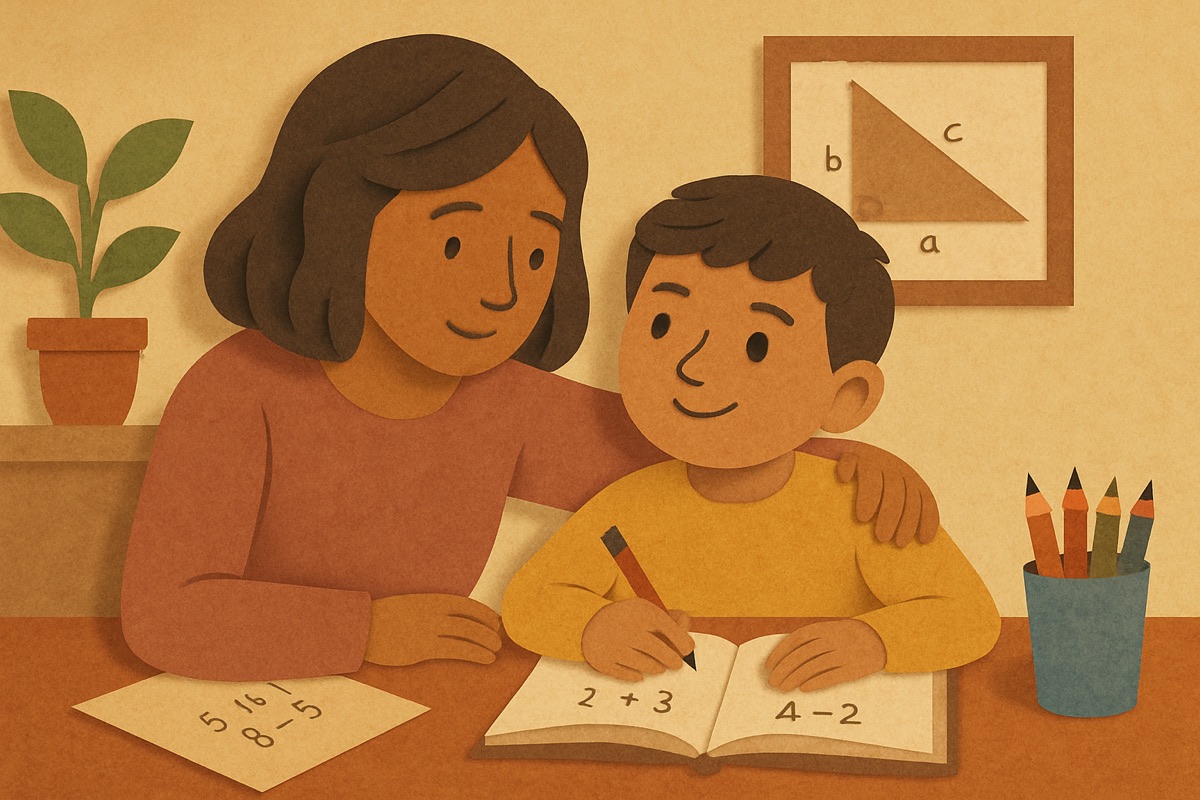
Try this at the table. When your child says "I can't do this, I'm bad at math," don't rush to correct it. Say, "Oh, that sounds like the mean voice again. What's it telling you right now?" You're not agreeing with the voice. You're pointing at it. Kids as young as six can grasp that the thought and the thinker are two different things once you frame it out loud a few times.
Give them a real comeback, not a slogan
Here's where a lot of well-meaning advice falls apart. We tell kids to "think positive" or hand them a poster that says "I can do hard things." An anxious kid sees right through that. If they just failed to carry a ten, telling them "you're a math superstar" reads as a lie, and now they trust you a little less.
The comeback has to be believable. It has to be something the kid can say and not feel like they're pretending. The most useful ones are specific and true:
- "I can't do this yet." (The word "yet" does real work. It turns a verdict into a timeline.)
- "I got stuck on this one part, not the whole thing."
- "This is hard right now, and hard is not the same as impossible."
- "I got the first two steps. I only need help with the third."
Notice none of these say "I'm great at math." They say the problem is narrower than the panic claims. That's what an anxious brain needs, not cheerleading. A smaller, truer story.
Find the evidence together
When your kid says "I always mess up subtraction," the anxious brain is doing a magic trick. It takes one bad moment and stretches it over the whole subject and all of time. Always. Every time. That's the tell. Words like always and never are almost never accurate.
You can be the fact-checker. Gently. "You said you always mess up subtraction. Can we find one you got right this week?" Then go find it. Pull out the homework from Tuesday where they nailed six out of eight. Real evidence beats reassurance every time, because your kid can see it with their own eyes.
I had a second grader who was convinced he "couldn't read clocks." We counted, and it turned out he could read every clock except the ones showing times between the numbers, like 3:40. His actual problem was tiny and fixable. But in his head it had grown into "I can't tell time," which felt enormous and permanent. Shrinking the problem back to its real size is half the battle.
Let them see you lose to your own doubt voice
Kids learn self-talk mostly by copying the adults around them. If you slam your laptop shut and mutter "I'm such an idiot" when a spreadsheet won't cooperate, your kid files that away. Not the spreadsheet part. The "that's what you say when something's hard" part.
You don't have to be relentlessly upbeat. Honestly, fake calm doesn't fool them. What helps is narrating your own struggle out loud with the same tools you're teaching. "Ugh, I keep getting this wrong. Okay. I'm going to slow down and try one more time." That's a live demonstration of a person meeting a wall and not collapsing into it. It's worth more than any lecture about mindset.
Keep the stakes low while the skill is new
Talking back to the doubt voice is a skill, and skills need low-pressure reps. The middle of a timed test is the worst place to practice it. The kitchen table on a random Tuesday, with no grade attached, is the best.
This is also why grinding through page after page of problems can quietly feed the voice. A kid who does forty problems and misses twelve has just handed the Doubt Monster twelve pieces of ammunition. A kid who does eight problems, gets stuck on one, and works through it with you has had a small, real win. Real progress on a few problems builds more confidence than a big pile of half-right ones. We built our own math app, Math Prizes, partly around that idea, but you don't need any app to do it. You need short sessions and honest feedback.
None of this happens in one night. The first time you say "sounds like the mean voice is back," your kid might roll their eyes. Say it anyway. A few weeks in, you'll hear something small and enormous. Your kid, stuck on a problem, will mutter to themselves: "I can't do this yet." And then they'll pick the pencil back up. That's the whole thing, right there.