Should a Kid Use ChatGPT for Homework? Where I Draw the Line
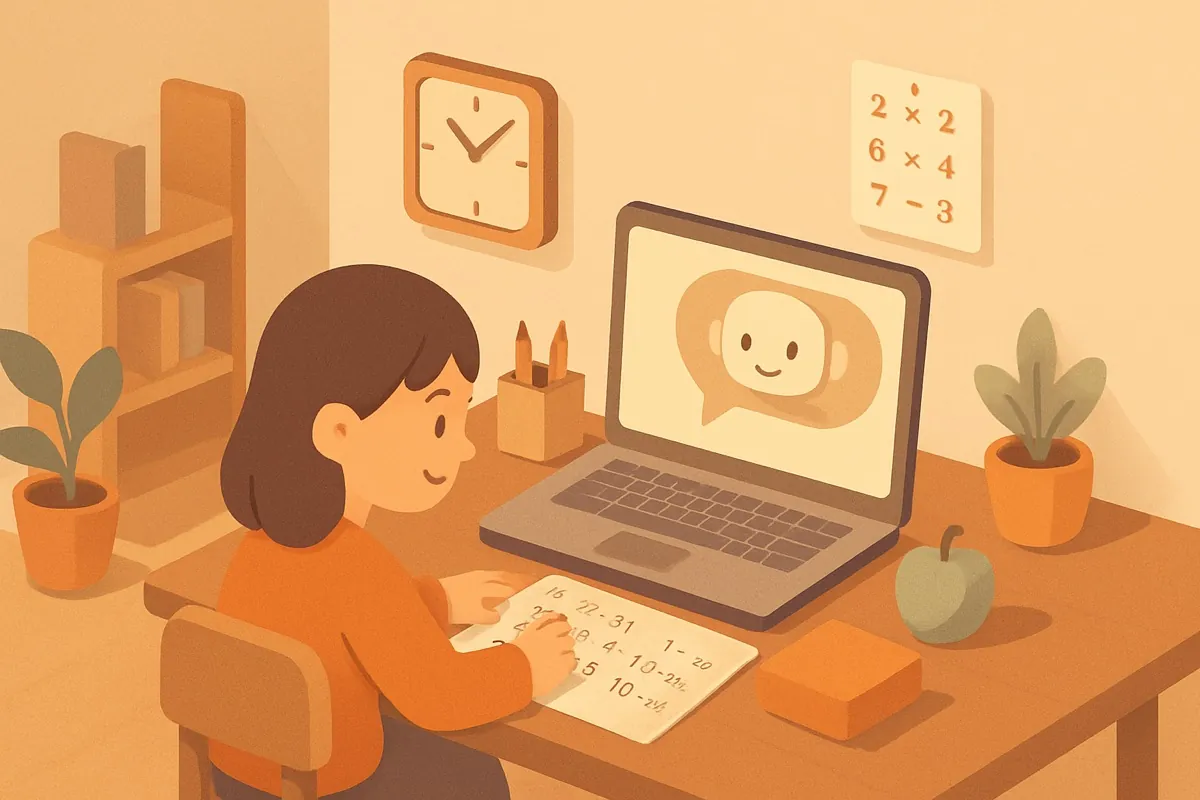
A student handed me a paragraph last spring that was cleaner than anything he'd written all year, and I knew in about four seconds it wasn't his. Not because it was too good. Because it didn't sound like a person, and it definitely didn't sound like him. When I asked him to explain one of his own sentences, he couldn't. He'd typed the prompt into a chatbot, copied the answer, and turned it in without reading it closely enough to defend a single line.
That's the version of kids using ChatGPT for homework that keeps teachers up at night. Not the tool itself. The specific move where a kid outsources the thinking and never notices the thinking was the point. But I've also watched the same tool help a struggling kid finally understand a math step nobody had managed to explain to her. Same tool, opposite outcomes. The line between them is real, and it's worth knowing where it sits.
The line, in one sentence
Here's my rule, and it's simple enough that a nine-year-old can hold it: the AI can help you understand, but it can't do the work for you.
If your kid asks it to explain why you carry the one in addition, that's understanding. If your kid asks it to solve all twenty problems and copies the answers, that's doing the work for them. The activity looks almost identical from across the room. A kid at a screen, typing, reading. The difference is entirely in who's doing the mental lifting, and that difference is everything.
The reason this matters isn't about cheating or getting caught. It's that learning is what happens in your brain while you struggle with something slightly too hard. If a machine removes the struggle, it also removes the learning. Your kid gets the finished paragraph and keeps none of the thinking that was supposed to come with it.
Where it genuinely helps
I don't think the answer is to ban the thing. That ship sailed, and honestly there are moments where it's a solid tutor. A few uses I'm fine with:
- Explaining a concept a different way. When a kid didn't get it from the teacher or the textbook, a chatbot can reword the same idea five ways until one clicks. That's a patient tutor who never sighs.
- Checking work after it's done. Kid solves all the problems, then asks the AI to check and explain any misses. The kid still did the work. The AI is the second set of eyes.
- Getting unstuck on one step. "I'm on step three of this problem and I don't know what to do next." That's a hint, not a handout.
- Practice questions. "Give me five more problems like this one." Now it's generating work instead of doing it.
Notice what all of those have in common. The kid stays the one thinking. The AI explains, checks, or gives more practice. It never hands over a finished answer that the kid pastes in and forgets.
The trap nobody warns you about
The sneaky problem isn't the obvious copy-paste cheat. It's the in-between. A kid asks for "help," the AI gives a fully worked answer, and the kid reads it, nods, and thinks they learned it. They didn't. Reading a solution and generating one are completely different skills, and the gap doesn't show up until test day, when there's no chatbot and the kid realizes they never actually practiced the thing.
I've seen this exact letdown. A seventh grader used AI to "study" for a week and bombed the quiz. She was genuinely confused, because she'd spent hours with the material. But every one of those hours, the machine did the hard part and she watched. Watching someone lift weights doesn't make you stronger.
So the question I teach kids to ask themselves is blunt: "Could I do this again right now with the tab closed?" If the honest answer is no, they didn't learn it. They borrowed it.
How to keep it honest at home
You can't hover over every homework session, and you don't need to. A couple of habits do most of the work.
Ask your kid to explain their answer to you, out loud, in their own words. Not read it. Explain it. This takes ninety seconds and it exposes borrowed work instantly, because a kid who understands can teach it back and a kid who copied cannot. It's the same trick I use in class, and it never fails.
The other habit is to make the AI show its reasoning, not its answers. Teach your kid to add "explain each step and don't just give me the final answer" to their questions. It's a small change that flips the tool from a vending machine into a tutor. Same tool, different job.
None of this requires you to understand the assignment yourself, which is the part parents worry about most. You're not checking the math. You're checking whether the thinking happened, and you can hear that in how your kid talks about it. A kid who did the work sounds like they own it. A kid who didn't gets vague and quiet fast. Trust that. It'll tell you more than staring at the screen ever could.