Online Learning at Home That Isn't Just More Screen Time
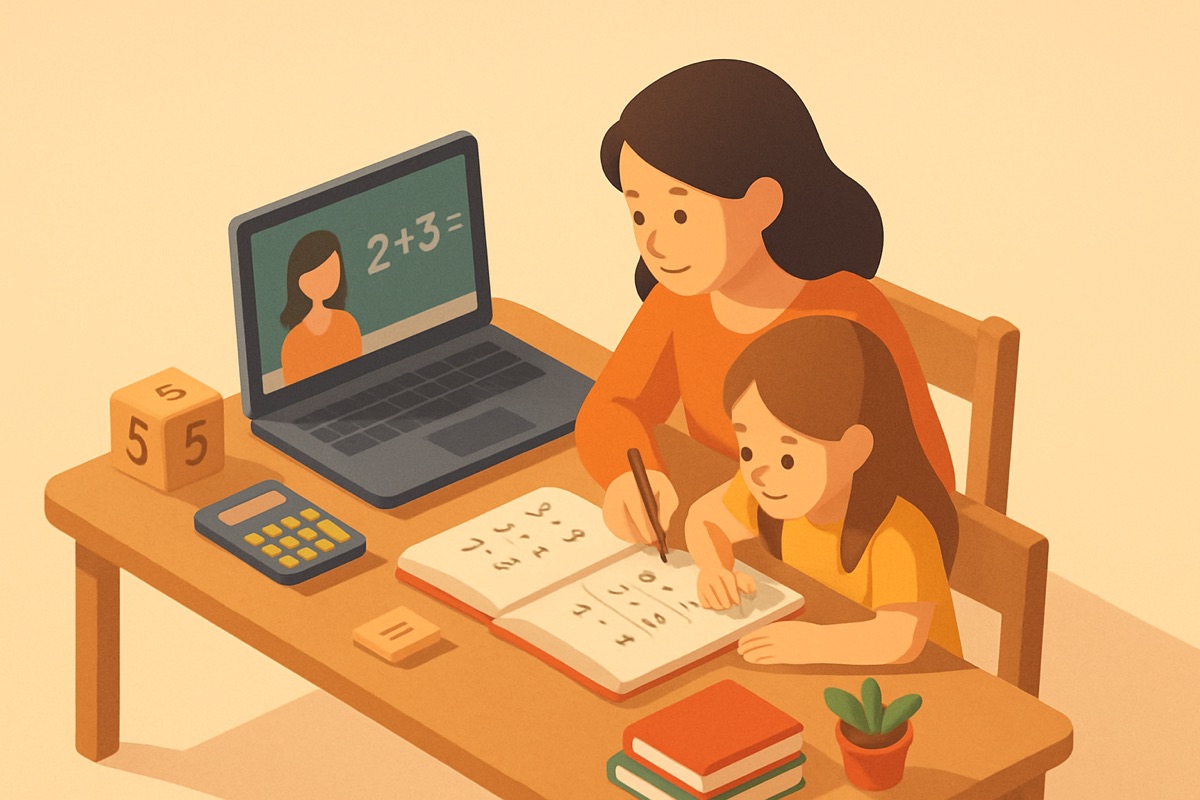
A parent told me last spring that her daughter had "done math for an hour" on a tablet app every day all summer and still couldn't do her subtraction facts in the fall. I asked to see the app. It was mostly a cartoon character bouncing around, a cute animation for every tap, and math problems so easy the girl could clear them without reading. She'd spent an hour a day being entertained near some numbers. That's not the same as learning, and the app was built so the difference would be hard to notice.
That's the trap with online learning at home for kids. The screen can be doing real teaching or it can be doing a very good impression of it, and from across the room the two look identical. Both keep the kid quiet and busy. Only one of them actually moves the needle. If you're going to spend the screen time, it's worth knowing which kind you've got.
The difference between teaching and occupying
Here's the plain test. Occupying keeps a kid busy. Teaching changes what a kid can do. After a good session, a child can do something they couldn't do before, or do it faster, or explain it better. After a session of the occupying kind, they've had fun and moved nothing.
The tell is how the app responds to a kid who's succeeding. A teaching tool notices when the work has gotten easy and makes it harder. It keeps the child at the edge of what they can do, which is uncomfortable and productive and the whole reason learning happens. An occupying tool keeps the difficulty flat and pleasant forever, because its actual goal is engagement time, not progress. That summer app never once got harder. It couldn't, because harder isn't as fun, and fun was the product.
Watch what the app rewards
Follow the rewards and you'll find out what the app really values. This is the clearest signal there is.
- If the kid gets coins, stars, or a new character skin just for tapping through screens regardless of whether they understood anything, the app rewards time spent. That's occupying.
- If the rewards come from getting harder things right, from a streak of genuine correct answers, from actually leveling up in difficulty, the app rewards progress. That's teaching.
A lot of apps dress up the first kind to look like the second. Confetti and a chime for every single answer, right or wrong, trains a kid to keep tapping, not to think. When rewards are handed out for mere participation, the kid learns that showing up is the point. The good tools make the kid earn the celebration, and they tie it to real understanding, not to how many minutes the app kept them staring.
Signs you've got a real learning tool
You don't need to be a teacher to spot the good ones. A few things stand out.
- It gets harder as the kid gets better. The problems your child sees in week three should be tougher than week one. If they're not, the tool isn't adapting.
- It's honest about wrong answers. It marks them wrong, shows why, and gives another try. It doesn't cheerfully accept everything.
- It teaches, not just tests. When a kid is stuck, a good tool shows a worked example or a hint that builds understanding, instead of just flashing the right answer and moving on.
- The kid can explain what they did. Ask your child what they learned. "I figured out you can break 8 plus 5 into 8 plus 2 plus 3" is real. "I got to level 6" is not.
That last one is my favorite check because it costs nothing. Ask a kid to explain the math, not report their score. What comes out tells you exactly which kind of app they've been using.
The adaptive part matters most
If I had to keep one feature, it's the one that adjusts to the kid. A tool that gives every child the same fixed set of problems is a worksheet with sound effects. A tool that watches what your kid gets wrong and gives them more of that, then eases up once they've got it, is doing the thing a good tutor does.
This is why the difficulty question matters so much. A kid who's always getting everything right isn't learning, they're reviewing what they already know, which feels great and teaches little. A kid who's getting everything wrong is drowning and will quit. The sweet spot is a steady mix of right and just-hard-enough, and only an adaptive tool can hold a kid there as they grow. That's the whole game, and it's why my wife and I built our own math app around it instead of the confetti approach. The difficulty had to move with the kid or it wasn't worth their time.
Keep it short, and stay close
Even the best learning tool works better in smaller doses than you'd think. Fifteen or twenty focused minutes of real, appropriately hard practice does more than an hour of drifting. Long sessions drift into the occupying mode no matter how good the app is, because attention fades and the kid starts tapping on autopilot. Short and sharp beats long and glazed.
And check in. Sit next to your kid for a few minutes now and then. Watch whether they're thinking or just tapping. Ask them to walk you through a problem. You'll learn more about whether an app is teaching in five minutes of watching than in any review or star rating. The parent from last spring figured this out fast once she actually sat and watched. The app that looked educational fell apart the moment she paid attention to what her daughter was really doing with it.
The bar to hold
Online learning at home can absolutely teach. Some of it is genuinely good, better in some ways than what a busy classroom can offer one kid, because it can adapt to that one child in a way a teacher with twenty-five students can't. But the label "educational" is free to slap on anything, and plenty of the stuff wearing it is entertainment with a worksheet stapled to the back.
So hold the bar. Does it get harder. Does it reward getting better instead of just showing up. Can your kid explain what they learned. If the answers are yes, that screen time is doing work. If they're no, it's a babysitter with a nice logo, and there's nothing wrong with a babysitter, as long as you're not mistaking it for a teacher.