How to Tell If an AI Tutor Is Teaching Your Kid or Just Doing the Homework
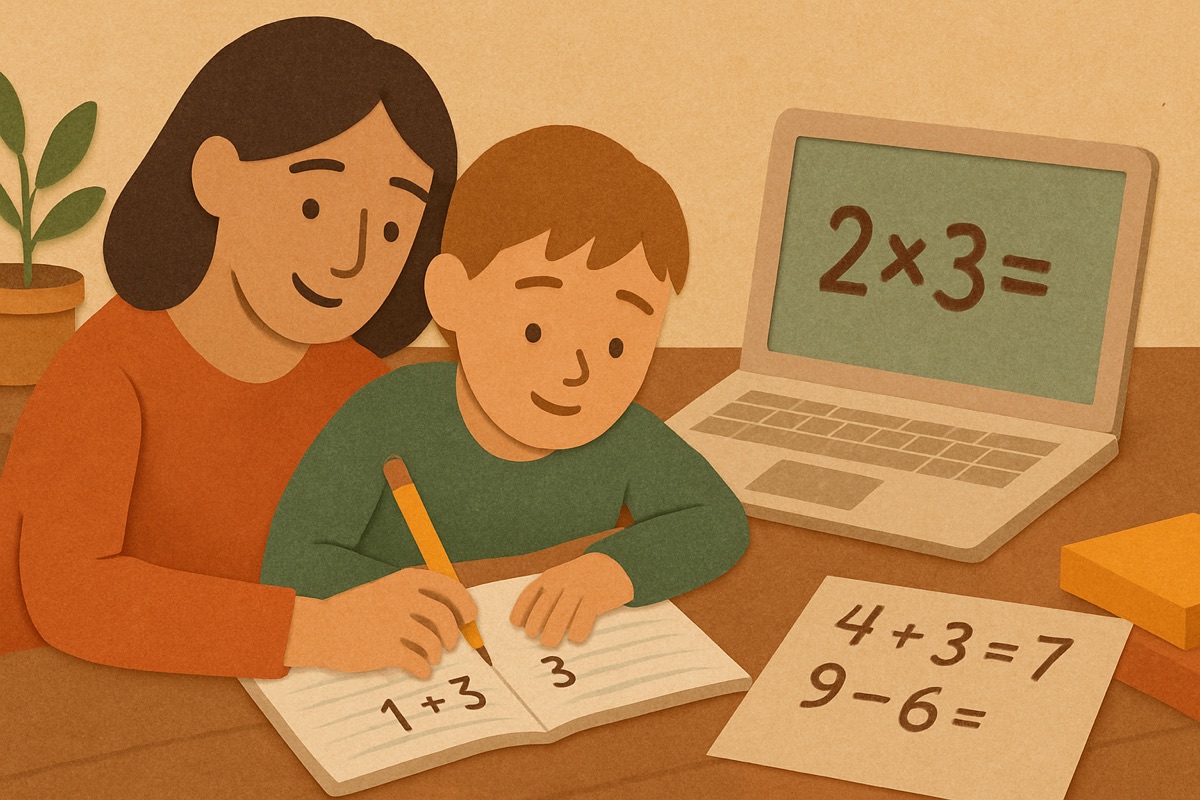
Last spring a fourth grader handed me a page of long division that was flawless. Every quotient correct, every remainder in place, the little subtraction steps lined up neat as bricks. I asked him to walk me through the second problem out loud. He couldn't. He didn't know why he brought the 6 down or what the 6 even was. The page was perfect and his understanding was zero. When he finally admitted an app had done it, I wasn't surprised. That gap, between a finished worksheet and a kid who actually learned something, is the whole question of AI tutor vs doing homework, and it's a lot easier to miss than you'd think.
I've taught elementary school for sixteen years. I've watched a lot of tools come through the classroom promising to help, and some of them do. But a homework helper and a tutor are not the same animal, even when they look identical on the screen. One builds a kid up. The other just makes the assignment disappear. Here's how I tell them apart.
A tutor makes your kid do the thinking
The single best test I know is embarrassingly simple. Watch who is doing the mental work.
A real tutor, human or otherwise, keeps handing the hard part back to the child. Your kid types in a word problem, and instead of an answer, the tool asks, "What are they asking you to find?" It waits. It lets your child sit in that uncomfortable moment where they don't know yet. That moment feels like failure to a parent watching, but it's the exact spot where learning happens. Struggle is not a bug in the process. It is the process.
A homework-doer skips all of that. Problem in, answer out. Maybe it shows steps, maybe it writes a tidy explanation. But your child never had to decide which operation to use, never had to get stuck, never had to try something wrong and fix it. They read the answer, copied it down, and moved on. It looked like help. It was more like a vending machine.
So the first thing I'd do is sit next to your child for one session and just notice: is the app asking questions back, or is it answering them?
Watch what happens after a wrong answer
Here's where the mask really slips.
When a kid gets a problem wrong, a tutor treats that as useful information. My best students get things wrong constantly, because they're reaching. A good tool notices the mistake, figures out what kind of mistake it was, and adjusts. Your child missed three subtraction-with-regrouping problems in a row? A tutor gives them a fourth one, maybe an easier version, and stays on the topic until it clicks. It doesn't rush ahead.
A homework-doer doesn't care about the wrong answer, because it was never going to let your kid be wrong in the first place. It just supplies correct answers on demand. There's no diagnosis, no "let's try that again a different way," no memory of what tripped your kid up yesterday.
You can spot this in a few minutes. Have your child intentionally get one wrong, or just watch during a real mistake. Does the tool slow down and dig in? Or does it paper over the error and keep the assignment moving?
Five signs the tool is teaching, not finishing
When I'm looking at any homework app, these are the things I actually check:
- It asks before it answers. A hint or a question comes first, not the solution.
- It stays on a weak spot. More problems on the thing your kid missed, not a fast march to the end of the worksheet.
- The explanation is in kid language. Real teaching sounds like a person talking to a nine year old, not a textbook paragraph your child skims and ignores.
- Your kid can re-do the problem alone afterward. This is the big one. If they can't repeat it without the app, nothing stuck.
- It's a little slower than you'd like. Teaching takes longer than answering. If the homework is done suspiciously fast, that's a clue, not a feature.
Notice that speed is on the wrong side of the ledger. Parents love a tool that gets homework done quick, and I understand why. But fast and finished is exactly what a homework-doer sells you. Learning is slower than that, and it's supposed to be.
The re-do test I use at home
If you only do one thing, do this. After your child finishes an app-assisted problem, cover it up and ask them to do one just like it, with no help. Same kind of problem, different numbers.
If they can, the tool taught them something. Genuinely, that's a win, and you can relax a little. If they stare at the page like they've never seen it before, the app did the homework and your kid was a spectator. I do a version of this in my classroom every week. It takes ninety seconds and it tells me more than any grade on the page ever could.
I had a third grader last year whose multiplication homework was always right and whose quiz scores were always low. Her mom was baffled. The re-do test cracked it open in about two minutes. At home an app was feeding her answers, so the homework glowed. On a quiz, alone, she had nothing to lean on. Once we knew that, we could fix it. But the perfect homework had been hiding the problem for months.
Why this matters more than the grade
Here's the thing I wish more families understood. The homework is not the point. Nobody is going to remember whether your kid's third grade fractions worksheet got a check-plus. The point is what's happening inside their head while they do it.
When a tool does the work, it doesn't just skip the assignment. It skips the part where your child's brain builds the actual skill. And that debt comes due later, usually on a test, usually when it's harder to catch up. A kid who leaned on answers all through the easy years hits fifth grade math and suddenly nothing has a foundation under it. I've met that kid many times, and it's a hard place to climb out of.
Rewards and streaks and points are fine, and kids love them. We built a little math app for our own children partly around that idea. But the reward has to be tied to real progress, to a skill your kid actually owns, not to a worksheet that got finished. A tool that pays out for busywork is just teaching your child that looking productive is the same as learning. It isn't.
Where I land on this
An AI tutor can be a wonderful thing for a kid. I mean that. The good ones are patient in a way a tired parent at 8 p.m. sometimes can't be, and they'll give a child their tenth try at the same problem without a sigh. But the same category of tool, pointed the wrong way, will quietly rob your kid of the very struggle that makes them smarter.
The difference isn't in the technology. It's in whether the thing was built to teach your child or built to make the homework go away. Sit next to them once. Watch a wrong answer. Run the re-do test. You'll know within a session which one you've got, and that's worth ten minutes of your evening more than almost anything else you could do.