Are AI Tutors Safe for Elementary Kids? A Parent's Honest Look
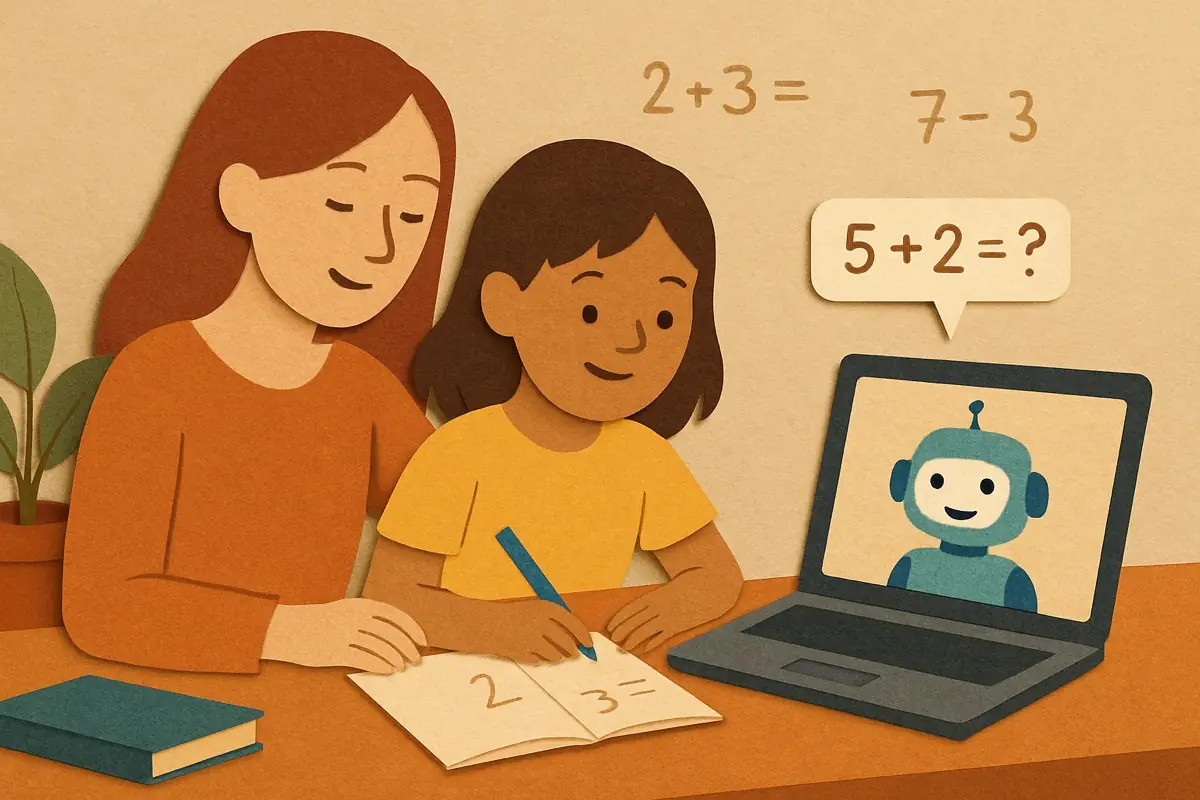
My eight year old asked a homework app why 7 times 8 is 56, and it wrote her a paragraph. A friendly, confident, well-worded paragraph. The problem is that two of the sentences in it were wrong, and she had no way to know which two. She just nodded and moved on. That moment is the whole question in miniature. When people ask whether an AI tutor for kids is safe, they usually picture a stranger in a chat window. The bigger risk is quieter than that.
I've written software for fifteen years, and I build a math app for my own kids. So I want to walk through this the way I'd think about it for my own house, not the way a marketing page would.
What "safe" actually means here
Safety with an AI tutor is really three separate questions wearing one coat.
- Content safety. Will it say something inappropriate, scary, or just plain wrong to a seven year old?
- Data safety. What is it recording about your kid, and where does that go?
- Learning safety. Is it actually teaching, or is it doing the thinking for your child and calling it help?
Most articles only cover the first one because it's the scariest to imagine. In practice, the third one is the one that quietly does the most damage, and almost nobody warns you about it.
The part everyone worries about, and how real it is
The nightmare version is an AI saying something horrible to your kid. Real tools built for children put a lot of guardrails between the model and the child, and for the big, name-brand education apps those guardrails mostly hold. A general chatbot you found in an app store is a different story. It was not built for a nine year old, and it will happily wander into topics you would not want.
So the honest answer to "will it say something bad" is: it depends entirely on whether the tool was built for kids or repurposed for them. A tool made for classrooms has spent real engineering effort on this. A random "AI helper" has not.
Here's the test I use. Ask the app something a curious kid would actually ask, something a little off the rails. "What happens when you die?" "Is Santa real?" Watch what it does. A tool built for children hands that back to you, the parent, or answers gently and neutrally. A tool that was not built for kids just answers, with total confidence, whatever its training pulled up. Five minutes of poking tells you more than any privacy policy.
The risk nobody puts on the box
An AI tutor can be perfectly clean, perfectly private, and still be bad for your kid. That's because the easiest thing in the world for these tools to do is hand over the answer.
I watched a fourth grader I know type a word problem straight into a homework helper. It gave her the answer, the steps, and a little explanation. She copied the answer, closed the app, and learned nothing. She did not practice reading the problem. She did not decide which operation to use. She did not get stuck, which is the exact moment learning happens. The tool was helpful in the way a calculator is helpful, and just as educational.
Real understanding comes from doing the hard part yourself. When a tool removes the hard part, it removes the learning too. This is the thing I care about most, because it's invisible. Your kid finishes the worksheet. The homework looks done. Everyone's happy. And nothing got learned.
A good AI tutor for kids does the opposite of answer-vending. It asks your kid a question back. It gives a hint, not a solution. It notices your kid got three subtraction-with-regrouping problems wrong and gives them a fourth one instead of moving on. If the tool never lets your child struggle a little, it is not tutoring. It is autocomplete with a friendly voice.
The data question, in plain terms
Every app that talks to your kid is collecting something. The questions worth asking are simple:
- Does it need an account tied to your real name and your kid's real name, or can it run without that?
- Does it show ads? If it does, it is making money from your child's attention, and that shapes every decision inside it.
- Does the privacy policy mention COPPA, the U.S. law covering data from kids under 13? A tool built for children will say so plainly. A tool dodging the question is telling you something.
You do not need to be a lawyer here. If a "kids" app wants a lot of personal information and won't tell you why, that's your answer. Good children's software collects as little as it can get away with, because the people who built it have kids too and know exactly how that feels.
How I'd actually decide
If I were handing my own kid an AI tutor tomorrow, I'd run four checks, in order.
First, sit next to them for one full session. Not hovering forever, just once. Watch what the tool does when your kid is right, and more importantly, when they're wrong. What happens after a mistake is the whole personality of the app.
Second, try to break it. Ask it the weird questions. See if it stays in its lane.
Third, read who made it and how they make money. A subscription from a company that builds for schools has different incentives than a free app plastered with ads.
Fourth, and this is the one people skip, keep checking in. Not because the tool will turn evil, but because a kid who's supposed to be practicing fractions can quietly turn any chat window into a way to get answers without thinking. That drift is normal. Catching it is just part of the job.
Where I land
An AI tutor can be genuinely good for an elementary kid, and it can also be a fast way to skip all the learning while looking productive. Same category of tool, opposite outcomes. The deciding factor is almost never the AI itself. It's whether the thing was built to teach your child or built to keep them busy, and whether you stay close enough to tell the difference.
I build one of these tools, so take that for what it's worth. We kept the answer-vending out on purpose, because the point was never to finish the worksheet. It was to make my kids a little better at math than they were yesterday. Whatever you put in front of your child, that's the bar. Not "did it keep them occupied," but "did they walk away knowing something they didn't know before." If you can answer yes to that, you've probably got a safe one.